
What is IGF-1 LR3?
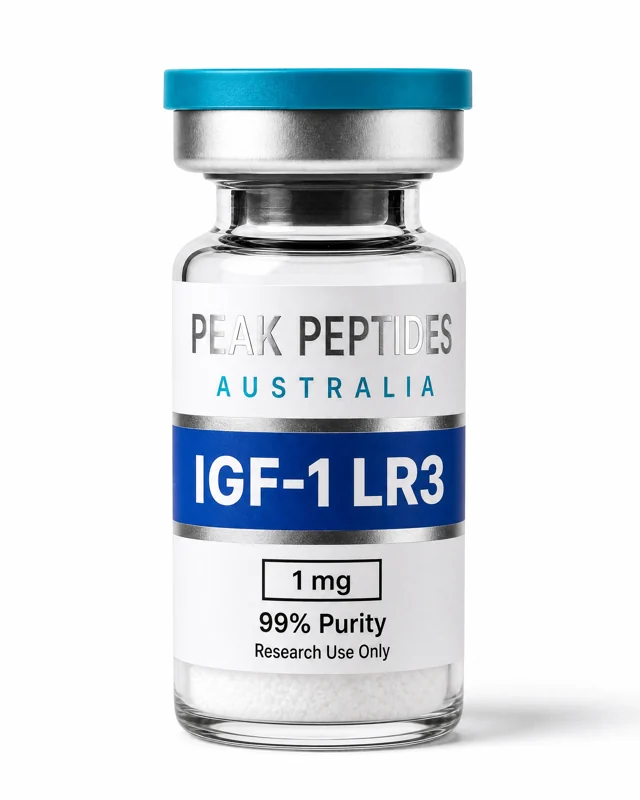
IGF-1 LR3 is an engineered IGF-1 analogue investigated mainly in structural, cell-culture and animal research. The verified 1 mg Peak vial is labelled for laboratory research only; it is not the approved mecasermin medicine and has no established human administration protocol.
Research classification: Experimental analogue · cell and animal evidence; no verified human regimen. The IGF-1 LR3 1 mg vial label reports nominal content; it does not state a suitable amount for human use.
Mechanism and research questions
Long R3 IGF-I was engineered to change its interactions with IGF binding proteins. Cell and animal studies investigate IGF1R-mediated signalling; they do not establish a clinical effect or a validated human pharmacokinetic half-life for this research vial.
Mechanistic findings and early experiments do not by themselves establish clinical efficacy, an approved treatment cycle or equivalence between suppliers' formulations. Interpret claims in the context of the specific experimental model and references.
How to read a reported schedule
The source-linked IGF-1 LR3 mechanism review distinguishes altered IGF-binding-protein interactions measured in study models from unproven clinical effects. The TGA-registered mecasermin formulation is a different molecule and does not supply instructions for an IGF-1 LR3 research vial. No validated human dose, diluent, route or cycle exists for this product.
For the existing schedule, its evidence caveats and the concentration calculator, see the IGF-1 LR3 protocol and vial reference. Figures displayed there are research context, not a personalised prescription.
Vial identity and preparation
An exact-matching Peak Peptides Australia 1 mg vial is shown on the research reference page. The product is supplied for in-vitro research, not administration.
Reconstitution cannot be inferred from vial strength alone. Confirm the exact compound, lot, expected appearance, compatible sterile diluent, final volume, transfer method and discard/storage period from validated formulation documentation. BAC water and a 28-day period are not universal defaults. See the illustrated product-specific preparation guide and the abnormal-solution safety guide.
View Peak Peptides Australia's research-only listing and confirm its current labelled strength.
Sources, limits and next steps
- Long R(3)IGF-I and IGF-I: distinct IGF-binding-protein effects in experimental systems — PubMed
- INCRELEX (mecasermin) Australian approved medicine — distinct compound — TGA ARTG
- IGF-1 LR3 evidence and limitations, with primary references — Peptide Dosages Australia
For clinical decisions, consult a qualified professional and the product information for an approved formulation. Research-only supplier material must not be injected or used to treat a condition. Explore the A–Z research directory to compare evidence categories.