The Safety Rule: Do Not Use a Persistently Cloudy or Particulate Solution
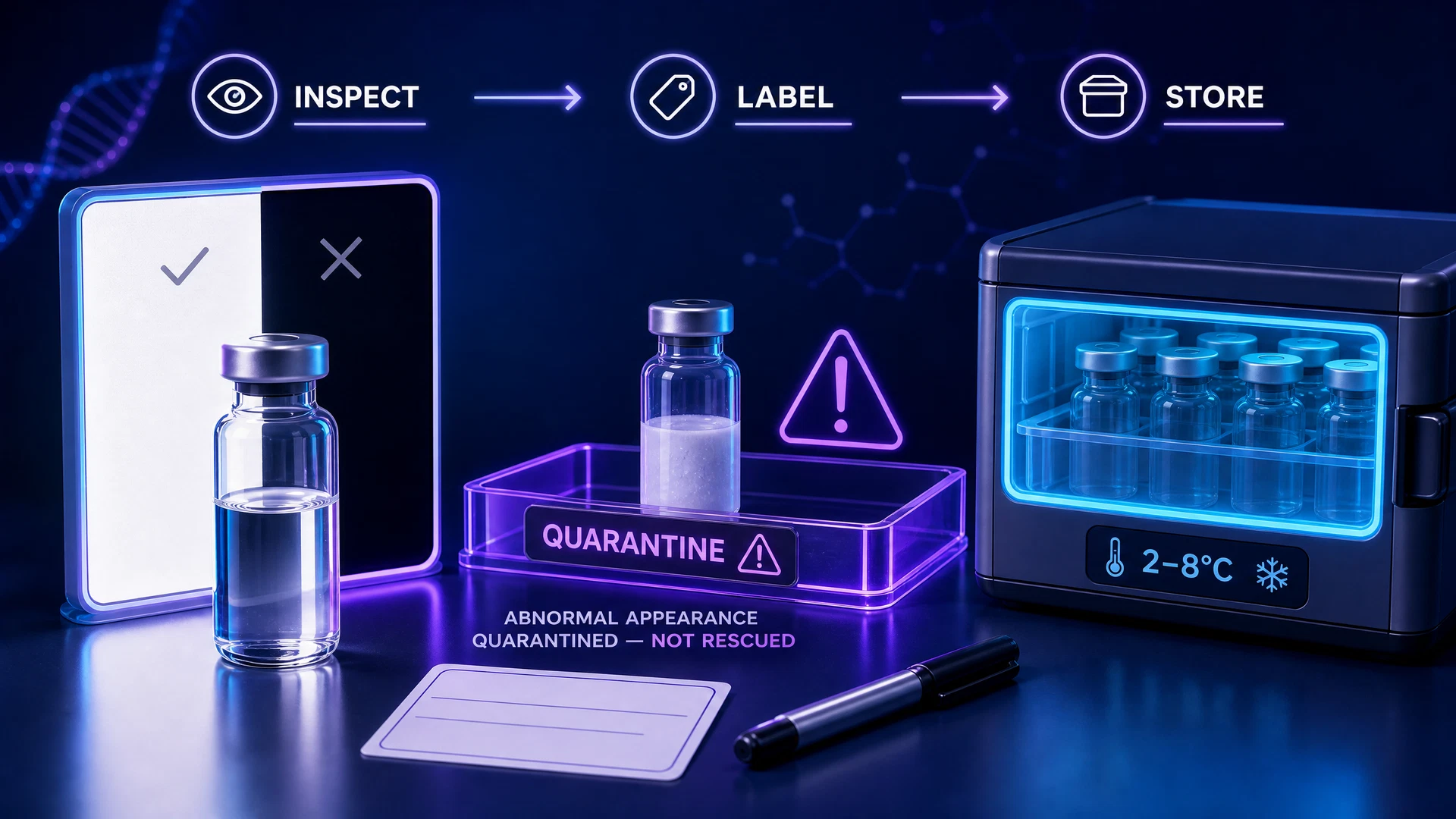
If a product that is intended to become a clear solution remains cloudy, milky, clumped, gelled, discoloured, stringy, or visibly particulate, stop. Quarantine the vial, photograph it under good lighting, record the batch and diluent details, and contact the supplier or a qualified laboratory. Do not administer it to a test subject.
Visible appearance cannot tell you whether the cause is harmless incomplete dissolution, peptide aggregation, chemical degradation, rubber or glass fragments, or microbial contamination. The FDA states that visible particulates in injectable products can jeopardise safety and may include foreign matter, degradant precipitates and proteinaceous aggregates. [1]
What Cloudiness or Clumping Can Mean
| Possible cause | What may be happening | Why visual inspection is not enough |
|---|---|---|
| Incomplete dissolution | Powder is dispersed or suspended but has not fully entered solution. | It can look similar to aggregation or contamination. |
| Precipitation | The peptide was initially soluble but came out of solution because of pH, salts, concentration or temperature. | The precipitate may be chemically altered or may redissolve only under a validated laboratory method. |
| Aggregation or gel formation | Peptide molecules have self-associated through hydrophobic interactions or hydrogen-bond networks. | Proteinaceous particles can be visible or subvisible and cannot be assessed by eye alone. |
| Contamination | Microorganisms or foreign material may have entered through handling, a damaged closure or a non-sterile diluent. | A clear solution can still be contaminated, and a cloudy solution cannot be assumed sterile. |
| Container or stopper particles | Glass delamination or rubber coring can introduce fragments. | Particles may be difficult to distinguish from undissolved peptide. |
| Degradation or formulation incompatibility | Heat, light, oxidation, repeated freeze-thaw, or an incompatible solvent may have changed the product. | Appearance does not measure potency or chemical integrity. |
Sigma-Aldrich describes gel, cloudiness or visible particulate after a laboratory solubilisation attempt as evidence that the peptide is suspended rather than fully dissolved. [2]
Temporary Dispersion Versus Persistent Abnormal Appearance
During the first moments after adding the correct diluent, the lyophilised cake may break into wisps or temporary specks as it hydrates. Follow the exact product instructions for the permitted standing time and mixing method. A solution intended to be clear must reach the specified appearance within that validated window.
If cloudiness, flakes, fibres, a jelly-like mass, colour change, or floating material persists beyond the product's instructions, treat it as a quality failure. Do not rely on an arbitrary “wait 15 minutes” rule for every peptide; formulations differ.
Can Dilute Acetic Acid Prevent Clumping?
For selected basic research peptides, a documented acidic solvent can improve initial solubility by changing peptide charge and reducing self-association. This may prevent precipitation when the method is selected in advance from a lot-specific technical sheet. [3]
That does not mean acetic acid prevents all cloudiness. It cannot prevent contamination, glass or rubber particles, oxidation, heat damage, incorrect formulation, or every form of aggregation. It must never be added after the fact as a home troubleshooting step for a vial intended for use. If a supplier's instructions specify bacteriostatic water and the vial remains abnormal, quarantine it and contact the supplier.
Safe Troubleshooting Workflow
- Stop handling the vial. Do not shake, heat, sonicate or add another chemical.
- Separate it from usable stock. Mark it “do not use.”
- Document the facts. Photograph the vial against light and dark backgrounds; record product, batch, expiry, diluent brand, volume, time, temperature and technique.
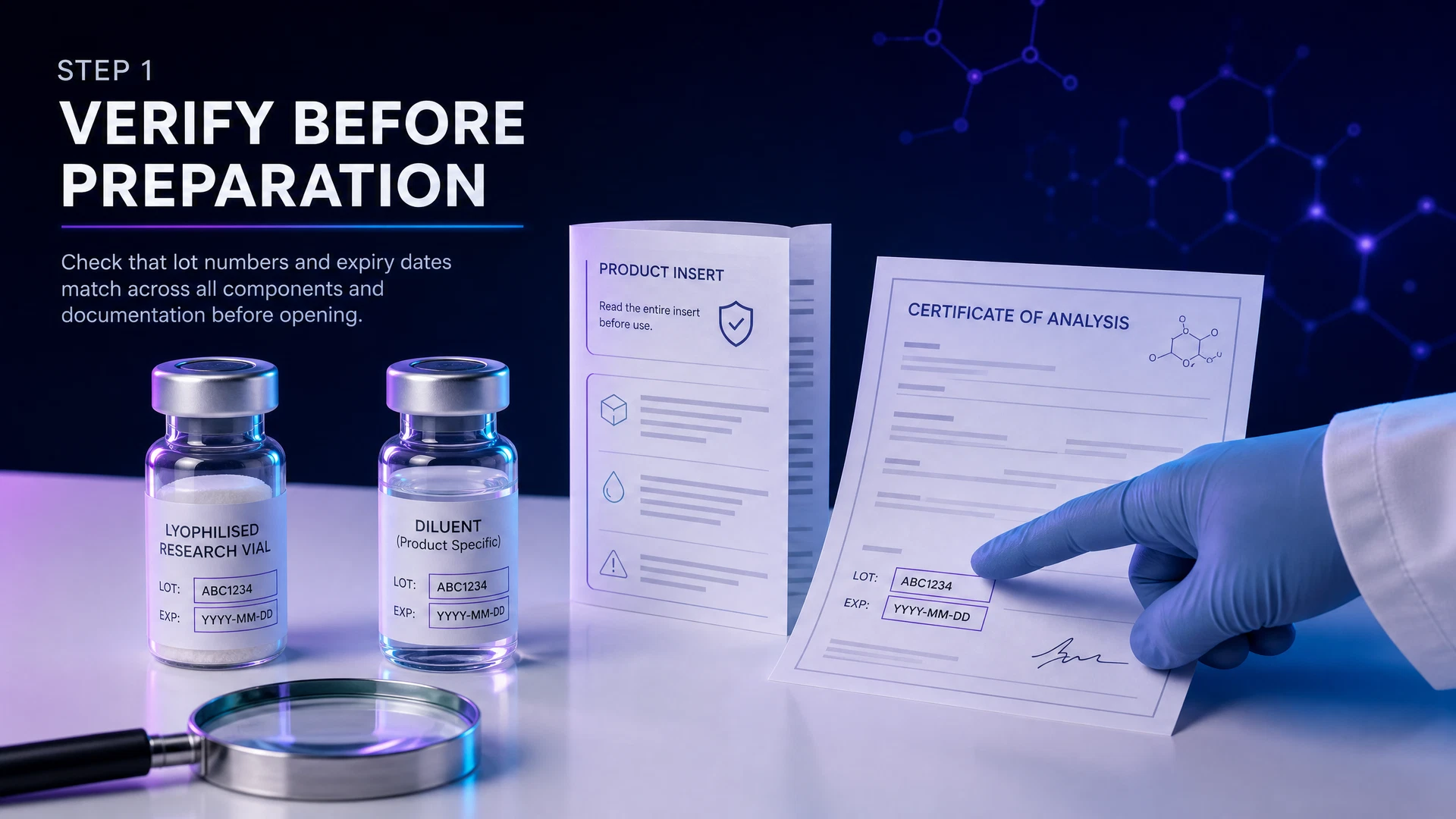
- Check the exact instructions. Compare your process with the supplied insert or lot-specific COA.
- Contact the supplier. Ask for a product-specific quality assessment or replacement process.
- Dispose according to local instructions. Do not attempt to recover a questionable solution for a test subject.
Review the site's reconstitution and diluent safety hub before preparing another vial.
What Clear Appearance Does Not Prove
A clear, colourless solution is an important visual acceptance criterion for many products, but it does not prove the correct peptide is present, that the concentration is correct, that the product remains potent, or that it is sterile. Subvisible particles and microorganisms cannot be ruled out by looking at a vial.
A 2024 review of visible particles in parenteral products describes potential physical, microbiological and chemical risks and emphasises that particle safety depends on origin, size, composition and exposure. [4]