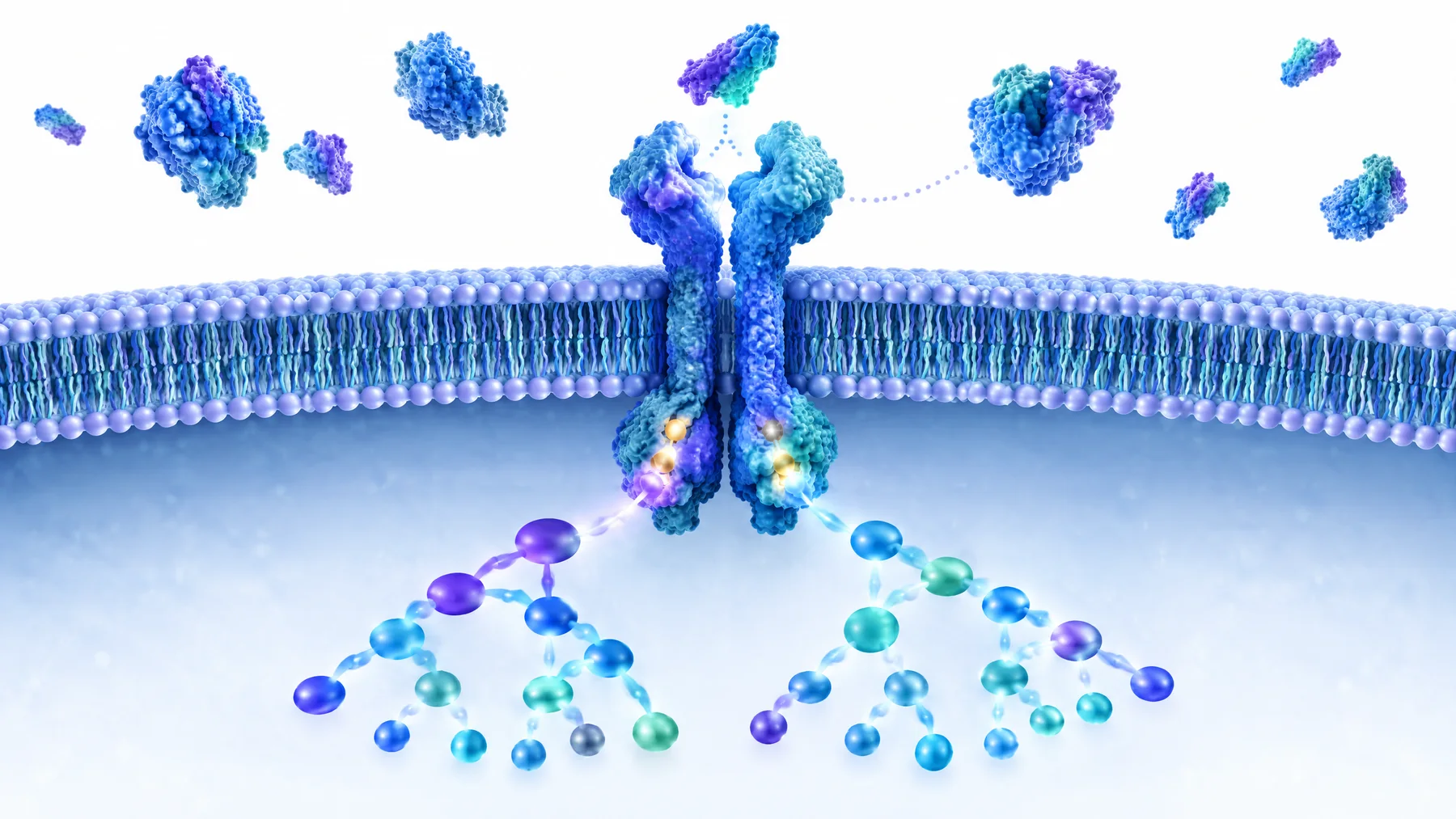

What is Selank?
Selank is a synthetic linear heptapeptide (seven amino acids), Thr-Lys-Pro-Arg-Pro-Gly-Pro (TKPRPGP). It is a peptide, not a hormone, topical ingredient, mixture or small molecule. The evidence base is best described as limited human clinical research alongside animal and laboratory research; it is not an Australian TGA-approved medicine. The parent peptide and differently modified products (for example, N-acetyl Selank) are not automatically interchangeable.
Selank is a defined synthetic heptapeptide that has been studied principally in anxiety-related and neurobiology research. A small, older comparative randomised study in 62 people with generalised anxiety disorder and neurasthenia reported psychometric outcomes comparable with medazepam, but the publicly available abstract leaves key design and safety details unclear. Rat behavioural, receptor-binding and gene-expression experiments supply biological leads, not a validated human treatment protocol. Australian readers should not equate research-only vials with an approved formulation: the TGA says goods not on the ARTG are unapproved and has not assessed unapproved products for quality, safety or efficacy.
Identity: a defined seven-amino-acid peptide
Selank is a synthetic linear heptapeptide with the sequence Thr-Lys-Pro-Arg-Pro-Gly-Pro (TKPRPGP). In chemical terms, that makes it a short peptide rather than a conventional small-molecule anxiolytic or a glycoprotein hormone. This matters when assessing online claims: a product described as ‘N-acetyl Selank’ is a chemically modified analogue, not simply another label for the same parent compound. [1] [6]
The published record uses Selank in several research settings—rat brain tissue, rat behavioural models, receptor-binding preparations and small human studies. That breadth does not establish a clinical indication. It instead means that each conclusion has to be read at the level tested: molecular signal, animal behaviour, brain-imaging observation or patient-reported clinical outcome. [2] [3] [4] [5] [6] [7]
Molecular pathway: a GABA-related hypothesis, not a settled target map
GABAergic signalling is the most prominent mechanistic lead. A rat membrane radioligand study reported that Selank altered [3H]GABA binding in a manner the authors interpreted as positive allosteric modulation, with non-additive effects when combined with some benzodiazepines. This is an experimental binding observation; it does not demonstrate direct receptor occupancy, a single human target, or clinical benefit in people. [6]
A separate controlled rat experiment examined frontal cortex messenger RNA after one intranasal administration. It found time-dependent changes in transcripts among 77 evaluable neurotransmission-related genes, including GABA receptor subunits, GABA transporters and dopamine- and serotonin-receptor genes. Because mRNA changes are downstream, tissue-specific and short-term, they cannot by themselves identify the primary receptor or predict a treatment effect. [4]
What the animal studies actually found
In a conditioned active-avoidance learning experiment, Wistar rats with initially low learning ability received Selank or piracetam before training across four days. The abstract reports more correct responses and fewer errors with Selank in the poor-learning subgroup, with effects increasing on repeated administration; normal rats showed a different time course. This is a specific conditioned-avoidance model, not evidence that Selank improves memory, concentration or anxiety in humans generally. [3]
In another experiment, male Wistar rats underwent unpredictable chronic mild stress and were assessed using an elevated-plus maze after Selank, diazepam, or their combination. The authors reported that the combination was most effective in the stressed condition, while Selank alone was most effective for anxiety changes induced by a course of test substances. Maze behaviour in stressed rats is not a validated basis for combining Selank with diazepam in people. [5]
The frontal-cortex gene-expression experiment used 30 male Wistar rats, with five animals per treatment/time-point pool; it assessed one and three hours after a single administration. Pooling tissue, the narrow time window and one sex limit inference about individual variability, long-term effects and translation to patients. [4]
Human evidence: limited and not sufficient for a treatment claim
The most directly clinical publication located is a 2008 randomised comparative study, published in Russian, of 62 patients with generalised anxiety disorder (GAD) and neurasthenia: 30 received Selank and 32 medazepam. Its abstract reports similar anxiolytic effects on Hamilton, Zung and CGI scales and reports changes in serum leu-enkephalin measures, particularly in participants with GAD. The abstract does not provide enough accessible information to independently judge concealment, blinding, attrition, adverse events, dose rationale, prespecified outcomes or durability; the findings should therefore be regarded as preliminary rather than practice-changing. [2]
A 2020 resting-state fMRI study included 52 healthy participants and compared Selank, Semax and placebo with scans before and at 5 and 20 minutes after injection. It found between-group and between-condition functional-connectivity differences involving the right amygdala and right temporal regions. Functional connectivity is a physiological imaging outcome in healthy volunteers, not proof of symptom relief, cognitive enhancement or safety in an anxiety disorder. [7]
Safety, interactions and the limits of ‘natural’ language
A peptide sequence does not make a product inherently safe. The available publications do not supply the large, independently replicated human safety database needed to establish rates of common adverse effects, rare serious harms, effects in pregnancy, or safety in people with psychiatric, neurological, liver or kidney conditions. The absence of a reported problem in a small study is not evidence that the problem is absent. [2] [7] [9]
The rat stress study and the laboratory binding study both raise an interaction question with diazepam and related GABA-active drugs, but neither establishes a human interaction profile. It would be unsafe to infer from those experiments that a combination is beneficial, harmless or dose-adjustable. No human co-administration schedule, tapering advice, dilution method, storage rule or injection protocol is validated by these sources. [5] [6]
Australian regulatory context: approved medicines versus research vials
The ARTG is the TGA’s public database of therapeutic goods that can be legally supplied in Australia and can be searched by product name, active ingredient, sponsor or ARTG number. A search of the public ARTG/TGA record context for Selank did not identify an Australian registered Selank medicine. This is not an approval, endorsement or product-quality finding; anyone considering a product should recheck the ARTG directly because entries and legal circumstances can change. [8]
Generally, goods not included in the ARTG are unapproved therapeutic goods. The TGA states that it has not evaluated such goods for quality, safety, efficacy or performance; clinician-led Special Access Scheme and Authorised Prescriber pathways exist in particular circumstances, but they do not turn a retail research vial into an approved medicine. [9]
The TGA has warned that online peptide products may have unknown contents or origin and may be incorrectly formulated, contaminated or fail basic sterility standards. A supplier’s ‘research use only’, purity percentage or vial label is therefore not evidence of a TGA-evaluated human formulation. [10]
Comparison with related substances: similarity is not interchangeability
Selank and Semax are often discussed together, and the fMRI study examined both. They are nevertheless distinct peptide fragments with different sequences and research histories; an imaging finding for one cannot be transferred to the other. Likewise, a rat comparison with piracetam is a comparator experiment, not evidence that Selank is equivalent to an approved nootropic or that either compound treats anxiety. [3] [7]
Diazepam has established pharmacology and approved formulations that are separate from Selank. The non-additive laboratory observations and rat co-administration result are reasons for caution and formal interaction research, not a rationale for a ‘stack’ or blend. Combined products lack a validated combined protocol when the individual agent itself has limited human evidence. [5] [6]
Practical reading of the evidence
A useful evidence hierarchy begins with the question being asked. The controlled rat studies can support statements such as ‘Selank changed behaviour in this rat paradigm’ or ‘transcripts changed in rat frontal cortex.’ They cannot support a universal claim that it treats GAD, improves cognition or works by a confirmed receptor mechanism in people. The one small comparative clinical study merits attention, but it needs transparent, contemporary, adequately powered replication with meaningful safety follow-up. [2] [3] [4] [5]
For Australian consumers, the important distinction is between a molecule that appears in research papers and a medicine evaluated in a registered formulation. Until a regulator has assessed a specific formulation and a robust clinical evidence base defines benefit, risk and use conditions, no universal self-administration instructions can responsibly be drawn from the Selank literature. [8] [9] [10]
Questions readers ask
Is Selank actually a peptide?
Yes. Selank is the synthetic heptapeptide Thr-Lys-Pro-Arg-Pro-Gly-Pro (TKPRPGP). It is not a small molecule, hormone or topical cosmetic ingredient. [1] [6]
Does the research prove that Selank treats generalised anxiety disorder?
No. A 62-participant randomised comparative study reported encouraging findings versus medazepam, but the accessible report is limited and does not provide enough detail to establish a contemporary treatment recommendation. Animal and imaging findings do not close that evidence gap. [2] [5] [7]
Is Selank approved by the TGA in Australia?
No Australian registered Selank medicine was identified in the public ARTG/TGA search context used for this article. The ARTG is the source to check for current lawful supply entries; a product not on it is generally an unapproved therapeutic good unless an exemption or authorised pathway applies. [8] [9]
Are online ‘research’ Selank vials equivalent to a medicine used in a study?
They should not be assumed equivalent. The TGA warns that unapproved peptides sold online may have uncertain identity, manufacture, contamination control and sterility, and has not assessed unapproved goods for quality, safety or efficacy. [9] [10]
Can Selank be combined with diazepam or other anti-anxiety medicines?
The literature located includes rat and laboratory interaction findings, not a validated human combination regimen. Those signals make unsupervised co-use particularly inappropriate; they do not establish benefit or safety. [5] [6]
What remains uncertain
This is a deliberately cautious, literature-grounded overview, not medical advice or a dosing guide. The accessible clinical record is small, older and incompletely reported in English; several mechanistic findings are from rats or isolated membrane preparations. No Australian-approved Selank formulation, product information or Consumer Medicine Information was identified in the public ARTG review, so there is no authoritative Australian label from which to derive administration, storage, contraindications or adverse-event rates. A public-register non-result can change and should be rechecked directly. Research-vial identity, purity and sterility cannot be inferred from a supplier claim.
References and further reading
- [1] Peptide-based Anxiolytics: The Molecular Aspects of Heptapeptide Selank Biological Activity. Rat brain-cell plasma-membrane radioligand-receptor analysis with HPLC quality control; publication abstract also states the peptide sequence.
- [2] Efficacy and possible mechanisms of action of a new peptide anxiolytic selank in the therapy of generalized anxiety disorders and neurasthenia. PubMed-indexed randomised controlled comparative trial; 62 patients with GAD and neurasthenia, Selank (n=30) compared with medazepam (n=32), assessed with Hamilton, Zung and CGI scales plus serum enkephalin activity.
- [3] The optimizing action of the synthetic peptide Selank on a conditioned active avoidance reflex in rats. Wistar rat conditioned active-avoidance learning experiment; animals with initially low versus normal learning ability received repeated pre-training Selank or piracetam over four days.
- [4] Selank Administration Affects the Expression of Some Genes Involved in GABAergic Neurotransmission. Thirty male Wistar rats; single intranasal Selank, GABA or vehicle administration; pooled frontal-cortex RNA assessed at one and three hours using a 84-gene RT-PCR array.
- [5] Peptide Selank Enhances the Effect of Diazepam in Reducing Anxiety in Unpredictable Chronic Mild Stress Conditions in Rats. Male Wistar rat experiment with unpredictable chronic mild stress, individual or combined Selank/diazepam administration, and elevated-plus-maze assessment.
- [6] Peptide-based Anxiolytics: The Molecular Aspects of Heptapeptide Selank Biological Activity. Radioligand-receptor analysis in brain-cell membrane preparations; HPLC was used to obtain and verify reagents and Selank purity.
- [7] Functional Connectomic Approach to Studying Selank and Semax Effects. Resting-state fMRI in 52 healthy participants before and 5 and 20 minutes after injection of Selank, Semax or placebo; predefined amygdala and dorsolateral prefrontal cortex regions of interest.
- [8] Australian Register of Therapeutic Goods (ARTG). TGA public searchable register for medicines, medical devices and biologicals that can be supplied within Australia.
- [9] Access an unapproved therapeutic good (health practitioners). TGA guidance on access pathways and clinical responsibilities for unapproved therapeutic goods.
- [10] Unapproved peptide product promoters and suppliers are put on notice. TGA public safety/compliance communication on online promotion, supply, manufacture and importation of unapproved peptide products.