What is Pancragen—and why does evidence level matter?
Pancragen is the name used in a small body of literature for a short synthetic tetrapeptide, generally described as Lys–Glu–Asp–Trp or an amidated form. Researchers have looked at pancreatic-cell marker expression and glucose-related measurements. That makes it a legitimate topic of research, not a confirmed way to repair a pancreas or treat type 2 diabetes. [1] Pancreatic-cell study [2] Older-adult report.
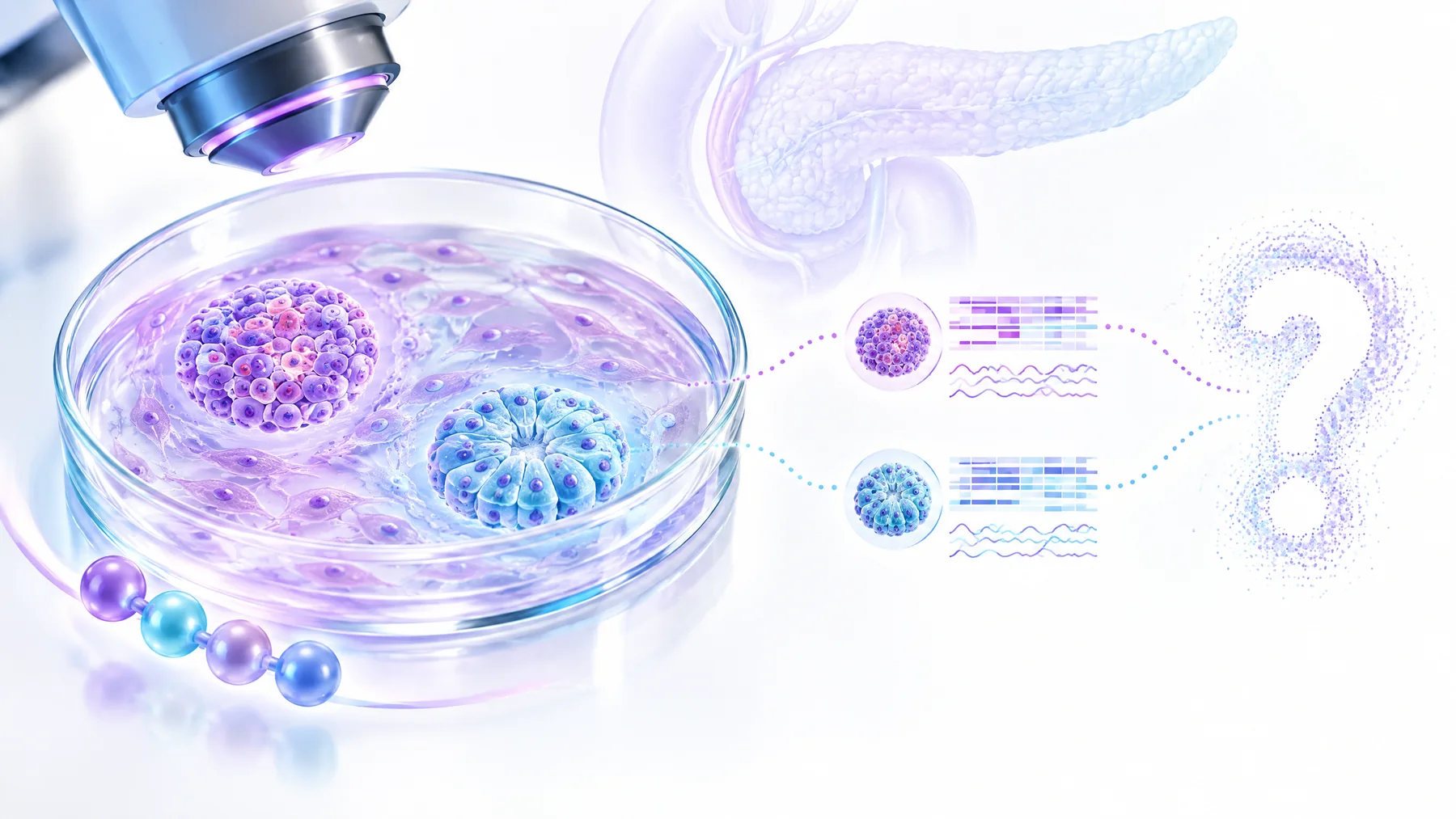
Our visual deliberately centres a laboratory culture dish. The faint pancreas in the background gives anatomical context, not a claim that the peptide travels selectively to that organ or regenerates it. The study-based schematic below uses dashed paths where an experimental observation does not establish a clinical mechanism.
First, how do normal pancreatic islets regulate glucose?
Pancreatic islets contain several endocrine cell populations. Beta cells make insulin, which helps lower blood glucose. Alpha cells make glucagon, which helps raise it. Delta cells release somatostatin, which regulates neighbouring endocrine cells. NIH has mapped the diversity of human islet cells to understand how these normal systems relate to diabetes risk. [3] NIH human-islet research.
These are facts about normal islet physiology, not established actions of Pancragen. A study measuring a pancreatic-cell marker does not automatically show new functional beta cells, altered insulin secretion in a person, improved blood sugar control or reversal of diabetes.
What did the pancreatic-cell study actually measure?
In a 2013 report, researchers compared pancreatic cell cultures described as ‘young’ and ‘aged’. They reported reduced expression of differentiation-related markers with ageing and increased expression after Pancragen exposure. The markers included PDX1 and PTF1A on the acinar-associated side, and PDX1, PAX6, PAX4, FOXA2 and NKX2.2 on the islet-associated side. These are names of regulatory factors and cell-identity markers, not a count of newly functioning pancreatic islets. [1] Primary abstract.
The publicly accessible abstract does not provide enough detail on the culture source, sample size, exposure, controls, effect sizes or adverse effects to independently assess every step of the experiment. The authors proposed a therapeutic interpretation, but their measured endpoint as reported is marker expression in cultured cells. We should not turn their hypothesis into a headline promising pancreatic regeneration, anti-inflammatory benefit or diabetes treatment.
Why a marker is not the same as a working pancreatic cell
Research often follows a ladder of increasingly demanding measurements. A change in a gene or protein marker can indicate that a cell's programme is shifting. Showing that a mature beta cell actually senses glucose and secretes insulin in a controlled assay is a different question. Showing the sustained restoration of normal glucose regulation in a living person is further away still. The Pancragen culture abstract reports the first sort of observation; it does not supply the later functional or clinical demonstrations. [1] Cell-study abstract.
This matters when reading the study authors' proposed ‘mechanism’. A hypothesis that marker expression may play a role in an eventual response is not a direct measurement of a receptor or an experiment showing regenerated tissue. The anatomical pancreas drawn faintly behind our laboratory scene deliberately does not connect directly to a cured patient. Compare the model's marker outcome with the NIH description of actual islet-cell functions to see the missing steps.
Is there a known Pancragen receptor?
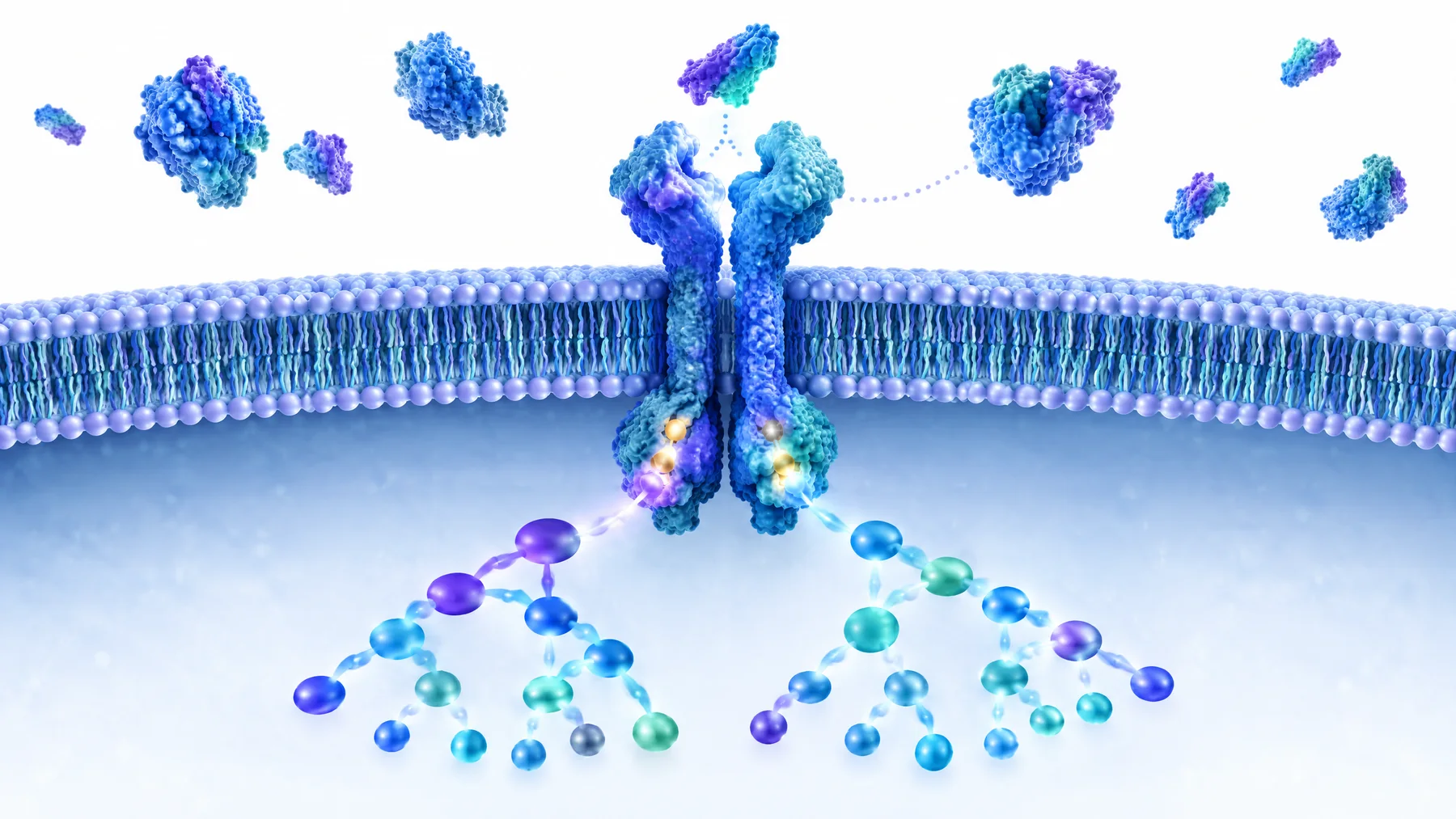
The primary records reviewed here do not establish a specific receptor that Pancragen binds, a human pharmacokinetic pathway, or delivery that targets the pancreas. Short peptides may have complex and context-dependent biological effects. Marker changes alone cannot identify the direct molecular target that caused them. [1].
Our figure therefore stops at the observation: Pancragen was applied in an experimental cell setting, and selected markers were reported to change. Any arrow onward to functional tissue repair, safe treatment or clinical outcomes would require separate evidence that this study does not provide.
What about the aged-rhesus-monkey findings?
A later report studied only nine older female rhesus macaques. Five were assigned Pancragen and four a different glucose-lowering medicine, glimepiride; researchers measured glucose, insulin and C-peptide before, during and after treatment, including with glucose challenges. They reported changed glucose and endocrine measurements. This is an animal observation in a very small, single-sex sample, with non-equivalent comparators and no information in the abstract that establishes human treatment benefit or safety. [4] Primate report.
A separate rodent report used a chemically induced diabetic model and measured glucose and vascular-related endpoints. It adds a different preclinical context, not a replication in people. Animal routes, amounts and treatment periods are characteristics of a model, not a regimen that can be transferred to a person or supplier vial. [5] Rat report.
The small older-adult report: an interesting signal with missing detail
A 2011 published abstract describes 30 healthy older people and 33 older people with type 2 diabetes. Among the diabetes group, the authors reported reductions in fasting glucose, glucose during a standard tolerance test, plasma insulin and an insulin-resistance index after Pancragen exposure, while people described as not receiving Pancragen had no reported changes in the listed metabolic indices. [2] Primary abstract.
The accessible abstract does not say how many of the 33 people received the peptide rather than no peptide, whether allocation was random, whether outcomes were blinded, how large the changes were, what other diabetes therapies were in use, or what adverse events were recorded. The full methodology was not accessible in the source reviewed. We therefore describe it as a small, incompletely reported early human observation—not as a placebo-controlled definitive trial or proof of an approved treatment.
A checklist for interpreting the older-person report
For a glucose-related claim, treatment-arm size and baseline differences matter. Did the people receiving Pancragen start with the same disease severity, background medicines, diet and monitoring as those not receiving it? Was the comparison allocated at random or did clinicians choose participants? Were laboratory outcomes prespecified, and how were missing values handled? None of those details is clear from the accessible abstract, so its language about a promising approach should be read as the authors' interpretation rather than a verified effect size.
It is also essential to separate metabolic surrogates from patient-centred outcomes. A shift in fasting glucose or an insulin-resistance index does not, by itself, show fewer diabetes complications, improved daily function, or long-term safety. When a study is small and its methods and adverse-event record are incomplete, uncertainty can be large even if a reported laboratory result sounds favourable. No person should substitute the abstract for established diabetes monitoring or care.
An evidence ladder instead of a promise
On a phone, swipe the table sideways to see every column.
| Evidence | What was reported | What remains unproven |
|---|---|---|
| Pancreatic-cell cultures [1] | Changes in selected differentiation-related marker expression. | Direct receptor, functioning new islets, human pancreatic repair. |
| Old female macaques [4] | Glucose, insulin and C-peptide changes in a nine-animal comparison. | Human efficacy, safety or an interpretable head-to-head drug comparison. |
| Older-person report [2] | Abstract-reported glucose and insulin-resistance associations. | Robust controlled clinical benefit, effect size, adverse-event profile, or reproducibility. |
| Standard diabetes care | Separate, established treatment and monitoring pathways. | None of the above Pancragen studies replaces them. |
This is why our illustration separates normal pancreatic physiology from Pancragen model findings in distinct, evidence-labelled panels.
What do we know about risks and interactions?
There is not an adequate clinical safety database in the verified Pancragen sources to quantify common or rare adverse events, interactions, pregnancy effects, long-term risks or suitability alongside diabetes medicines. This is an evidence gap, not evidence that the compound is safe. The reports describe glucose-related observations, so people considering any material that might affect glucose while taking insulin or another glucose-lowering drug face a consequential clinical question for a qualified professional—not an online research protocol. [2] [4].
Likewise, neither a paper's tetrapeptide sequence nor a product listing establishes a particular purchased vial's identity, purity, sterility, formulation or equivalence to the material used in the study. Do not extrapolate from a research abstract to mixing, storage or administration instructions.
Australian product-status questions
The ARTG is the public register used to check an exact medicine's product name, sponsor, formulation and status. The TGA explains that goods not included on the ARTG have not been assessed by it for safety, quality and effectiveness, although specific access pathways exist. [6] TGA guidance.
This article does not claim to have performed a current exact-product ARTG search for every marketed material named Pancragen. It does not certify a supplier vial as an approved medicine, pronounce every access pathway lawful or unlawful, or offer a route or dosage for human use. For clinical decisions, a named product and current documentation matter more than a generic ingredient label.
Frequently asked questions
Does Pancragen regenerate beta cells? No verified study here demonstrates functional beta-cell regeneration in people. A cell-culture marker change is a different endpoint. [1].
Is the small older-adult report a randomised clinical trial? The accessible abstract does not provide the treatment-arm counts or trial methods needed to establish that claim. It reports a small association and substantial unanswered questions. [2].
Can the monkey study tell me a human dose? No. Nine aged animals in a short comparison cannot define safe human administration, a viable product formulation or a chronic treatment plan. [4].
Why show insulin and glucagon in the figure? They explain normal islet physiology. They are not presented as measured Pancragen effects in humans. [3].
Primary references and Australian context
- Khavinson et al., Bulletin of Experimental Biology and Medicine (2013). Pancreatic cell-culture differentiation-marker abstract.
- Korkushko et al., Bulletin of Experimental Biology and Medicine (2011). Small older-adult glucose/insulin abstract; treatment-arm methods not reported there.
- NIH. Human pancreatic islet-cell mapping. Normal alpha, beta and delta cell context, not a Pancragen study.
- Goncharova et al., Advances in Gerontology (2015). Nine old female rhesus macaques; preclinical only.
- Khavinson et al., rodent experimental-diabetes study (2007). Preclinical only.
- TGA. About the Australian Register of Therapeutic Goods. Search an exact named product to verify status.
- TGA. Unapproved therapeutic goods. What absence of ARTG assessment means and its limited pathways.