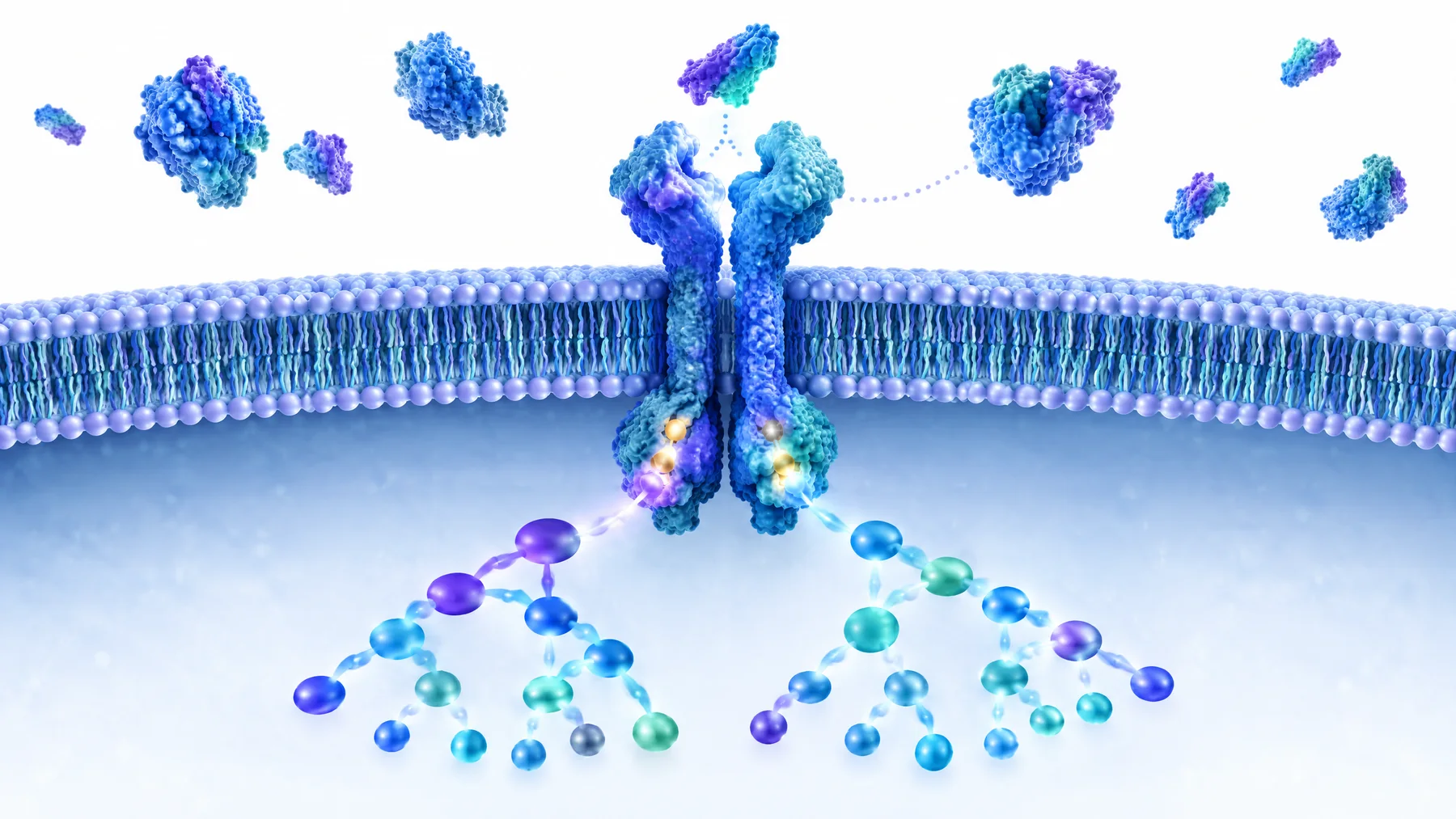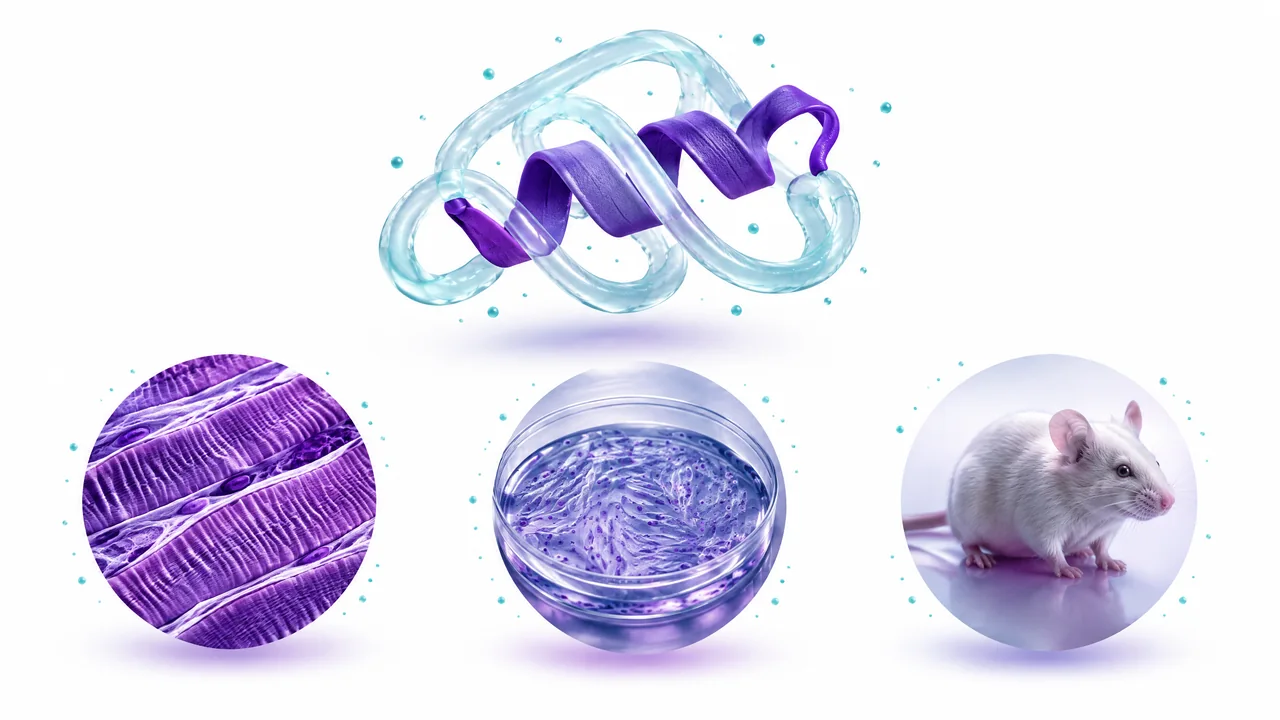
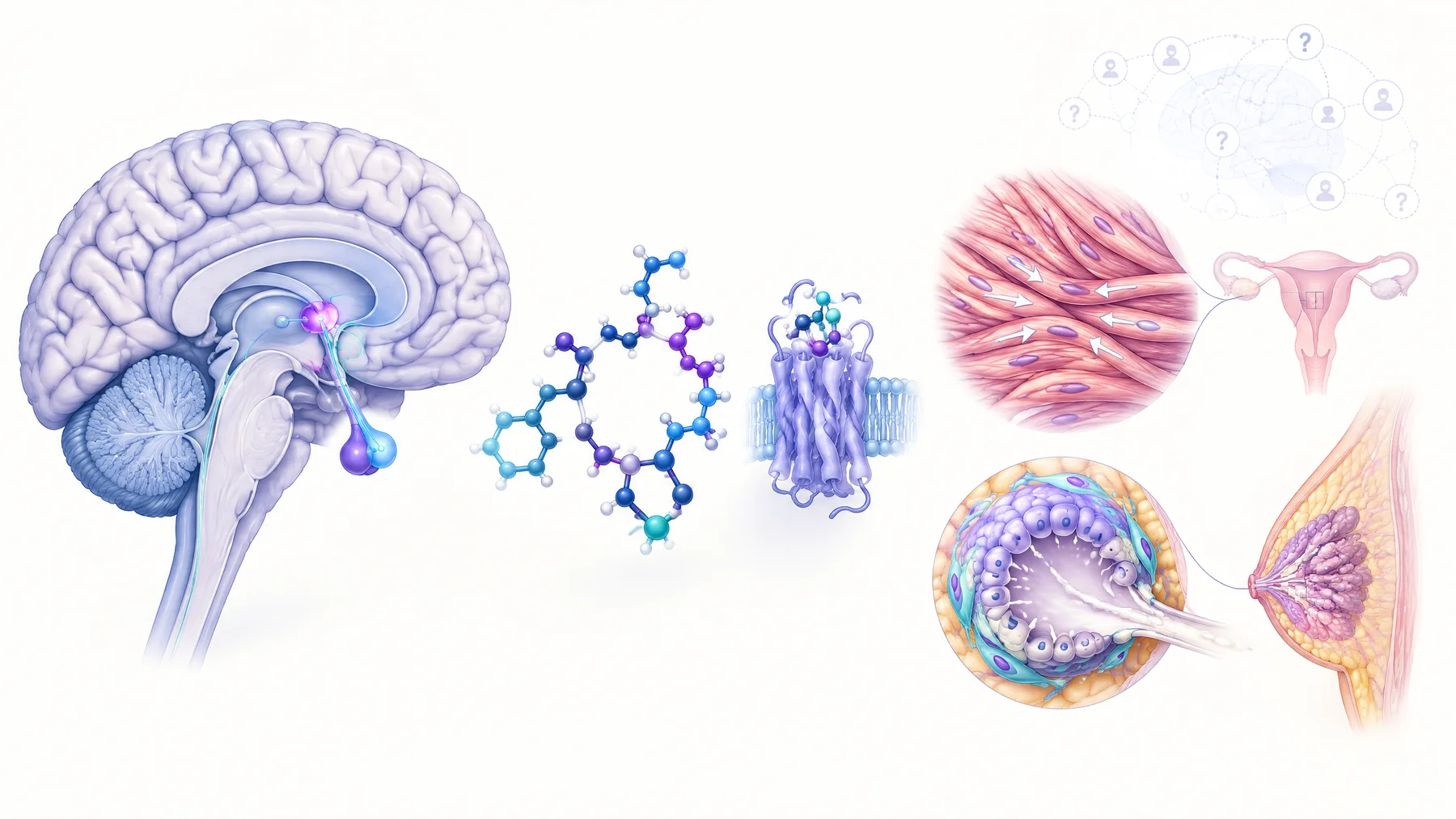
First, separate the three different questions
Oxytocin is a hormone your body makes, a medicine used for defined obstetric purposes, and a topic in behavioural neuroscience. Those are related subjects, but evidence for one does not automatically prove the others. In Australia a named oxytocin injection, Syntocinon 10 IU/1 mL, appears on the Australian Register of Therapeutic Goods (ARTG). That registered ampoule is not the same formulation or regulatory category as a research vial sold online. [1] TGA product record.
Our illustration distinguishes well-described physiology from the much less settled question of whether administering oxytocin improves social behaviour. It does not represent a treatment recommendation or a recipe for an online vial.
What is oxytocin, and where does it come from?
Oxytocin is a nine-amino-acid peptide. It is made in hypothalamic neurons, including the paraventricular and supraoptic systems, and transported towards the posterior pituitary for release into the bloodstream. Oxytocin signalling also occurs within the nervous system; blood hormone measurements cannot be taken as a simple reading of activity at every brain synapse. [2] Physiology review [3] Intranasal-research review.
Childbirth and suckling provide vivid examples of how a physical stimulus, neural signals and hormone release interact. Cervical stretch can feed back into further oxytocin release and contractions. During breastfeeding, suckling helps trigger release and the ejection of already-produced milk. Milk production itself depends substantially on other hormones, particularly prolactin; oxytocin's reflex is not a claim that it manufactures milk. [2].
How the oxytocin receptor turns a signal into contraction
Oxytocin binds the oxytocin receptor (OXTR), a G-protein-coupled receptor. In uterine smooth muscle, signalling through the Gq/11–phospholipase C pathway and intracellular calcium mobilization supports myometrial contraction. In the breast, receptor activation promotes contraction of myoepithelial cells around milk-containing alveoli, moving milk towards ducts. These are different tissues applying a related cellular signal, not evidence of a generalised effect throughout the body. [2].
Receptor number and tissue responsiveness change with physiological state. Near birth, sensitivity to oxytocin is part of a complex endocrine and obstetric system. A diagram showing ‘hormone → receptor → calcium → muscle response’ explains a pathway; it cannot determine an individual's drug need or safe clinical exposure.
What is actually established in clinical practice?
Registered oxytocin injection is used by trained clinicians for selected obstetric purposes. The Australian ARTG listing identifies Syntocinon as an active registered medicine and links to its Australian product information. The US injectable label separately documents medically indicated labour induction or augmentation and postpartum uterine bleeding control; its details are US product directions, not a replacement for the Australian product information. Clinical use depends on obstetric assessment and monitored maternal and fetal status.
Registration is product-specific. The ARTG entry concerns an oxytocin injection ampoule described in international units, with evaluated manufacturing and clinical information for its labelled uses. It does not validate a different brand's milligram-labelled powder, sterility, solution stability, route, or human use. Product comparisons based only on the ingredient name are especially misleading here because the presentations are materially different.
Why hospital monitoring is part of the medicine's use
Oxytocin can overstimulate uterine contractions. In the wrong circumstances that may jeopardise the mother or fetus; the prescribing information describes uterine hypertonicity, fetal distress, rupture risk and the need for trained observation when used to induce or strengthen labour. Prolonged exposure alongside certain fluid conditions can contribute to water intoxication and low sodium. Monitoring, contraindication assessment and timely adjustment are essential features of clinical care, not optional extras to a numerical dose.
Risks vary by indication, pregnancy circumstances, medicine presentation and route. This is why an internet ‘oxytocin protocol’ cannot substitute for a registered product's label and professional obstetric supervision.
The brain and the 'love hormone' label: what is known?
Oxytocin is involved in neural circuits relevant to social information, attachment and threat processing. That scientific interest is real. Yet the phrase ‘love hormone’ implies a simple, predictable effect that controlled human research has not established. Effects can vary by social context, participant characteristics, outcome measure and delivery method. Peripheral hormone release during ordinary social interaction is not interchangeable with exposure from an experimental nasal preparation. [3] Translational review.
The central-delivery question is also more complicated than ‘spray goes directly to the brain’. Intranasal research evaluates several possible pathways, including peripheral mechanisms. Studies of blood concentration, brain imaging and behaviour address different endpoints. Our diagram therefore marks the behavioural branch as under study, not a route to guaranteed empathy, trust, libido or social benefit.
What happened in the larger autism trial?
A 24-week NIH-funded randomised trial studied intranasal oxytocin in children and adolescents aged 3–17 with autism spectrum disorder. Among those completing the study, 139 received oxytocin and 138 placebo. The change in the social-interaction measure did not differ significantly between groups, and other social-function measures did not establish the hoped-for benefit. This result matters because early small studies had raised expectations. [4] NIH study summary.
A negative result in that population and study design does not answer every future oxytocin question. It does, however, rule out claiming that intranasal oxytocin is already a reliable autism treatment on the strength of plausible biology or isolated positive experiments.
And what does the schizophrenia research suggest?
A systematic review and meta-analysis pooled nine randomised trials involving 308 people. Overall it did not find a robust improvement in negative or positive schizophrenia symptoms with intranasal oxytocin. An apparent dose-related signal was sensitive to an outlying study and did not provide a dependable basis for treatment. Trial sizes and methods also varied. [5] Systematic review.
This illustrates a general scientific rule: a receptor pathway, laboratory response or brain-imaging change is not the same endpoint as a clinically meaningful improvement. Negative or mixed larger studies deserve as much weight as exciting early hypotheses.
How to read a behavioural-oxytocin study critically
First ask what was measured. A laboratory task about judging faces, a scan of regional brain activity and a validated measure of daily social functioning are not interchangeable endpoints. A change on a proxy test may motivate a future study, but it does not automatically mean a person feels better or functions differently outside the laboratory. [3] Research-methods review.
Then ask about comparison groups, duration and population. A one-off experiment in healthy volunteers cannot establish the same answer as a months-long randomised trial in children with a defined condition. In the 24-week autism study, more than 270 completers contributed to the reported comparison and the measured social-function endpoint still did not significantly separate oxytocin from placebo. An attractive mechanism and a negative well-controlled outcome can both be true: the first describes a possible pathway; the second tells us whether a particular treatment strategy worked in that tested setting. [4].
Finally, consider publication and subgroup effects. A promising result after splitting participants by dose or characteristics may be unstable, especially when a systematic review notes that a signal changes after a single outlying study is removed. Treat exploratory findings as questions for replication, not ready-made clinical answers. [5].
Why formulation and route cannot be collapsed into one ‘protocol’
The human body can release endogenous oxytocin in pulses. Clinicians may use a specified manufactured injection for obstetric indications under monitoring. Behavioural researchers have tested experimental intranasal preparations. An online supplier may sell a dry research vial. A shared peptide name does not establish shared delivery to a receptor, exposure over time, tissue distribution, clinical effect, sterility or regulatory evaluation. [1] Australian named-product record [3] Delivery research.
Even when two sources describe doses in different units, converting their numbers mathematically is not a scientific bridge between products. For the registered Syntocinon ampoule, its Australian PI identifies the formulation and supervised indication; for a distinct research vial, clinical suitability has not been established by this listing. The TGA explains why an item outside the ARTG assessment framework cannot borrow safety, quality or effectiveness findings from another approved item. [6] TGA unapproved-goods guidance.
Evidence at a glance
On a phone, swipe the table sideways to see every column.
| Question | What supports it | What does not follow |
|---|---|---|
| Uterine contraction and milk ejection | Established physiology and labelled obstetric medicine. [2] [1] | Self-administration, equivalence of different vials, or a universal route. |
| Social and psychiatric outcomes | Mechanistic interest and human experimental research. [3] | A proven general treatment or predictable 'bonding' effect; larger results have been mixed or negative. [4] [5] |
| Online research vial | The name on a listing may identify a research compound. | Australian medicine registration or equivalence to the Syntocinon ampoule. [6] |
Questions readers commonly ask
Is oxytocin a real medicine in Australia? Yes. The ARTG identifies a registered Syntocinon injection with its own product information. That status belongs to that product, not to every item named oxytocin.
Does oxytocin make someone trust or love more? There is no dependable, general-purpose clinical outcome of that sort. Social-response research is context-sensitive, while larger studies for specific clinical questions have not demonstrated broad efficacy. [3] [4].
Is a milligram-labelled vial equivalent to an ampoule listed in international units? No. Different presentation, potency description, quality framework and directions must not be treated as interchangeable. The ARTG record describes the named registered product; an online research vial is a separate item. [1].
References and further reading
- Therapeutic Goods Administration. SYNTOCINON oxytocin 10 IU/1 mL injection ampoule, ARTG 13383. Australian registered-product record and PI links.
- NCBI Bookshelf. Oxytocin — physiology, receptor and obstetric context. Physiology review.
- Quintana et al. Advances in intranasal oxytocin research. Translational review and methodological limitations.
- NIH. Oxytocin does not improve social functioning in children with ASD. Summary of the 24-week placebo-controlled trial.
- Sabe et al. Intranasal oxytocin for schizophrenia symptoms. Randomised-trial systematic review.
- TGA. Unapproved therapeutic goods. Product-specific Australian regulatory context.
- DailyMed. Oxytocin Injection, USP. US label used only for clinical-risk context; consult the Australian PI for local directions.