
What is Retatrutide?
Investigational human drug candidate; it is a synthetic, single peptide triple agonist rather than an approved medicine, supplement, hormone replacement product, topical ingredient, or research ‘blend’. It is also known as LY3437943.
Retatrutide is a purpose-designed peptide that activates GIP, GLP-1 and glucagon receptors. Randomised phase 2 trials have reported substantial short-term improvements in body weight and glycaemic measures in selected study populations, but those findings are not a product approval, a personalised prescription, or proof of long-term clinical outcomes. In Australia, the key practical distinction is between a monitored investigational medicine in a legitimate trial and an online or unmarked vial: the latter is not an approved retatrutide formulation and may not contain what its label claims.
What retatrutide is — and is not
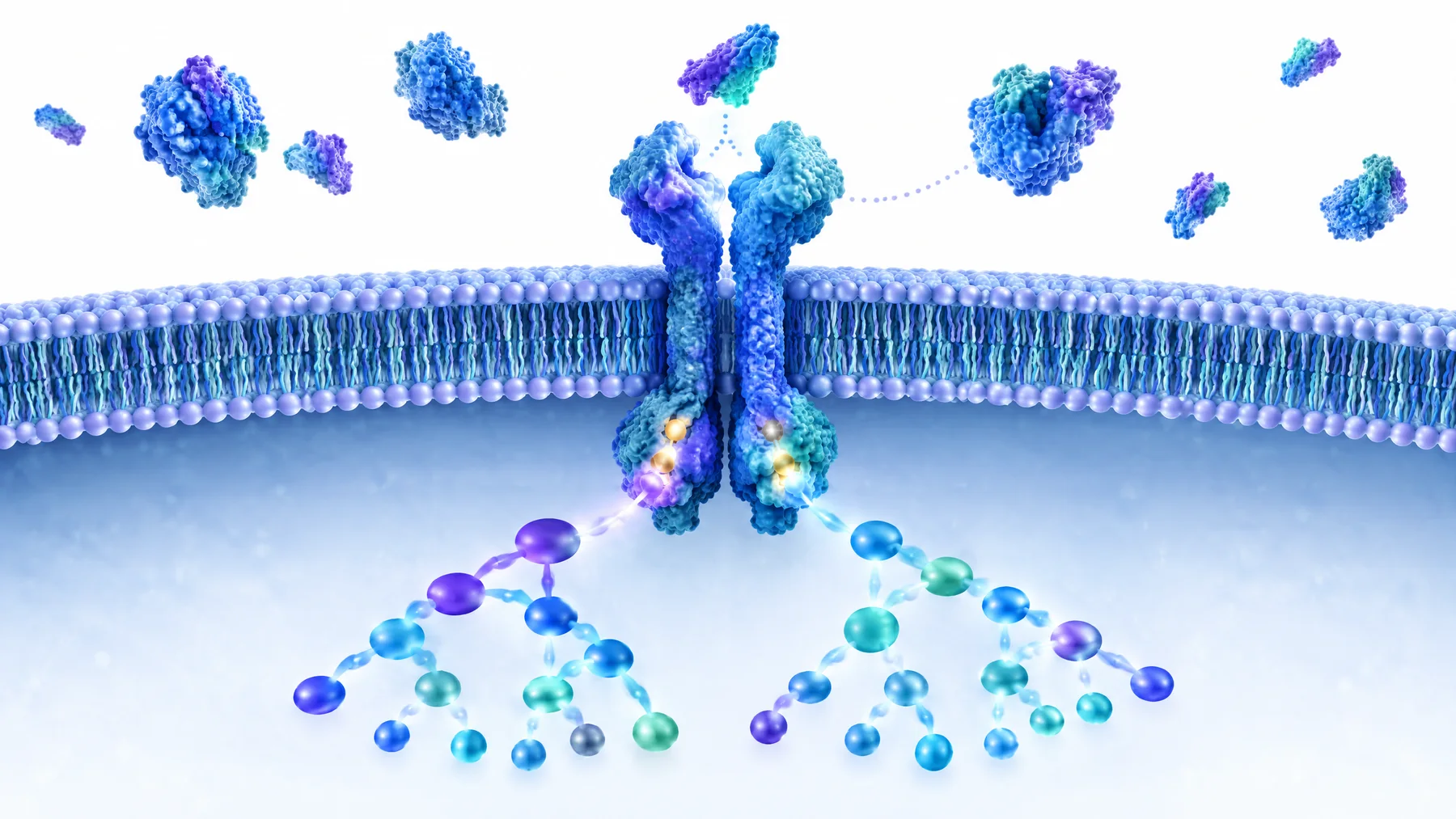
Retatrutide (LY3437943) is a single, fatty-diacid-conjugated peptide engineered to act as an agonist at three gastrointestinal-hormone receptors: glucose-dependent insulinotropic polypeptide (GIP), glucagon-like peptide-1 (GLP-1) and glucagon receptors. It is therefore genuinely a peptide medicine candidate, not a small molecule, a vitamin-like coenzyme, a topical cosmetic ingredient or a mixture of several agents. [1] [3]
Its status matters more than marketing language. The Australian Therapeutic Goods Administration (TGA) says retatrutide remains in human clinical trials and has not been approved by the TGA or a comparable international regulator. Accordingly, there is no approved retatrutide consumer product, Australian product information, pharmacy-labelled dose regimen or validated home-use protocol to copy from an approved formulation. [7] [8]
The molecular pathway: a triple receptor strategy
In cell-based pharmacology, LY3437943 showed agonist activity at the GIP, GLP-1 and glucagon receptors; the discovery paper describes relatively greater GIP receptor activity alongside balanced glucagon- and GLP-1-receptor activity. This three-receptor profile is the defining biological idea behind retatrutide, rather than an established guarantee of a particular clinical result in every person. [1]
The proposed contribution of each receptor must be read by model. In obese mice, the investigators attributed lower calorie intake to GIP and GLP-1 receptor activity and an additional rise in energy expenditure to glucagon receptor activity. Those are mechanistic animal-model findings, not direct evidence that the same component-by-component causal split occurs in humans. [1]
What preclinical and early human studies found
In the preclinical programme, retatrutide lowered body weight and improved glycaemic control in obese mice. The finding is useful for understanding why the candidate advanced, but mice are not a substitute for evidence on human effectiveness, adverse events, pregnancy safety or long-term cardiovascular outcomes. [1]
A phase 1b, randomised, double-blind multiple-ascending-dose study enrolled 72 adults with type 2 diabetes at four US centres and treated participants for 12 weeks. In the highest escalation cohort, placebo-adjusted body-weight change reached −8.96 kg at week 12; gastrointestinal disorders were the most frequent treatment-emergent events, and the reported half-life was about six days. This was a small, short safety/pharmacology study, not a registration label or a basis for self-administration. [2] [6]
Phase 2 obesity evidence: promising, but bounded
The pivotal published obesity study was a US multicentre, randomised, double-blind, placebo-controlled phase 2 trial in adults aged 18–75 years with obesity, or overweight plus a weight-related condition, and without type 2 diabetes. Participants also received lifestyle counselling. The prespecified primary endpoint was percentage weight change at week 24; the 48-week results were secondary outcomes. That design supports a placebo comparison in this selected population, not a direct comparison with another anti-obesity medicine. [3]
At week 24, least-squares mean weight change ranged from −7.2% with the 1-mg study arm to −17.9% with one 8-mg arm, versus −1.6% with placebo. At week 48, the reported range across retatrutide groups was −8.7% to −24.2%, versus −2.1% with placebo. The 24.2% figure is a model-based group mean in one phase 2 arm after 48 weeks; it is not a prediction for an individual and not evidence of a durable outcome after treatment stops. [3]
Type 2 diabetes and liver-fat studies answer different questions
In a separate 36-week phase 2 study at 42 US centres, 281 adults with type 2 diabetes were randomised to placebo, dulaglutide 1.5 mg or several retatrutide regimens. At week 24, HbA1c change in retatrutide groups ranged from −0.43% to −2.02%, versus −0.01% with placebo; at week 36, body-weight change ranged from −3.19% to −16.94%, versus −3.00% with placebo. These results apply to adults with the study’s diabetes, HbA1c, BMI and background-treatment criteria, rather than automatically to people without diabetes. [4]
A 98-person substudy of the obesity trial selected participants with metabolic dysfunction-associated steatotic liver disease and at least 10% liver fat on MRI-PDFF. At week 24, mean relative liver-fat change was −42.9%, −57.0%, −81.4% and −82.4% across the 1-, 4-, 8- and 12-mg groups, compared with +0.3% with placebo. The endpoint was MRI-measured liver fat, not biopsy-proven resolution of steatohepatitis, fibrosis reversal, liver-related survival or an approved liver-disease indication. [5]
Risks, adverse events and remaining uncertainty
Gastrointestinal events were the dominant tolerability signal in the obesity trial and were more common with retatrutide, particularly during dose escalation and in higher-dose groups. Nausea, diarrhoea, vomiting and constipation were commonly reported; treatment discontinuation for adverse events occurred in 6–16% of retatrutide participants versus none with placebo. In the diabetes phase 2 study, mild-to-moderate gastrointestinal events occurred in 35% of retatrutide recipients overall. [3] [4]
The obesity study also recorded a dose-dependent rise in heart rate through week 24 that later declined, one acute pancreatitis event, biliary events and mild-to-moderate altered skin sensation in some participants. The trial was neither large nor long enough to settle uncommon or delayed harms, cardiovascular outcomes, effects in pregnancy, interactions, outcomes after discontinuation, or safety in people excluded from the trials. Serious adverse-event frequency alone should not be mistaken for a complete safety assessment. [3]
Australian regulatory context: a vial is not an approved medicine
TGA guidance explains that products outside the Australian Register of Therapeutic Goods (ARTG) have not been assessed by the TGA for quality, safety or effectiveness. Some unapproved goods can be considered through tightly defined practitioner, clinical-trial or import pathways, but the existence of a pathway does not convert a product into an approved medicine or establish that an online product is authentic, sterile or clinically appropriate. [8] [9]
The distinction is especially concrete for retatrutide. After a serious adverse-event report, the TGA tested an unmarked vial sold as retatrutide and found undeclared semaglutide, no retatrutide and approximately eight times the semaglutide level found in TGA-assessed ARTG semaglutide products. The TGA advises that retatrutide products accessed outside clinical trials could be counterfeit and should not be used outside a clinical-trial setting. [7]
How to compare claims and read the studies
Retatrutide should not be treated as interchangeable with GLP-1-only or GIP/GLP-1 medicines: its defining investigational feature is added glucagon-receptor agonism. However, the published obesity study used placebo rather than an active anti-obesity-drug comparator, so it cannot establish superiority over another medicine. Comparisons across separate trials can be distorted by different populations, endpoint times, lifestyle programmes, estimands and dropout handling. [1] [3]
When reading a striking percentage, first ask: who was enrolled, compared with what, at which time point, and was the endpoint primary, secondary or exploratory? The obesity trial’s authors also note limitations in its US-only, majority-White sample and very small proportion of participants with overweight rather than obesity. These constraints are a reason for cautious interpretation, not a reason to disregard the randomised results. [3]
Questions readers ask
Is retatrutide approved in Australia?
No. The TGA states that retatrutide is undergoing human clinical trials and has not been approved by the TGA or any comparable international regulator. It is therefore not an approved Australian prescription medicine with an ARTG-approved product information document. [7] [8]
Is retatrutide actually a peptide?
Yes. It is a single synthetic peptide engineered as a triple agonist at GIP, GLP-1 and glucagon receptors, with a fatty-diacid moiety. It is not a small molecule or a blend of three separate hormones. [1] [3]
Do the trial results prove that retatrutide will work for everyone?
No. The phase 2 results are group averages from defined, screened study populations and time frames. The obesity trial excluded diabetes and several higher-risk conditions; the diabetes trial enrolled people with specified HbA1c, BMI and background-treatment criteria. Individual benefit and harm cannot be inferred from an average alone. [3] [4] [6]
Can a product sold online as ‘retatrutide’ be assumed to contain retatrutide?
No. In a TGA investigation, a product sold as retatrutide contained undeclared semaglutide and no retatrutide. An online label, a supplier certificate or the term ‘research use’ does not provide the quality, identity, sterility or dose assurance of an approved medicine or a trial supply chain. [7] [8]
What remains uncertain
The human evidence cited here is mainly phase 1–2, short relative to lifelong obesity, diabetes and liver disease management, and mostly from US study sites. The phase 2 obesity trial was placebo-controlled rather than a head-to-head comparison against another anti-obesity medicine; it also excluded many higher-risk groups and had limited racial/geographic diversity. [2] [3] [4] [5]
The MASLD substudy measured MRI-PDFF liver fat, not biopsy-based resolution or hard liver outcomes. Neither the published trials nor regulator guidance justifies an individual dosing, dilution, storage, injection, combination or self-treatment protocol. Regulatory status and trial availability can change; the cited TGA pages should be checked at the point of use. [5] [7] [8] [9]
References and further reading
- [1] LY3437943, a novel triple glucagon, GIP, and GLP-1 receptor agonist for glycemic control and weight loss: From discovery to clinical proof of concept. In vitro receptor pharmacology and obese-mouse studies, with phase 1 single-dose proof-of-concept context; Cell Metabolism (2022), doi:10.1016/j.cmet.2022.07.013.
- [2] LY3437943, a novel triple GIP, GLP-1, and glucagon receptor agonist in people with type 2 diabetes: a phase 1b, multicentre, double-blind, placebo-controlled, randomised, multiple-ascending dose trial. Phase 1b randomised, double-blind, placebo-controlled multiple-ascending-dose trial; 72 adults with type 2 diabetes at four US centres; 12 weeks; Lancet (2022), doi:10.1016/S0140-6736(22)02033-5.
- [3] Triple–Hormone-Receptor Agonist Retatrutide for Obesity. US multicentre randomised, double-blind, placebo-controlled phase 2 trial in adults with obesity or overweight plus a weight-related condition and no type 2 diabetes; 48-week treatment; New England Journal of Medicine (2023), doi:10.1056/NEJMoa2301972.
- [4] Retatrutide, a GIP, GLP-1 and glucagon receptor agonist, for people with type 2 diabetes: a randomised, double-blind, placebo and active-controlled, phase 2 trial. Randomised, double-blind, double-dummy, placebo- and active-comparator-controlled phase 2 trial; 281 adults with type 2 diabetes at 42 US centres; 36 weeks; Lancet (2023), doi:10.1016/S0140-6736(23)01053-X.
- [5] Triple hormone receptor agonist retatrutide for metabolic dysfunction-associated steatotic liver disease: a randomized phase 2a trial. Randomised, double-blind, placebo-controlled 48-week phase 2a MRI-PDFF substudy; 98 participants with MASLD and at least 10% liver fat; Nature Medicine (2024), doi:10.1038/s41591-024-03018-2.
- [6] A Study of LY3437943 in Participants With Type 2 Diabetes Mellitus (T2DM) — NCT04143802. Completed phase 1 randomised, double-masked, parallel-group study; actual enrolment 72; registered primary focus on safety through day 106.
- [7] TGA tests counterfeit retatrutide product following serious adverse event report. TGA post-market safety investigation and laboratory testing of a product sold as retatrutide; published 14 September 2026.
- [8] Unapproved therapeutic goods. TGA regulatory guidance page on goods not included in the ARTG and defined access pathways.
- [9] Clinical trials. TGA guidance on Clinical Trial Notification and Clinical Trial Approval schemes for unapproved therapeutic goods in Australia.