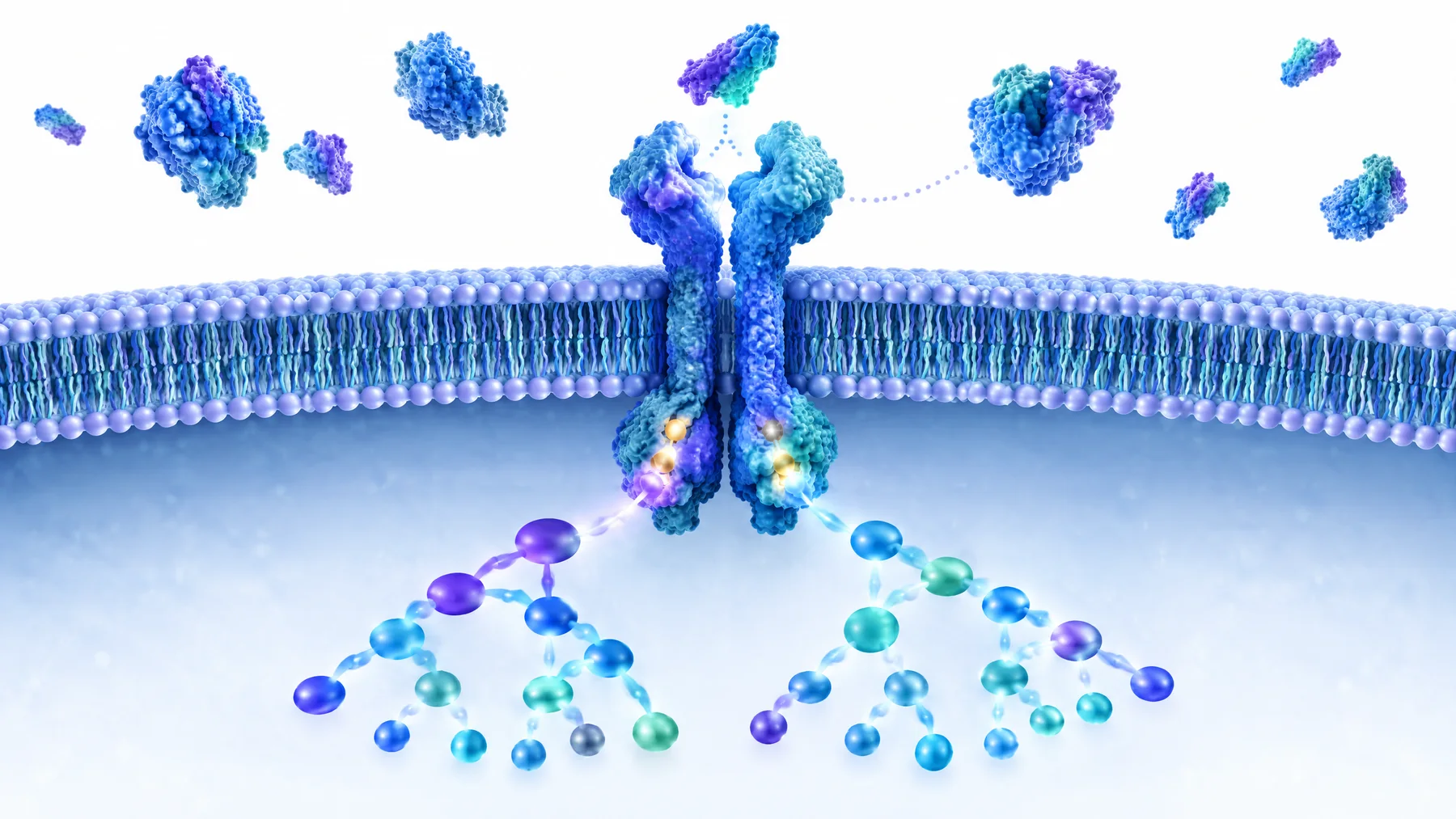

What is PEG-MGF (pegylated mechano-growth factor)?
PEG-MGF is a research-market name for a purported polyethylene-glycol (PEG)-modified MGF/IGF-1 E-domain-related peptide. It is not the same thing as naturally expressed human MGF: in human muscle, ‘MGF’ commonly denotes the IGF-1Ec splice transcript/protein precursor, whereas many laboratory papers test a short synthetic 24-amino-acid E-domain peptide. Published nomenclature is inconsistent, and the exact molecular identity, PEG attachment site, polymer size, purity and biological equivalence of a supplier vial labelled ‘PEG-MGF’ cannot be inferred from the name alone. It is a peptide-derived research substance, not a hormone product with an approved Australian formulation.
PEG-MGF sits at the edge of several different evidence streams that are often blended together in marketing: human muscle-biopsy studies of the IGF-1Ec/MGF transcript, experiments with an unpegylated synthetic E-domain peptide, and mouse gene-transfer work with full-length MGF. Those studies provide biological questions, not a clinical protocol for a pegylated commercial product. Human exercise research observed a short-lived increase in MGF transcript after eccentric muscle damage, while cell studies report conflicting results: one primary-human-cell study found increased proliferation/fusion potential in some donor-age groups, whereas a multi-model replication study found no distinct effect of native or stabilised MGF peptides. No PEG-MGF medicine label, ARTG entry or controlled human efficacy/safety dataset was identified in this review.
Identity: what the name does — and does not — identify
The most important distinction is between a biological splice variant and a retail label. Human IGF-1Ec is often called mechano-growth factor (MGF); it arises when IGF-1 transcripts are alternatively spliced and retains the mature IGF-1 sequence plus a distinctive E-domain. In the literature, ‘MGF’ can also mean a short synthetic C-terminal E-domain peptide, which is not the full precursor protein. This naming overlap has long been recognised as a source of confusion. [6]
PEG-MGF is marketed as a pegylated version of that MGF-related material. PEGylation is a chemical modification intended in general to alter a molecule’s handling in the body, but it creates a new construct rather than proving equivalence to endogenous IGF-1Ec, to full-length MGF, or to the 24-amino-acid synthetic E peptide used in older experiments. A recent clinical review places PEG-MGF among unregulated growth-hormone/IGF-1-axis compounds and highlights uncertainty about product composition and self-administration practices. [11]
Accordingly, PEG-MGF is best classified here as a peptide-derived, research-only substance with an ambiguous commercial identity. It is not an approved medicine, and a ‘research use’ vial is not an approved formulation, a validated biological standard, or evidence that a listed amount has the identity, sterility or stability required for human treatment. [7] [8] [9] [11]
What the MGF biology actually shows
The underlying biological observation is about expression, not treatment. In a study of 10 healthy young men after maximal eccentric knee-extensor exercise, muscle biopsies collected from 6 hours to 16 days showed a rapid, transient increase in MGF mRNA, followed by more prolonged increases in IGF-1Ea and IGF-1Eb transcripts. This documents a time-linked response in damaged human muscle; it does not test administration of MGF, PEG-MGF or any medicine. [1]
Mature IGF-1 signals through the IGF-1 receptor and downstream pathways including MAPK and PI3K/Akt. Some experiments with an MGF E-domain peptide have reported signalling that differs from mature IGF-1, but the receptor and full mechanism for the short E-domain peptide remain unsettled. That uncertainty is especially important for PEG-MGF, for which a pegylated construct-specific receptor, pharmacokinetic profile and tissue exposure have not been established in the sources reviewed. [1] [6] [11]
Model-specific findings: signals, not a single answer
One primary study cultured muscle progenitor cells from healthy human donors of different ages and tested the unpegylated MGF-24aa-E peptide. It reported longer proliferative life span and delayed senescence in neonatal and young-adult satellite-cell cultures, but not old-adult cultures; hypertrophy and reduced reserve-cell percentage were observed across cultures. This was an ex vivo cell-culture finding, not an administered-human outcome, and it does not establish the effect of PEG-MGF. [2]
A substantial counterpoint came from a cross-company replication effort. Native and stabilised MGF peptides, at concentrations up to 500 ng/mL, did not increase proliferation of C2C12 cells, primary human skeletal-muscle myoblasts or primary mouse muscle stem cells, and did not inhibit myoblast differentiation; mature IGF-1 and full-length IGF-1Eb were active positive comparators. The authors therefore questioned a distinct physiological role for a secreted MGF peptide in the tested systems. [3]
Animal findings must also be kept in their own lane. In adult male BALB/c mice with cardiotoxin injury to tibialis anterior muscle, electroporation-mediated overexpression of a plasmid encoding full-length MGF increased/delayed inflammatory-marker expression and delayed pro-inflammatory macrophage resolution, without an obvious improvement in muscle-regeneration outcomes. That is a gene-transfer experiment in injured mouse muscle, not a study of PEG-MGF injection or muscle building in people. [4]
An additional rabbit bone-defect study found that a non-PEG 24-amino-acid MGF-Ct24E peptide improved radiographic and histological healing at the higher tested local-treatment dose. It also found a non-linear cell response: 10 nM reduced living-cell population compared with lower concentrations in an osteoblast-like cell model. This illustrates both model dependence and why a positive animal experiment cannot supply a universal dose or safety rule. [5]
Human evidence: expression studies are not clinical trials
There is human evidence that muscle can express the MGF/IGF-1Ec signal after damaging exercise, and there are primary human-cell culture experiments with an unpegylated E-domain peptide. Neither is evidence that giving PEG-MGF to people improves recovery, strength, hypertrophy, injury healing or any medical condition. The cell model cannot determine whole-body distribution, metabolism, immunogenicity, cardiovascular effects, endocrine feedback or clinical benefit. [1] [2] [11]
No controlled human efficacy, pharmacokinetic, dose-ranging or long-term safety study of PEG-MGF was identified in the sources reviewed. The 2026 clinical review that names PEG-MGF explicitly places it among compounds where the gap between online self-administration and clinical evidence can extend to a complete absence of human studies. Therefore there is no evidence-based human administration schedule, route, reconstitution method, storage instruction or monitoring plan to report. [11]
Risks and uncertainty
For PEG-MGF itself, the adverse-effect profile is unknown because meaningful human exposure studies were not identified. It would be inaccurate to convert adverse effects reported for other growth-hormone/IGF-1-axis agents into proven PEG-MGF side effects. The appropriate conclusion is more basic: dose–response, distribution, endocrine effects, interactions, immunogenicity and long-term risk for a defined PEG-MGF construct remain uncharacterised. [11]
There is a separate product-quality risk when a vial is bought online. The TGA warns that purchasers may not know who made an online medicine or what it contains; products may be counterfeit, have the wrong active-ingredient amount, be contaminated, or contain undisclosed dangerous or illegal ingredients. This warning matters more, not less, when the label does not specify a validated PEG-MGF molecular standard. [9]
Conflicting laboratory outcomes are themselves a limitation. Positive findings with a synthetic E-domain peptide in selected cultures or animals coexist with null findings across other peptide preparations and human/mouse myogenic models. A biological hypothesis can justify further research, but it cannot validate performance, repair or anti-ageing claims for a pegylated retail product. [2] [3] [4] [5]
Australian regulatory context
No PEG-MGF product entry, Australian Product Information or Consumer Medicine Information was located in the ARTG material reviewed for this article. The ARTG is the TGA database used to search therapeutic goods supplied in Australia; absence of a located public record should be read as a current search finding, not as proof about every product using a similar or misleading name. On the evidence available, PEG-MGF should not be represented as a TGA-approved medicine. [7]
The TGA states that therapeutic goods outside the ARTG have not been assessed by it for quality, safety or effectiveness. Unapproved goods can only be accessed through defined pathways in limited circumstances, generally involving a health practitioner; those pathways do not turn an online research vial into an approved product or establish an indication for PEG-MGF. [8]
For competitive sport, the World Anti-Doping Agency prohibits IGF-1 and its analogues under growth factors, and also prohibits non-approved pharmacological substances at all times. PEG-MGF is not specifically named in the excerpts reviewed, so athletes should not infer permission from omission; anti-doping classification is a separate question from therapeutic approval. [10]
How to read MGF and PEG-MGF claims
Check exactly what was tested. ‘MGF’ may refer to an IGF-1Ec transcript measured in a biopsy, a full-length precursor expressed from a plasmid, or a short synthetic E-domain peptide. PEG-MGF adds another variable: chemical PEG modification. A headline that moves from one of those entities to a claim about a commercial PEG-MGF vial has crossed an evidence gap. [1] [3] [4] [6] [11]
Check the model and outcome before accepting a result. Exercise-associated mRNA expression does not demonstrate treatment benefit; cell proliferation does not demonstrate strength or injury recovery; and a mouse electroporation study does not establish a human injectable medicine. The most decision-relevant missing evidence for PEG-MGF is a clearly defined product tested in registered, controlled human studies with clinically meaningful outcomes and systematic safety follow-up. [1] [2] [3] [4] [11]
Questions readers ask
Is PEG-MGF an approved medicine in Australia?
No PEG-MGF ARTG listing or approved Australian product label was identified in this review. The TGA explains that products not included in the ARTG are unapproved and have not been assessed by it for quality, safety or effectiveness. [7] [8]
Is PEG-MGF a natural hormone?
No. MGF/IGF-1Ec refers to an IGF-1 splice variant in human biology, while PEG-MGF is a modified, research-market construct. A PEG-modified vial should not be described as the natural MGF signal found in muscle. [6] [11]
Do human studies show that PEG-MGF builds muscle or speeds recovery?
No. Human work located here measured endogenous MGF transcript after eccentric exercise or studied unpegylated peptide in cultured human cells. It did not administer PEG-MGF to people or measure clinical recovery, hypertrophy or performance outcomes. [1] [2] [11]
Why are MGF laboratory findings inconsistent?
Studies have used different entities, including a short E-domain peptide, native or stabilised peptides, and full-length gene expression, across different cell types and animal models. A primary human-cell study reported selected positive findings, whereas a separate multi-model study found no distinct myoblast or stem-cell effect from MGF peptides. [2] [3] [4]
Does a ‘research use only’ label make a PEG-MGF vial suitable for self-treatment?
No. It does not provide a TGA assessment or an evidence-based human protocol. The TGA cautions that online products may have incorrect amounts, contamination or undisclosed ingredients, and unapproved goods have not been assessed for quality, safety or effectiveness. [8] [9]
What remains uncertain
The direct PEG-MGF evidence base is exceptionally thin. Most available evidence concerns endogenous IGF-1Ec/MGF expression, unpegylated 24-amino-acid E-domain peptides or full-length MGF expressed by plasmid; none can identify or validate the exact composition of a commercial PEG-MGF vial. [1] [2] [3] [4] [5] [6] [11]
The Australian status statement is based on ARTG/public-label searches undertaken for this article. Product names can be variable or misleading, and the absence of an identified entry should not be interpreted as legal advice or as proof about every similarly labelled product. [7] [8]
No dose, route, frequency, dilution, storage method, combination protocol or expected outcome is supplied because no approved PEG-MGF label or validated human clinical regimen was identified. [7] [8] [11]
References and further reading
- [1] Expression of IGF-1 Isoforms after Exercise-induced Muscle Damage in Humans: Characterization of the MGF E Peptide Actions In Vitro. Ten healthy young men underwent maximal eccentric knee-extensor exercise with serial muscle biopsies; PCR/protein expression profiling was paired with C2C12 cell experiments using synthetic MGF E peptide.
- [2] Mechano Growth Factor E peptide (MGF-E), derived from an isoform of IGF-1, activates human muscle progenitor cells and induces an increase in their fusion potential at different ages. Ex vivo primary human skeletal-muscle cell cultures from healthy donors of different ages were exposed to an unpegylated MGF-24aa-E peptide.
- [3] Mechano-growth factor peptide, the COOH terminus of unprocessed insulin-like growth factor 1, has no apparent effect on myoblasts or primary muscle stem cells. In vitro replication experiments across C2C12 cells, primary human skeletal-muscle myoblasts, primary mouse muscle stem cells and neonatal rat ventricular myocytes using native/stabilised MGF peptides with mature IGF-1 controls.
- [4] Overexpression of Mechano-Growth Factor Modulates Inflammatory Cytokine Expression and Macrophage Resolution in Skeletal Muscle Injury. Adult male BALB/c mice received cardiotoxin injury in tibialis anterior; a plasmid encoding full-length MGF was delivered by local electroporation and compared with vector control.
- [5] Mechano growth factor E peptide promotes osteoblasts proliferation and bone-defect healing in rabbits. MC3T3-E1 osteoblast-like cells and a 5-mm rabbit radial segmental bone-defect model tested non-PEG MGF-Ct24E peptide against controls.
- [6] Mechano-Growth Factor: an important cog or a loose screw in the repair machinery?. Review of IGF-1 splice-variant nomenclature, processing and experimental MGF E-domain peptide literature.
- [7] Australian Register of Therapeutic Goods (ARTG). TGA public register that enables searches of Australian therapeutic goods and associated formulation/sponsor/label records.
- [8] Unapproved therapeutic goods. TGA regulatory guidance on goods not included in the ARTG and defined access pathways.
- [9] Buying medicines and medical devices online. TGA consumer information about risks associated with online therapeutic goods.
- [10] World Anti-Doping Agency Prohibited List. Current WADA prohibited-substance classification.
- [11] The emerging landscape of performance-enhancing peptides modulating GH-IGF1 axis: bridging the gap between clinical evidence and patient self-administration. Clinical evidence review of unregulated GH–IGF-1-axis peptides, including PEG-MGF, and the gap between evidence and online self-administration.