What is NAD+ (nicotinamide adenine dinucleotide)?
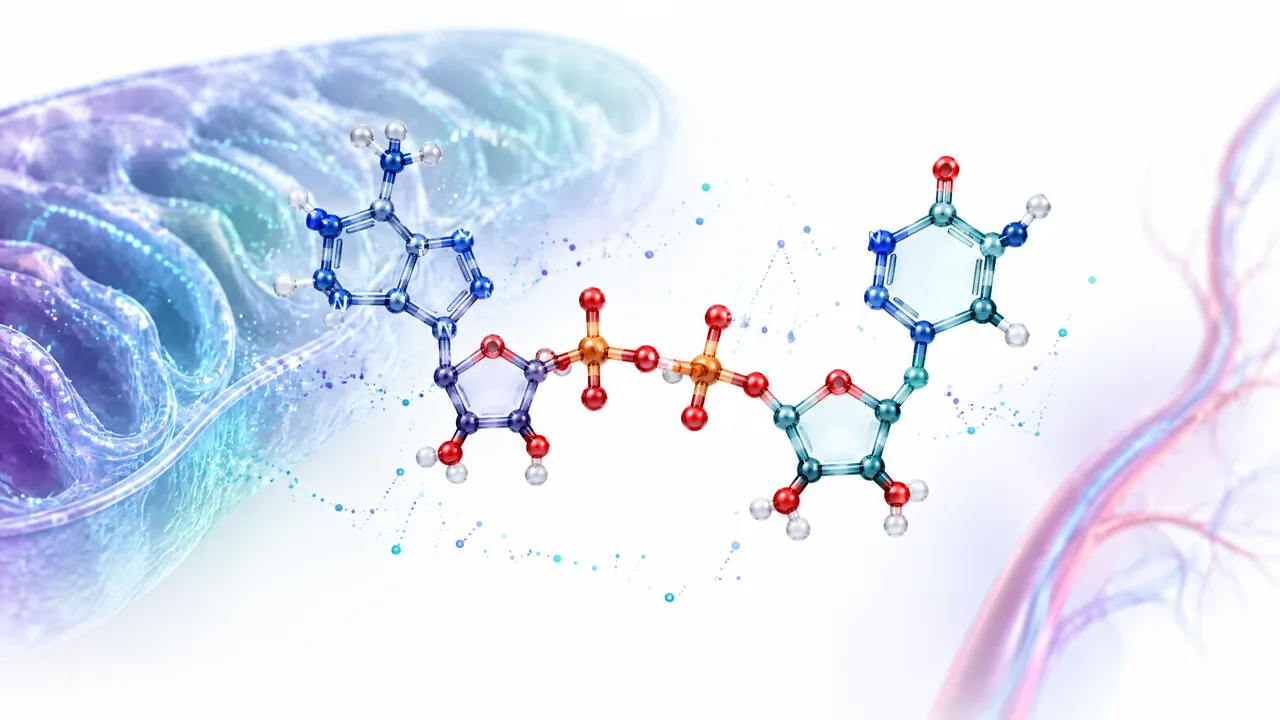
NAD+ is the oxidised form of nicotinamide adenine dinucleotide: an endogenous pyridine nucleotide coenzyme (also called nadide in medicine nomenclature), not a peptide, hormone, or conventional ‘peptide vial’. The PubChem record gives the NAD cation molecular formula as C21H29N7O14P2+2 and a molecular weight of 665.4 g/mol. NADH is the reduced redox partner; nicotinamide (NAM), nicotinamide riboside (NR), and nicotinamide mononucleotide (NMN) are chemically distinct vitamin B3-related substances or precursors, not alternative names for infused NAD+.
NAD+ is a coenzyme essential to redox metabolism and also a substrate for several NAD-consuming enzymes. That fundamental biology does not establish that an NAD+ infusion treats ageing, fatigue, neurodegeneration, obesity, addiction, or any other condition. The most directly relevant human paper located was a small, short, randomised pilot of an IV preparation in eight healthy men versus three saline controls; it measured blood and urine metabolites, not patient-centred outcomes. Australian readers should distinguish this experimental literature from regulation: the TGA says NAD/NAD+/NADH are not permitted ingredients in listed medicines, and the identified ARTG product containing nadide is export-only, not permitted for domestic supply.
1. Identity: a cellular coenzyme, not a peptide medicine
NAD+ (nicotinamide adenine dinucleotide) is a ubiquitous cellular coenzyme. In its oxidised/reduced pair, NAD+/NADH, it participates in electron-transfer reactions that underpin energy metabolism. It is not made of amino acids and is therefore not a peptide; it is also not a hormone. ‘NAD+ therapy’ is a marketing or clinical-practice phrase rather than the name of one standardised medicinal product, route, or indication. [1] [2]
The distinction between NAD+ and nearby terms is consequential. NADH is the reduced form of the same redox pair. NAM, NR and NMN are different molecules that can enter NAD metabolism through different routes; their pharmacokinetics, formulations, evidence base and regulatory treatment cannot be assumed to match direct NAD+ administration. [1] [2] [7]
2. Molecular pathway: what is established, and what an infusion does not prove
Within cells, NAD+ accepts electrons to become NADH; NADH then contributes electrons to the respiratory chain, supporting oxidative phosphorylation and ATP production. NAD+ is also consumed by enzyme families including PARPs, sirtuins and CD38/CD157 rather than acting only as a recyclable redox cofactor. These are established biochemical roles, not evidence that supplying NAD+ from outside the body corrects a particular disease process in people. [2]
Directly infused NAD+ has a complicated extracellular fate. In the human pilot, the pattern of NAD+, nicotinamide, ADP-ribose, methyl-nicotinamide and NMN in plasma and urine was consistent with metabolism and/or sequestration; the investigators did not establish how much intact infused NAD+ entered a particular tissue or cell type. Thus a rise in a plasma metabolite is not a demonstration of brain, muscle or mitochondrial target engagement. [2]
Mouse genetics adds a useful mechanistic clue but not a clinical answer. In aged CD38-knockout mice, higher mitochondrial NAD+ and improved glucose tolerance/ATP-linked oxygen consumption versus wild-type mice were reversed in CD38/SIRT3 double knockouts, supporting a CD38–NAD+–SIRT3 relationship in that mouse system. It does not show that an NAD+ infusion will reproduce those effects in humans. [4]
3. Model-specific findings: direct NAD+ and precursor studies are not interchangeable
A direct-NAD+ obesity experiment used male C57BL/6 mice fed a high-fat diet for 12 weeks. During the final four weeks, the treatment group received intraperitoneal NAD at 1 mg/kg/day while controls received saline. The authors reported less weight gain and recovery of suppressed diurnal locomotor rhythms in the obese mice. This is a defined preclinical intraperitoneal mouse experiment, not an intravenous human study and not evidence for a human weight-management protocol. [3]
Frequently cited ‘NAD+ repletion’ work often actually administers a precursor. Zhang and colleagues treated aged mice and mdx muscular-dystrophy-model mice with nicotinamide riboside (NR), reporting mitochondrial unfolded-protein-response/prohibitin changes, less muscle stem-cell senescence and lifespan effects in mice. The intervention was NR, so the result should not be presented as evidence that direct NAD+ injection has those outcomes. [5]
The same caution applies in neurodegeneration models. In 3xTgAD and DNA-repair-deficient 3xTgAD/Polβ+/- mice, NR normalised a measured cerebral NAD+/NADH ratio and improved several behavioural and pathological measures, while not reducing amyloid-beta accumulation. These are model-specific NR findings in transgenic mice, not proof of benefit from NAD+ administration in people with Alzheimer’s disease. [6]
4. Direct human evidence: a metabolite pilot, not an efficacy trial
The clearest direct human study found was Grant et al. (2019), a small pilot of healthy men aged 30–55 years. Eight participants received 750 mg of NAD+ in saline over six hours and three received saline; the study used plasma and urine LC–MS/MS measurements and did not enrol people for a disease outcome. The stated protocol is reported here to identify the experiment, not as a recommendation or a general administration schedule. [2]
At the end of the infusion, plasma NAD+ was reported 398% above baseline; nicotinamide, ADP-ribose and methyl-nicotinamide also increased, while NMN was significantly elevated at the two-hour post-infusion time point. Urinary NAD+ and methyl-nicotinamide excretion increased at six hours. These are short-term analyte findings, not measures of energy, cognitive performance, withdrawal, disease modification, or longevity. [2]
No adverse events were observed during that six-hour session, and liver-test changes at eight hours were judged by the authors not clinically significant. However, a finding in eight treated healthy men over hours cannot establish rare harms, safety in pregnancy, interactions, safety in chronic disease, longer-term safety, or clinical effectiveness. The study was also funded partly by NAD+ Research Inc.; one author was its director and medical director of the wellness centre where infusions occurred. [2]
5. Do not relabel precursor trials as NAD+ infusion trials
The NADPARK trial is often relevant to conversations about NAD metabolism, but its intervention was oral nicotinamide riboside, not NAD+. It randomised 30 newly diagnosed, drug-naive Parkinson’s disease participants to NR or placebo for about four weeks. The published report found peripheral NAD-metabolome changes and minor adverse events considered unrelated to NR, while the overall MDS-UPDRS clinical score did not significantly change in either group. [7]
Its registry confirms the trial’s primary purpose was a neurometabolic imaging question and that NR—not NAD+—was the active comparator intervention. Calling NADPARK proof for an NAD+ IV product would collapse a difference in molecule, route, population and endpoint. [7]
For readers comparing products, a credible paper should state the exact molecule, formulation, route, model or participant population, comparator, endpoint and follow-up. A change in blood NAD-related metabolites can be biologically interesting without being a validated clinical benefit; it also cannot validate a supplier’s vial, purity, sterility, storage claim or blended formulation. [2] [7]
6. Risks and uncertainty
The direct human evidence is too small and short to define a reliable risk profile. The sole pilot’s absence of observed acute adverse events is reassuring only for that selected group and observation window. It does not settle safety for different routes, repeated dosing, people with kidney or liver impairment, people taking medicines, or patients with a condition for which an infusion is marketed. [2]
Injectable products add route-specific quality and clinical risks that cannot be answered by a biochemical rationale: identity, concentration, sterility, endotoxin control, diluent compatibility, administration setting and management of an acute reaction matter. A research paper that used one pharmacy-prepared solution under study supervision is not a validation of another clinic’s or online supplier’s product. The TGA advises that goods not included in the ARTG have not been assessed by it for quality, safety or effectiveness. [2] [11]
There is no validated combined protocol for NAD+ ‘blends’. Adding vitamins, precursors, drugs or other injectable substances changes both the exposure and the safety question; results from a single-agent or single-formulation study cannot establish the safety or benefit of the combination. [2] [7]
7. Australian regulatory context: names and ARTG entries need close reading
For Australian supply, the TGA states that NAD, NAD+ and NADH are currently not permitted ingredients in listed medicines. It warns that products referring to these substances without an ARTG entry, exemption or other authorisation may be unlawfully supplied, and that unapproved goods have not been evaluated by the TGA for quality, safety or effectiveness. This is regulatory information, not a statement that every product labelled ‘NAD+’ is identical. [8] [11]
The ARTG does contain a product record, BIO G Nicotinamide Adenine Dinucleotide (NAD+) (ARTG 366430), which lists nadide among several ingredients and has licence category LIE. The TGA’s Export Only guidance states that Export Only medicines cannot be supplied in Australia, including duty-free outlets. Therefore, this record should not be read as domestic approval of NAD+ infusion treatment. [9] [10]
Product names can mislead. Another active ARTG record called ‘NAD+’ (ARTG 375757) lists nicotinamide, quercetin and Reynoutria japonica as its ingredients—not NAD+ itself. More broadly, listed medicines are assessed for quality and safety but not efficacy, whereas registered medicines are assessed for quality, safety and efficacy. Check the exact AUST number, ingredients, route and legal status rather than relying on a product name or supplier claim. [12] [13]
8. Practical reading of the evidence
Start by asking ‘what was actually given?’ Direct NAD+, NR, NMN, NAM and NADH are not interchangeable. Next ask whether the work was in cells, a named animal model or humans; whether it used a placebo or comparator; and whether the endpoint was a biomarker, a validated symptom scale or a clinical event. The direct-IV pilot answers a narrow pharmacometabolomic question, while the mouse studies answer model-specific biological questions. [2] [3] [5] [6]
Finally, separate study identification from treatment instruction. Exact study procedures explain what was tested; they do not establish a universal dose, dilution, storage condition, injection route, treatment interval or self-administration method. For a product being considered in Australia, ARTG status and a clinician’s assessment should be checked independently of wellness marketing. [2] [8] [11]
Questions readers ask
Is NAD+ a peptide?
No. NAD+ is a nicotinamide adenine dinucleotide coenzyme, not an amino-acid peptide. It has a defined small-molecule nucleotide structure and is part of the NAD+/NADH redox pair. [1] [2]
Has NAD+ been proven to increase energy or reverse ageing in people?
No such conclusion is supported by the direct human study reviewed here. That small study measured short-term plasma and urine NAD-related metabolites in healthy men; it did not test fatigue, physical function, ageing, lifespan or disease outcomes. [2]
Is NADPARK evidence for NAD+ infusions in Parkinson’s disease?
No. NADPARK tested oral nicotinamide riboside (NR), a precursor, in 30 people with newly diagnosed Parkinson’s disease. The overall clinical MDS-UPDRS score did not significantly change in the published study; it was not an NAD+ infusion trial. [7]
Is an ARTG product called ‘NAD+’ necessarily a product that contains NAD+?
No. ARTG 375757 is named ‘NAD+’ but its listed ingredients are nicotinamide, quercetin and Reynoutria japonica. The exact ARTG entry and ingredients, not the front-of-pack name, are what should be checked. [12]
Does the ARTG record for BIO G Nicotinamide Adenine Dinucleotide mean NAD+ can be supplied domestically as an approved Australian infusion?
No. The cited BIO G record is licence category LIE, and the TGA says Export Only medicines cannot be supplied in Australia. The TGA also says NAD/NAD+/NADH are not permitted ingredients in listed medicines. [8] [9] [10]
What remains uncertain
Direct human NAD+ evidence in this record rests chiefly on one very small, short pilot in selected healthy men. It was designed for plasma/urine metabolomics, not clinical efficacy or long-term safety, and included a commercial conflict of interest. [2]
The most prominent positive disease-related findings cited here are in mouse models or use precursors such as NR, not direct NAD+. Species, route, formulation, disease model and endpoint differences prevent direct translation to human treatment claims. [3] [5] [6]
ARTG name searches do not themselves establish that a product contains NAD+ or that it is a domestically approved medicine for an advertised indication; product identity, ingredients, licence category and route need independent checking. [9] [10] [12] [13]
References and further reading
- [1] Nicotinamide-Adenine-Dinucleotide (PubChem CID 170855691). Curated chemical identity and computed descriptor record
- [2] A Pilot Study Investigating Changes in the Human Plasma and Urine NAD+ Metabolome During a 6 Hour Intravenous Infusion of NAD+. Small randomised controlled pharmacometabolomic pilot: 8 healthy men received IV NAD+ and 3 received saline; plasma/urine LC-MS/MS and short-term safety observation.
- [3] Effects of Chronic NAD Supplementation on Energy Metabolism and Diurnal Rhythm in Obese Mice. Male C57BL/6 diet-induced-obesity mouse model; high-fat diet for 12 weeks, with intraperitoneal NAD or saline during the final 4 weeks.
- [4] CD38 dictates age-related NAD decline and mitochondrial dysfunction through an SIRT3-dependent mechanism. Wild-type, CD38-knockout, SIRT3-knockout and double-knockout mouse experiments, including mitochondrial and glucose-tolerance measures.
- [5] NAD+ repletion improves mitochondrial and stem cell function and enhances life span in mice. Aged and mdx muscular-dystrophy-model mouse experiments using the NAD+ precursor nicotinamide riboside (NR).
- [6] NAD+ supplementation normalizes key Alzheimer's features and DNA damage responses in a new AD mouse model with introduced DNA repair deficiency. 3xTgAD and DNA-repair-deficient 3xTgAD/Polβ+/- mouse models treated with the NAD+ precursor NR, with behavioural, pathology and biochemical endpoints.
- [7] The NADPARK study: A randomized phase I trial of nicotinamide riboside supplementation in Parkinson's disease. Triple-blind, randomised placebo-controlled pilot in 30 newly diagnosed, drug-naive Parkinson’s disease participants; oral NR, not NAD+, for approximately four weeks.
- [8] NAD, NAD+, NADH or NMN medicines sold in Australia. TGA regulatory guidance and consumer/sponsor alert, updated 3 February 2026.
- [9] BIO G Nicotinamide Adenine Dinucleotide (NAD+) (ARTG 366430). Official product-register entry
- [10] Exporting medicines from Australia. TGA guidance on commercial export and Export Only medicine listings.
- [11] Unapproved therapeutic goods. TGA overview of defined access pathways for goods not included in the ARTG.
- [12] NAD+ (ARTG 375757). Official product-register entry
- [13] Medicines and TGA classifications. TGA overview of registered and listed medicine pathways.