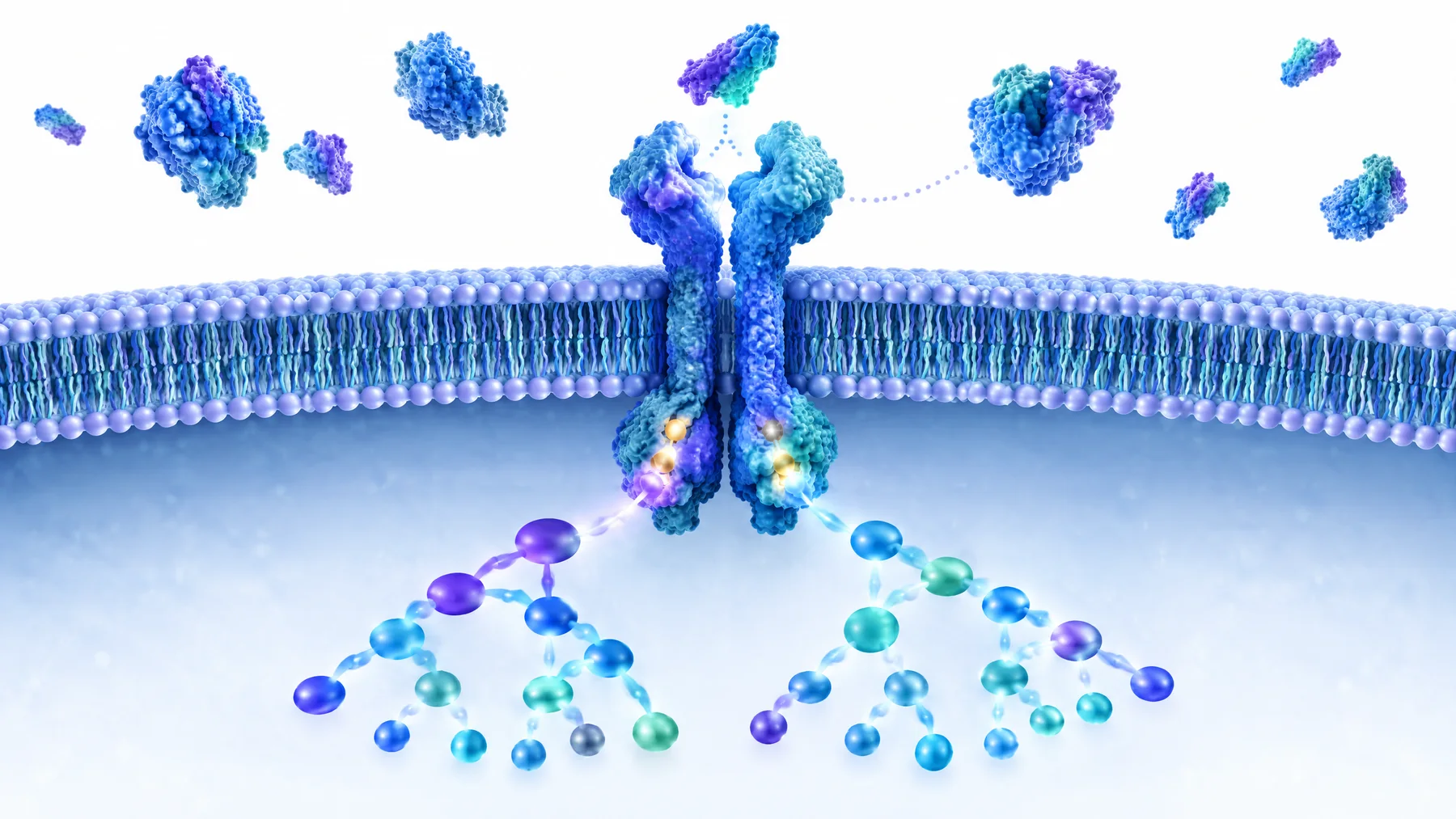

What is Mechano Growth Factor (MGF; IGF-1Ec-related E-peptide)?
MGF is an ambiguous research term, not a single approved medicine. In human muscle biology it commonly denotes the IGF-1Ec splice variant (called IGF-1Eb in rodents); in peptide-product discussions it often denotes a synthetic 24-amino-acid sequence from the C-terminal E-domain of that precursor. The latter is a peptide research tool, whereas the former is an endogenous IGF-1 transcript/precursor context. These are not interchangeable with mature IGF-1 or with a clinically validated injectable formulation.
MGF is best understood as shorthand for an IGF-1 splice-variant/E-domain research question, rather than as a defined medicine. Human exercise studies report changes in IGF-1Ec/MGF expression, but cell-culture findings for the synthetic 24-amino-acid peptide conflict and do not establish clinical benefit or a treatment protocol (Sources 1, 2, 3, 6).
1. Identity: one acronym, two related but different things
In the literature, MGF may mean the human IGF-1Ec splice variant, the rodent IGF-1Eb counterpart, or a synthetic 24-amino-acid peptide corresponding to the C-terminal part of the variant's E-domain. This naming overlap is consequential: a transcript or full-length precursor that contains the mature IGF-1 sequence is not the same experimental material as an isolated short synthetic peptide. [1] [3] [2]
Accordingly, MGF is not best classified as a conventional drug name. The short synthetic MGF-E/C-terminal fragment used in many experiments is a peptide; the endogenous IGF-1Ec label refers to alternative splicing of the IGF-1 gene. Articles and product pages that treat all of these as one substance can overstate what a particular experiment actually tested. [1] [3] [4]
2. Molecular context: what the studies can, and cannot, show
The IGF-1 gene can generate different transcripts through promoter use and alternative splicing. In the nomenclature used by the replication study, the human IGF-1Ec and rodent IGF-1Eb forms include a distinctive C-terminal region beyond the 70-amino-acid mature IGF-1 protein. The 24-residue C-terminal sequence has been synthesised and called MGF in experiments. [3] [1]
That molecular relationship does not prove that an injected or added 24-residue peptide reproduces the biology of endogenous IGF-1Ec expression. A receptor for the isolated MGF peptide was not established by the cited studies, and the later multi-laboratory work explicitly questioned whether the discrete peptide has a physiological role in muscle repair. [3]
3. What has been observed in human muscle after exercise
A 2009 study put 10 healthy young men through damaging eccentric knee-extensor exercise and obtained serial muscle biopsies. It reported a rapid, transient rise in MGF/IGF-1Ec mRNA, followed by more prolonged increases in other IGF-1 isoform transcripts; the investigators also reported similar broad patterns for selected protein measurements. This is an expression study after an exercise challenge, not a trial of administered MGF. [1]
In a separate study of healthy elderly men, five weeks of resistance training increased MGF mRNA in vastus lateralis biopsies. The experiment also tested growth hormone with or without training, so its transcript findings cannot establish that MGF peptide caused muscle growth, recovery or functional improvement. Messenger-RNA change is not a dose, a circulating concentration, or evidence for a therapeutic injection. [6]
4. Synthetic-peptide findings are model-specific
Several early cell studies reported activity for synthetic E-domain fragments. Ates and colleagues found increased desmin-positive progenitor-cell numbers in primary human cultures from healthy donors and from people with muscular dystrophy or ALS, while reporting that the MGF E peptide blocked myogenic differentiation in that setting. Mills and colleagues reported increased migration-related behaviour of human myogenic precursor cells, alongside changes in u-PA, u-PAR, MMP-7 and PAI-1 measures. [4] [5]
Kandalla and colleagues studied primary human muscle cultures from donors of different ages. Their synthetic MGF-24aa-E peptide increased proliferative lifespan and delayed senescence in neonatal and young-adult satellite-cell cultures, but not old-adult cultures; hypertrophy-associated changes were reported across cultures. These are cultured-cell endpoints and donor-age-dependent observations, not evidence that a person receiving MGF gains muscle or treats sarcopenia. [2]
5. A serious replication result tempers the claim
Fornaro and collaborators tested native and stabilised MGF peptides across C2C12 myoblasts, primary human skeletal-muscle myoblasts and primary mouse muscle stem cells. At concentrations up to 500 ng/mL, they found no significant increase in proliferation and no inhibition of differentiation; mature IGF-1 and full-length IGF-1Eb did produce proliferative responses. They also did not find the reported signalling response in cardiac myocytes. [3]
This does not prove that every earlier result was wrong. It does show that activity is not robustly reproduced across peptide preparations and biological systems. Differences in species, cell isolation, peptide chemistry, endpoint selection and culture conditions may matter, but they are not a basis for choosing a human dose, route, schedule, dilution or storage method. [2] [3] [4] [5]
6. Human therapeutic evidence and safety: the central gap
The human studies located for this record measured IGF-1 isoform expression after exercise or training; they did not administer synthetic MGF as a treatment. The primary studies reporting direct peptide effects were principally cell-culture experiments, with the migration paper also describing an in-vivo precursor-cell context rather than a human MGF treatment trial. No validated clinical administration schedule can be inferred from them. [1] [2] [3] [4] [5] [6]
Consequently, clinical efficacy, pharmacokinetics, tissue distribution, immunogenicity, interactions, long-term risks and a safe route of administration remain unresolved for a synthetic MGF peptide. Biological plausibility around IGF-1 signalling is not a substitute for product-specific human safety and efficacy data. [1] [3] [8]
7. Australian regulatory context and sport
No Australian ARTG MGF medicine entry or Australian product information was identified in this focused review. This is a limited research finding, not a legal ruling: the ARTG is the TGA's public reference database, and—unless an exemption applies—therapeutic goods not in it cannot be supplied in Australia. A current ARTG search by product, sponsor and active ingredient is the appropriate verification step for a named product. [7]
A research-vial label does not itself establish pharmaceutical quality, TGA assessment or a lawful therapeutic formulation. The TGA says unapproved therapeutic goods have not been assessed by it for safety, quality or effectiveness and are only accessible through defined pathways in specified circumstances. For tested athletes, WADA expressly prohibits IGF-1 and its analogues and also lists broader growth-factor/modulator categories; individual product status should be checked with a sports-medicine or anti-doping authority rather than assumed. [8] [9]
8. Reading MGF claims and comparing it with IGF-1
Mature IGF-1, full-length IGF-1 splice forms and the isolated E-domain peptide should be kept separate when reading a paper. In the failed-replication experiment, mature IGF-1 and full-length IGF-1Eb stimulated proliferation whereas the tested MGF peptides did not. Therefore, a claim about IGF-1 receptor signalling or a full precursor cannot automatically be transferred to a short MGF peptide. [3]
The most useful questions are: Which exact sequence was tested? Was it a transcript measurement, a full-length protein, or a synthetic fragment? Which species and cells were used? Was there a mature-IGF-1 comparator? And was the result independently reproduced? Until controlled human treatment studies answer the clinical questions, claims of muscle repair, hypertrophy or anti-ageing benefit should be read as hypotheses rather than established outcomes. [1] [2] [3] [4] [6]
Questions readers ask
Is MGF an approved medicine in Australia?
This review did not identify an ARTG MGF medicine or an Australian MGF product-information document. The TGA identifies the ARTG as the public database for therapeutic goods supplied in Australia and says goods not in the ARTG generally cannot be supplied unless exempt. Verify any specific product in the live ARTG rather than relying on a vial or website claim. [7]
Is MGF actually a peptide?
The answer depends on the usage. IGF-1Ec/MGF is a splice-variant term, while the research material often called MGF is a synthetic 24-amino-acid C-terminal E-domain peptide. They are related but not interchangeable entities. [1] [2] [3]
Does exercise prove that MGF builds muscle?
No. Exercise studies observed changes in MGF/IGF-1Ec messenger RNA and related protein measurements in biopsied muscle. They did not test administration of synthetic MGF or demonstrate that MGF alone caused hypertrophy, recovery or improved performance in people. [1] [6]
Why do some articles say MGF activates muscle stem cells while others do not?
Positive findings came from particular synthetic peptides and cell-culture models, whereas a later multi-laboratory study found no significant effects in C2C12 cells, primary human myoblasts or primary mouse muscle stem cells. This conflict is a reason not to convert laboratory results into a clinical claim. [2] [3] [4] [5]
Is there a safe MGF injection, reconstitution or storage protocol?
No clinical protocol is supported by the studies reviewed here. The cited human work is expression research and the direct-peptide work is preclinical. Unapproved therapeutic goods have not been assessed by the TGA for safety, quality or effectiveness, so supplier instructions are not a substitute for an approved product label or clinical evidence. [1] [2] [3] [8]
What remains uncertain
MGF terminology is inconsistent: the papers variously refer to a splice transcript/full precursor and to a synthetic 24-residue E-domain peptide. Conclusions about one should not be automatically applied to the other. [1] [2] [3] [4]
The most directly relevant peptide data are preclinical and heterogeneous, and a substantial multi-model replication attempt reported null results. There are no cited controlled human studies of administered MGF for muscle outcomes. [1] [2] [3] [4] [5] [6]
The ARTG finding is a focused research check, not legal or clinical advice. Product status can change, exemptions and access pathways can be fact-specific, and a named product should be verified in the current ARTG and discussed with an appropriately qualified Australian clinician or regulator. [7] [8]
References and further reading
- [1] Expression of IGF-1 Isoforms after Exercise-induced Muscle Damage in Humans: Characterization of the MGF E Peptide Actions In Vitro. Ten healthy men completed eccentric knee-extensor exercise with biopsies before and at 6 hours, 2, 5 and 16 days; IGF-1 isoform mRNA/protein measures were paired with synthetic-peptide experiments in C2C12 cells.
- [2] Mechano Growth Factor E peptide (MGF-E), derived from an isoform of IGF-1, activates human muscle progenitor cells and induces an increase in their fusion potential at different ages. Primary human muscle-cell cultures from healthy donors of different ages exposed to synthetic MGF-24aa-E peptide.
- [3] Mechano-growth factor peptide, the COOH terminus of unprocessed insulin-like growth factor 1, has no apparent effect on myoblasts or primary muscle stem cells. Native and stabilised MGF peptides tested up to 500 ng/mL in C2C12 cells, primary human skeletal-muscle myoblasts, primary mouse muscle stem cells and cardiac myocytes; IGF-1 and full-length IGF-1Eb served as comparators.
- [4] The IGF-I splice variant MGF increases progenitor cells in ALS, dystrophic, and normal muscle. Human primary muscle-cell cultures from healthy subjects and from muscular dystrophy and ALS patients, examining IGF-I splice-variant peptide effects on proliferation and differentiation.
- [5] A new pro-migratory activity on human myogenic precursor cells for a synthetic peptide within the E domain of the mechano growth factor. Synthetic MGF-Ct24E peptide experiments in human myogenic precursor cells, including migration-related molecular measures and an in-vivo precursor-cell context.
- [6] The effect of recombinant human growth hormone and resistance training on IGF-I mRNA expression in the muscles of elderly men. Healthy elderly men assigned to resistance training with placebo, resistance training plus growth hormone, or growth hormone alone; serial vastus lateralis biopsies and quantitative RT-PCR at baseline, 5 and 12 weeks.
- [7] Searching the Australian Register of Therapeutic Goods (ARTG). TGA guidance describing the ARTG public database, supply status and search methods.
- [8] Unapproved therapeutic goods. TGA overview of unapproved therapeutic goods and defined access pathways.
- [9] World Anti-Doping Agency Prohibited List. Current WADA prohibited-substances classification.
- [10] DailyMed search results for: mechano growth factor. Database search performed for the exact term 'mechano growth factor'.