What is L-Carnitine (Levocarnitine)?
L-carnitine, also called levocarnitine, is the biologically active R-enantiomer of carnitine: a naturally occurring, water-soluble quaternary-ammonium small molecule derived from amino-acid metabolism. It has formula C7H15NO3 and molecular weight 161.20 g/mol. It is NOT a peptide, protein, hormone, or investigational peptide candidate. ‘Carnitine’ is a family term that also includes acetyl-L-carnitine and propionyl-L-carnitine; these are related compounds, not interchangeable names for the same formulation.
L-carnitine has a well-established biochemical role in mitochondrial handling of long-chain fatty acids and is used in labelled medicines for defined carnitine-deficiency settings. A small trial in a genetically homogeneous primary-carnitine-deficiency cohort found lower fatty-acid oxidation after a four-day treatment pause, while one small, carbohydrate-co-supplemented trial in healthy recreationally trained men found changes in muscle metabolism and a performance-test result after 24 weeks. Those results do not establish a general treatment or performance benefit. In Australia, a specific levocarnitine oral solution is on the ARTG as a medicine with licence category LI; this must not be confused with an unlabelled online ‘research’ vial or with universal clinical approval.
Identity, category and related compounds
L-carnitine is the name generally used for levocarnitine, the R form of carnitine. The body can synthesise carnitine from lysine and methionine in the liver, kidneys and brain, and it is also present in animal-derived foods. It is therefore best described as an endogenous metabolite and nutrient-related small molecule, not as a peptide. About 95% of body carnitine is stored in skeletal and cardiac muscle, which helps explain why muscle energy metabolism is a recurring research focus. [1] [2]
The related forms acetyl-L-carnitine and propionyl-L-carnitine belong to the broader carnitine family, but a study or label for one form should not automatically be transferred to another. Likewise, the presence of L-carnitine in foods or supplements does not turn every claim made for it into a medicine indication. Healthy adults generally synthesize enough carnitine to meet requirements, and no Dietary Reference Intake has been set for it. [2]
The molecular role: a transport function, not a stimulant claim
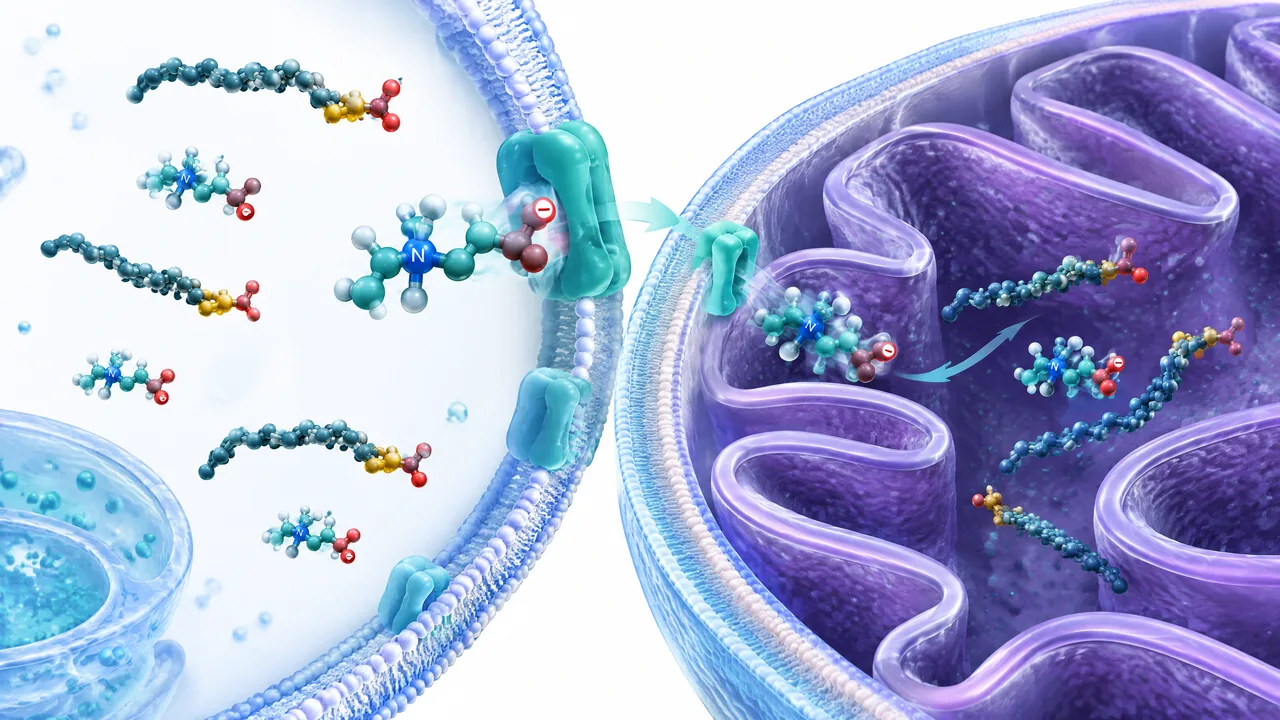
Levocarnitine acts as a carrier in the transport of long-chain fatty acids across the inner mitochondrial membrane, allowing fatty-acid substrate to reach oxidation pathways that contribute to energy production. This is a biochemical transport role; it does not by itself demonstrate that adding L-carnitine will increase fat loss, athletic capacity, or energy in a person whose carnitine status is normal. [2] [5]
In certain inborn metabolic disorders, acyl-CoA compounds can accumulate. The official label describes formation and urinary excretion of acylcarnitines as part of the rationale for treatment in defined secondary-deficiency settings. That disease-specific rationale is distinct from the much broader consumer claim that any fatigue or weight concern reflects low carnitine. [5] [6]
Model-specific finding: primary carnitine deficiency
Primary carnitine deficiency (PCD) is an inherited defect in cellular carnitine transport, not ordinary dietary low intake. In a hospital-based interventional study, eight adults with PCD who were all homozygous for the c.95A>G (p.N32S) variant completed exercise testing on treatment and after a four-day pause; 10 age- and sex-matched healthy people served as controls. During one hour of submaximal cycling, total fatty-acid oxidation was higher while the PCD participants were receiving L-carnitine than after the pause: 12.3 versus 8.5 micromol/kg/min (P=0.008). [4]
Even with treatment, total fatty-acid oxidation in that PCD group remained lower than in the healthy controls (29.5 micromol/kg/min). The study therefore supports a measured metabolic effect in this narrowly defined genetic disease model; it does not show restoration to normal, establish effects in all PCD genotypes, or justify extrapolation to healthy people. [4]
Human exercise evidence: a notable but narrow trial
A 2011 randomised, double-blind controlled trial enrolled 14 healthy, non-smoking, non-vegetarian recreationally trained men (seven per group). For 24 weeks, the intervention group consumed 2.0 g L-carnitine-L-tartrate with 80 g carbohydrate twice daily; controls consumed the carbohydrate drink alone. The co-intervention was substantial—about 160 g carbohydrate daily in both groups—so this was a test of that combined protocol, not a test of ordinary L-carnitine use in isolation. [3]
At 24 weeks, muscle total carnitine increased 21% in the carnitine group and not in controls. During the protocol's cycle tests, investigators reported lower glycogen use at the lower workload, lower muscle lactate at the higher workload, and an 11% increase from baseline in the 30-minute work-output test in the carnitine group. These are interesting measured findings, but the sample was very small, male-only, recreationally trained, and used biopsies plus an unusual long, carbohydrate-heavy regimen; it cannot establish a general performance effect or a consumer administration schedule. [3]
What broader human evidence can—and cannot—say
Outside diagnosed deficiency, the evidence does not support treating a plausible mechanism as a guaranteed outcome. The NIH Office of Dietary Supplements characterises findings for athletic performance as mixed. It highlights the 14-person trial above but also describes a 12-week study in 24 men that found no significant effect on VO2max, blood lactate, muscle energy metabolism, or physical performance, despite an increase in muscle carnitine stores among vegetarian participants. [2] [3]
This distinction matters for marketing language. ‘Supports fatty-acid transport’ is a biochemical statement. ‘Improves fitness’, ‘burns fat’, or ‘treats low energy’ are clinical or functional outcome claims that require relevant, adequately powered studies in the people and context being advertised. The available evidence includes meaningful clinical use in deficiency, but not a universal benefit across healthy populations. [2] [4] [5]
Safety, interactions and uncertainty
Oral levocarnitine labels report gastrointestinal complaints such as nausea, vomiting, abdominal cramps and diarrhoea, as well as body odour. They also report seizures in people with or without pre-existing seizure activity, and serious hypersensitivity reactions have been reported. These are safety signals from clinical and postmarketing sources, not evidence that every user will experience them. [5] [6]
The official label advises INR monitoring when levocarnitine is initiated or adjusted in people taking warfarin. In severe renal impairment or end-stage renal disease, chronic high-dose oral use can allow trimethylamine and trimethylamine-N-oxide metabolites to accumulate because renal excretion is impaired. The NIH fact sheet also notes that approximately 3 g/day of supplemental carnitine can cause gastrointestinal effects and fishy odour, while the clinical significance of microbiome-derived TMAO in this setting remains uncertain. [2] [5]
Australian regulatory context and the vial distinction
L-carnitine is not merely an investigational substance. The TGA ARTG includes Levocarnitine Oral Solution, USP 1 g/10 mL (ARTG 489926), with levocarnitine as the ingredient, ARTG date 26 May 2025, therapeutic-good type ‘Medicines’, licence category LI and status A. This establishes an active Australian ARTG entry for that named oral product; it is not a blanket finding that every L-carnitine product, route or health claim has been evaluated in the same way. [7]
The TGA explains that listed medicines are lower-risk products with low-risk ingredients and low-level indications, and are not assessed by the TGA before market entry in the way higher-risk medicines are. By contrast, official US prescription labels identify specific oral tablet and intravenous injection medicine products for defined carnitine-deficiency settings. An online supplier's ‘research-use’ vial is not made clinically equivalent merely because its label names L-carnitine; do not infer approved route, sterility, quality, indication or dosing from a research product listing. [5] [6] [7] [8]
A practical way to read an L-carnitine study
Start with the model. The PCD experiment involved eight adults sharing one disease-causing genotype and assessed fatty-acid oxidation after a short treatment interruption. The healthy-volunteer trial involved 14 recreationally trained men and a 24-week combination of L-carnitine-L-tartrate with large carbohydrate drinks. Neither answers whether an unrelated adult with tiredness, weight concerns or a different medical condition will have the same result. [3] [4]
Then separate a proximal measurement from a patient-important outcome. A higher muscle carnitine content or altered exercise substrate measure can be valuable mechanistic evidence, but it is not automatically evidence of fewer symptoms, better long-term health, or a reason to self-treat. Product-specific labelling and clinician assessment are particularly important where deficiency, kidney disease, seizure history, pregnancy, anticoagulants, or injectable products are involved. [2] [3] [5] [6]
Questions readers ask
Is L-carnitine a peptide?
No. L-carnitine (levocarnitine) is a chiral, quaternary-ammonium small molecule and an endogenous metabolite. Its molecular formula is C7H15NO3; it is not built from an amino-acid chain and is not a peptide or hormone. [1] [2]
Is L-carnitine an approved medicine in Australia?
A named levocarnitine oral solution has an active ARTG entry as a medicine with licence category LI. That is product-specific. The TGA distinguishes listed medicines from higher-risk medicines that it assesses for safety and efficacy before supply, so an ARTG entry should not be presented as universal approval of every L-carnitine dose, injection, seller or therapeutic claim. [7] [8]
Does L-carnitine reliably improve exercise performance or fat loss?
Not reliably on the evidence reviewed here. One 14-person, carbohydrate-co-supplemented trial found favourable exercise-test changes after 24 weeks, but broader performance findings are mixed and another study described by NIH found no significant performance effect. A mitochondrial transport mechanism is not proof of a universal fitness or fat-loss outcome. [2] [3]
Can a research vial be treated like a medical L-carnitine injection?
No. A labelled intravenous medicine is a specific prescription product with a defined route and regulated product information. A supplier vial labelled for research does not establish clinical-grade manufacture, sterility, route, indication, dose, storage or suitability for human administration. This article does not provide an injection or self-administration protocol. [5] [6]
Who should seek professional advice before using L-carnitine?
People with suspected carnitine deficiency or inherited metabolic disease need clinical assessment rather than self-diagnosis. Extra caution is warranted with kidney impairment or dialysis, seizure history, warfarin use, pregnancy or breastfeeding, and before considering any injectable product, because labels describe metabolite accumulation, seizure reports, INR interaction monitoring, and limited pregnancy/lactation evidence. [5] [6]
What remains uncertain
The strongest mechanistic and clinical evidence is contextual: inherited or secondary carnitine deficiency is not the same as non-specific tiredness, weight concerns or routine sporting use. The PCD exercise study had eight affected adults sharing one genotype, so it cannot represent all people with PCD or the general population. [4] [5] [6]
The headline healthy-volunteer study was only 14 men, split seven per group, and tested L-carnitine-L-tartrate together with 160 g carbohydrate per day for 24 weeks. Its muscle and cycle-test outcomes should not be converted into a stand-alone, universal supplement or administration protocol. [3]
Regulatory status and product quality are formulation- and jurisdiction-specific. The Australian ARTG record cited is for one oral solution; it neither validates online research vials nor proves every advertised indication, route, concentration or blended preparation. [7] [8]
References and further reading
- [1] (-)-Carnitine (L-carnitine; Levocarnitine), PubChem CID 10917. Curated compound identity record
- [2] Carnitine: Fact Sheet for Health Professionals. Authoritative evidence summary
- [3] Chronic oral ingestion of L-carnitine and carbohydrate increases muscle carnitine content and alters muscle fuel metabolism during exercise in humans. Randomised, double-blind, controlled human trial; 14 healthy recreationally trained men, 24 weeks
- [4] L-Carnitine Improves Skeletal Muscle Fat Oxidation in Primary Carnitine Deficiency. Human interventional exercise-metabolism study; eight adults with PCD and 10 matched controls, with a four-day treatment pause
- [5] Label: LEVOCARNITINE tablet. Regulatory product information
- [6] Label: LEVOCARNITINE injection. Regulatory product information
- [7] Levocarnitine Oral Solution, USP 1g/10ml (ARTG 489926). Official Australian regulator product record
- [8] Medicines. Official regulator guidance