
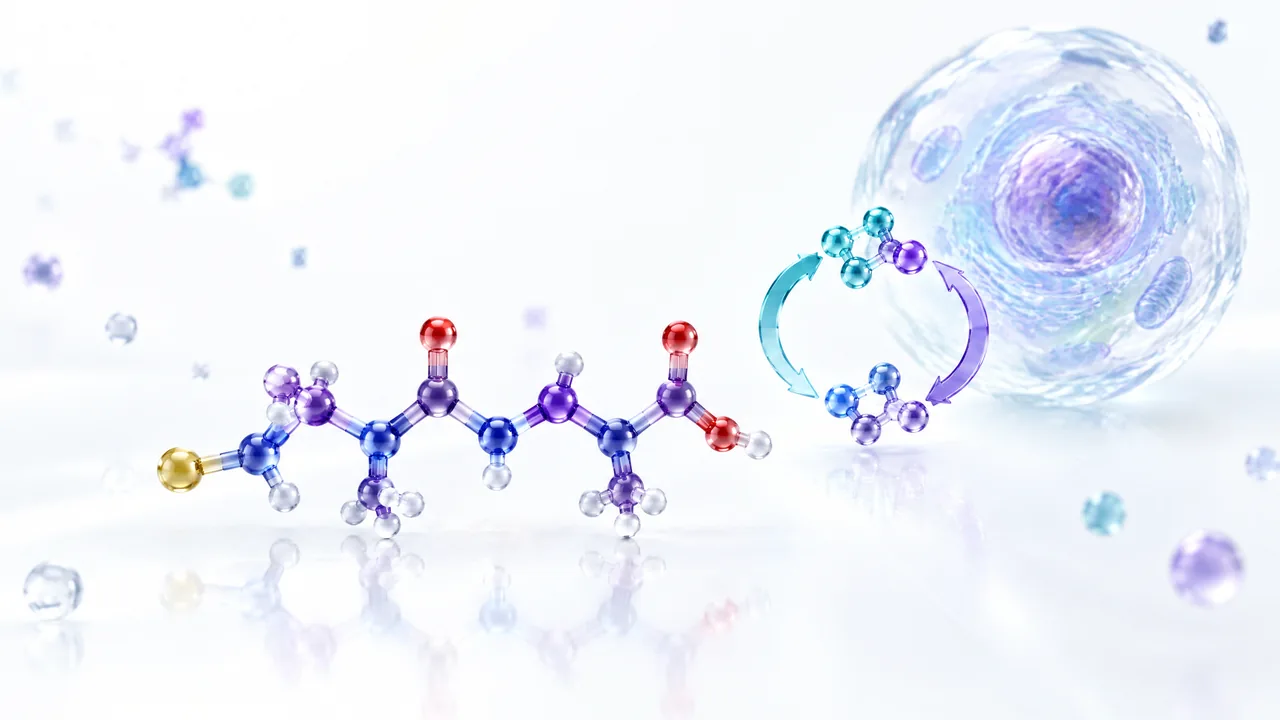
What is Glutathione?
Glutathione, usually abbreviated GSH in its reduced form, is an endogenous tripeptide made from glutamate, cysteine and glycine. It is a small endogenous redox molecule—not a peptide-drug receptor agonist, a hormone, or a research-only injectable. Commercial products can be oral complementary medicines, while an injectable vial is a distinct sterile-drug/compounding question (Sources 2, 5–7).
Glutathione is a genuine tripeptide made within cells and central to redox chemistry. Human oral studies show inconsistent changes in blood and cellular glutathione-related biomarkers, while clinical outcomes have not been established. Australian ARTG listing is formulation-specific and should not be read as broad clinical approval; dietary-supplement material and sterile injectables are not interchangeable (Sources 1–7).
What glutathione is—and is not
Reduced glutathione (GSH) is a low-molecular-weight, water-soluble tripeptide composed of cysteine, glutamate and glycine. Cells also contain oxidised glutathione (GSSG), a disulphide form. These are parts of an endogenous redox system, not evidence that adding glutathione treats every condition associated with ‘oxidative stress’. [2]
The word peptide can be technically correct here, but it can also mislead. Glutathione is not a therapeutic peptide engineered to activate a particular hormone or receptor pathway, and it is not a hormone. The evidence reviewed for supplementation concerns an endogenous tripeptide and measured biochemical or skin-pigment endpoints; it does not establish a general disease-treatment role. [1] [2] [4]
The molecular pathway: a recyclable redox pair
In the cellular redox cycle, GSH can be oxidised to GSSG while participating in reactions that limit reactive oxidant chemistry. Glutathione reductase then uses reducing power from NADPH to convert GSSG back toward GSH. X-ray structural work resolved electron flow from NADPH through the enzyme’s flavin and redox-active protein disulphide bridge to GSSG, which supports this specific recycling step. [2] [8]
This pathway explains why investigators measure reduced and oxidised glutathione or their ratio. It does not make the ratio a diagnosis by itself, nor does a rise in a blood or cell-compartment measurement prove improved health, longevity, immunity or detoxification in an individual. The human trials below mainly assessed such intermediate biomarkers rather than patient-centred clinical outcomes. [1] [2] [3]
Human oral evidence: formulation and study model matter
A six-month randomised, double-blind, placebo-controlled trial enrolled 54 healthy non-smoking adults and tested two oral GSH dose levels. At six months, the high-dose group had higher GSH concentrations in erythrocytes, plasma, lymphocytes and buccal cells, and both treatment groups had a lower whole-blood oxidised-to-reduced glutathione ratio. The study also reported higher natural-killer cytotoxicity at three months in the high-dose group. These are compartmental and immune-marker findings in healthy volunteers, not evidence of prevention or treatment of disease. [1]
A separate randomised, double-blind, placebo-controlled four-week study in 40 healthy adults found the opposite for its chosen endpoints: among 39 completers, oral GSH did not significantly change urinary F2-isoprostanes, urinary 8-hydroxy-2′-deoxyguanosine, erythrocyte GSH measures or the GSH:GSSG ratio versus placebo. Reported effects were generally mild, but the investigators stressed that findings in healthy adults do not generalise to people with acute or chronic illnesses. [2]
A third study examined a different formulation: liposomal GSH. It was a one-month pilot in only 12 healthy adults aged 50–80 years, randomised between two dose groups but without a placebo group. It reported maximum increases from baseline in whole-blood, erythrocyte, plasma and peripheral-blood-mononuclear-cell GSH, alongside changes in oxidative-stress and immune markers; no difference was detected between dose groups. Its small, mostly female sample and lack of a placebo comparator make it preliminary rather than confirmatory. [3]
What the skin-pigment study did—and did not show
One small, double-blind, placebo-controlled study randomised 60 otherwise healthy medical students to oral glutathione or placebo for four weeks and measured melanin indices at six sites. At week four, reductions were significantly greater with glutathione at two sites—the right face and sun-exposed left forearm—while both groups were reported as well tolerated. The authors specifically said long-term safety was not established. This short study is not a basis for assuming a lasting, uniform or clinically necessary skin-lightening effect. [4]
For readers, the important distinction is endpoint versus outcome: a device-measured melanin-index change at selected sites is not the same thing as a broad claim about complexion, dermatological benefit or safety with repeated use. Replication in larger, more diverse populations and longer follow-up would be needed to answer those questions. [4]
Safety, uncertainty and the special problem of injectable products
The oral trials were short or conducted in selected healthy volunteers, so their tolerability observations cannot establish safety for pregnancy, children, chronic disease, polypharmacy, prolonged use or intravenous administration. In the four-week placebo-controlled study, no serious or systematic adverse effects were reported; mild gastrointestinal symptoms, flushing and weight gain were recorded, but the study was too small and short to exclude uncommon or delayed harms. [2]
Do not treat a supplier vial, a dietary-supplement powder and a regulated sterile injectable as interchangeable. In a 2019 U.S. compounding alert, the FDA described reports involving patients given intravenous products containing L-glutathione made with material labelled as a dietary supplement. Testing found excessive bacterial endotoxin in samples; reported reactions included nausea, vomiting, chills, low blood pressure and breathing difficulty, and one patient was transferred to hospital. The alert concerns a specific quality failure, not proof that all glutathione causes those reactions, but it clearly demonstrates why route, sterility, endotoxin control and product provenance matter. [7]
The published oral studies do not validate an injection protocol, reconstitution method, storage rule, blend or administration schedule. A claimed ‘research’ or ‘wellness’ vial should therefore not inherit safety or effectiveness from oral supplementation papers. [1] [2] [3] [7]
Australian regulatory context: listing is product-specific
Australia’s ARTG contains a record titled “Glutathione” (ARTG ID 232323), sponsored by FIT-BioCeuticals Pty Ltd. The record identifies glutathione as the ingredient and gives licence category “LI” with active licence status. That is evidence of an ARTG-listed medicine record for that product; it is not a finding that every glutathione product, formulation, route or claim is authorised. [5]
The TGA explains that listed medicines are lower-risk, non-prescription products using low-risk ingredients and limited claims. They must be entered in the ARTG before supply, but are not individually assessed by the TGA before supply; the sponsor self-certifies compliance with applicable safety, quality and efficacy requirements and the TGA may conduct post-market checks. An ARTG listing should therefore not be described as equivalent to pre-market evaluation of a registered prescription medicine. [6]
For a real product, the relevant question is the exact ARTG entry, label, dosage form and permitted indication—not the ingredient name alone. This is particularly important when online marketing moves from oral complementary products to intravenous, compounded or research-supply claims that are not supported by the ARTG record above. [5] [6] [7]
Comparing formulations and related terms
“Glutathione” can refer to the endogenous molecule, reduced GSH in an oral capsule or liquid, oxidised GSSG measured in a laboratory, or GSH enclosed in a liposomal carrier. These are related but not interchangeable research models. The conventional oral trials and the small liposomal pilot differed in formulation, duration, comparators, participant age and endpoints, so their findings should not be pooled into a single universal expectation. [1] [2] [3]
It is also useful to separate a molecule from its proposed role. GSH is an endogenous tripeptide in cellular redox biochemistry; an oral supplement study asks whether a particular product changes selected markers; a sterile injection raises additional manufacturing and route-specific risks. None of these categories establishes a validated combined protocol with other antioxidants, vitamins or compounds. [2] [7] [8]
How to read a glutathione study without overreading it
Start with the model: were participants healthy adults, patients with a defined illness, or cells? Then identify the formulation and comparator. The strongest oral body-store study had placebo control and six months of follow-up, the null trial also had placebo control but only four weeks, and the liposomal study had 12 people and no placebo group. Different designs can produce different results without either paper being a universal answer. [1] [2] [3]
Next, ask what was actually measured. GSH concentration, GSH:GSSG ratio, isoprostanes, natural-killer cytotoxicity and melanin index are study endpoints. They may be biologically interesting, but they are not substitutes for evidence that a formulation improves symptoms, prevents disease or is safe over the long term. This is the central limitation of the current human supplementation literature. [1] [2] [3] [4]
Questions readers ask
Is glutathione actually a peptide?
Yes. GSH is an endogenous tripeptide made from cysteine, glutamate and glycine. It is not, however, a peptide hormone or a receptor-targeting peptide medicine. [2]
Do oral glutathione products reliably raise glutathione in the body?
Not reliably across all studies and formulations. A six-month placebo-controlled trial found increases in several measured compartments, whereas a four-week placebo-controlled trial found no significant change in erythrocyte glutathione status or oxidative-stress markers. A 12-person liposomal pilot reported increases from baseline but had no placebo group. [1] [2] [3]
Does glutathione treat ‘oxidative stress’ or disease?
The cited human supplementation trials primarily measured biomarkers in healthy volunteers. They do not establish treatment or prevention of disease, and a biomarker change should not be converted into a clinical-benefit claim. [1] [2] [3]
Does ARTG listing mean glutathione is an approved prescription medicine in Australia?
No. The ARTG has a listed medicine record for one glutathione product, while the TGA states listed medicines are not individually assessed before supply and rely on sponsor certification within a low-risk, limited-claim framework. The exact product record and label matter. [5] [6]
Can an oral supplement paper be used to justify injectable glutathione?
No. Oral studies do not establish sterility, endotoxin control, dose, preparation, route-specific safety or effectiveness for injectables. The FDA’s compounding alert illustrates the harm that can arise when dietary-supplement-grade material is used in sterile injectable products. [1] [2] [3] [7]
What remains uncertain
Human supplementation evidence is heterogeneous and dominated by small trials in healthy volunteers using different oral formulations, durations and biomarker endpoints (Sources 1–4). The liposomal study had only 12 participants and no placebo; the skin study lasted four weeks; no cited trial establishes a general clinical indication, injection regimen, blend protocol, or long-term safety. ARTG status is product-specific and a listed medicine is not individually pre-market assessed by the TGA (Sources 5–6).
References and further reading
- [1] Randomized controlled trial of oral glutathione supplementation on body stores of glutathione. Six-month randomised, double-blind, placebo-controlled trial in 54 healthy non-smoking adults; two oral GSH dose groups; body-compartment GSH measures and selected immune markers.
- [2] Effects of Oral Glutathione Supplementation on Systemic Oxidative Stress Biomarkers in Human Volunteers. Four-week randomised, double-blind, placebo-controlled trial in 40 healthy adults (39 completers), assessing urinary oxidative-stress markers and erythrocyte glutathione measures.
- [3] Oral supplementation with liposomal glutathione elevates body stores of glutathione and markers of immune function. One-month, two-dose pilot in 12 healthy adults aged 50–80 years; randomised between dose groups, with no placebo comparator.
- [4] Glutathione as an oral whitening agent: a randomized, double-blind, placebo-controlled study. Four-week randomised, double-blind, placebo-controlled trial in 60 otherwise healthy medical students, using melanin indices at six sites as the main outcome.
- [5] Glutathione (232323). Regulatory database record, not a clinical study.
- [6] Listed medicines. Regulatory guidance, not a clinical study.
- [7] FDA highlights concerns with using dietary ingredient glutathione to compound sterile injectables. Regulatory investigation and adverse-event report, not a controlled efficacy or safety trial.
- [8] The catalytic mechanism of glutathione reductase as derived from x-ray diffraction analyses of reaction intermediates.. X-ray crystallographic analysis of glutathione reductase reaction intermediates and binding partners.