What is GHK-Cu (copper tripeptide-1)?
GHK-Cu is a copper complex of the three-amino-acid peptide glycyl-L-histidyl-L-lysine (GHK). It is therefore a peptide–metal complex, not a hormone, and should not be confused with a generic copper supplement or an unspecified ‘copper peptide’ mixture. In cosmetic ingredient nomenclature it is listed as Copper Tripeptide-1. It has two very different product contexts: Copper Tripeptide-1 is listed by the European Commission’s cosmetic-ingredient database with a skin-conditioning function, while GHK-Cu products promoted for therapeutic purposes—especially injectable products—are treated as unapproved peptide products in Australian TGA safety advice. GHK-Cu is not an approved therapeutic medicine on the basis of the Australian regulator material reviewed here. The TGA specifically names GHK-Cu among examples of unapproved peptide products not included in the ARTG; that status is distinct from a cosmetic that is presented only with cosmetic claims.
GHK-Cu has biologically interesting, model-specific findings in fibroblast culture, rat wound chambers and a mouse scald model, plus an older placebo-controlled topical diabetic-ulcer study. Those results do not validate self-injection, systemic use, or a universal dosing protocol. Australia’s TGA identifies GHK-Cu-containing therapeutic peptide products as unapproved and warns that vial contents, sterility, adverse effects and effectiveness may be unknown. [Sources 1–6]
1. Identity: what the name does—and does not—mean
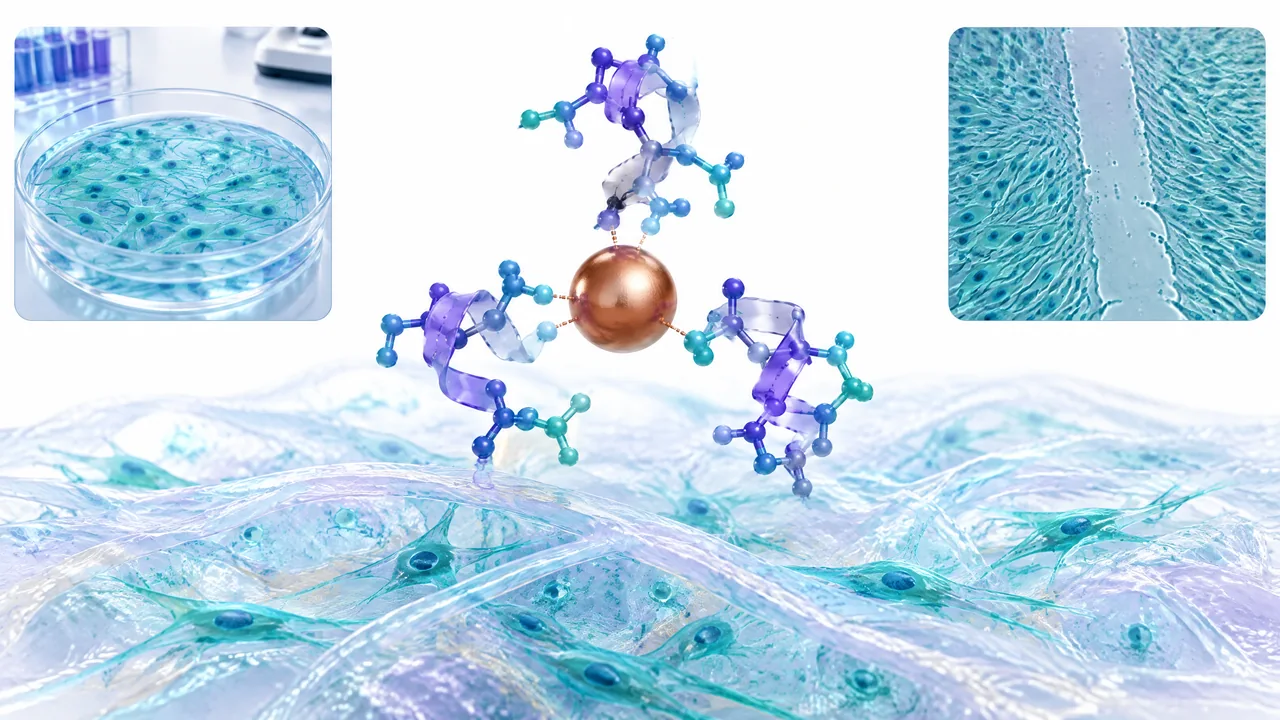
The shorthand GHK-Cu refers to glycyl-L-histidyl-L-lysine complexed with copper(II). The GHK portion is a tripeptide—three amino acids long—and the copper-bound complex, rather than free GHK alone, is the material tested in much of the wound-remodelling literature. In one fibroblast experiment, copper ions reproduced the MMP-2 response whereas GHK alone did not, a useful reminder that ‘GHK’ and ‘GHK-Cu’ are not interchangeable labels in an experiment. [1] [2]
The INCI name Copper Tripeptide-1 can appear on topical cosmetic ingredient lists, where the EU CosIng entry describes it as a copper complex of Tripeptide-1 and assigns the function ‘skin conditioning’. That cosmetic identity does not make a cream a medicine, nor does it establish that a powder or vial marketed online has the same identity, purity, concentration, vehicle or safety evaluation as a finished topical product. [6] [8]
2. Molecular pathway: a remodelling signal, not a proven anti-ageing pathway
The clearest direct cell-culture finding is that GHK-Cu increased MMP-2 in conditioned medium from dermal fibroblasts, increased MMP-2 mRNA, and increased secretion of TIMP-1 and TIMP-2. MMPs participate in extracellular-matrix breakdown and TIMPs constrain MMP activity, so the experiment supports an effect on measured remodelling-related markers in that cell system—not a simple claim that GHK-Cu ‘builds collagen’ in every tissue. [2]
In the rat wound-chamber study, local GHK-Cu exposure was followed by concentration-dependent increases in wound-chamber dry weight, DNA, total protein, collagen and glycosaminoglycans; type I and III collagen mRNAs increased, whereas TGF-beta mRNA did not. This is a credible experimental observation of matrix accumulation in an implanted rat model. It does not identify a single human receptor, prove a systemic mechanism, or show that more matrix is beneficial in every wound type. [1]
3. What the model-specific studies actually found
Two older primary studies illustrate why model labels matter. Maquart and colleagues implanted stainless-steel mesh wound chambers under the skin of rats and observed more extracellular-matrix components after sequential chamber injections of GHK-Cu than saline. Siméon and colleagues used cultured dermal fibroblasts and measured MMP-2 and TIMPs. Neither study is a clinical trial, and the rat-chamber injection or a dish of fibroblasts is not an administration instruction for people. [1] [2]
A 2017 study tested GHK-Cu packaged in liposomes, not simply GHK-Cu alone. The formulation increased proliferation of human umbilical-vein endothelial cells in vitro and, in a mouse scald model, was associated with stronger CD31 and Ki67 signals and wound healing by day 14; the liposomal product performed better than free GHK-Cu for the reported angiogenesis comparison. This supports further formulation- and species-specific research, but it cannot establish a human therapeutic effect or prove that angiogenesis explains every outcome. [3]
4. Human evidence: a historical topical ulcer trial, not evidence for injections
The most directly relevant human primary study located was a 1994 multicentre, randomised, evaluator-blinded, placebo-controlled study of a topical GHK-Cu gel for diabetic neuropathic plantar ulcers. Everyone also received structured wound care, including sharp debridement, pressure-relieving footwear and diabetes/activity education. The paper reported median area closure of 98.5% with the gel versus 60.8% with vehicle, and a lower reported infection incidence in immediately treated plantar ulcers (7% versus 34%). [4]
That is a signal from one older, topical, formulation-specific wound-care trial—not a finding about cosmetic facial products, oral use, or injected GHK-Cu. The accessible record does not turn the study gel into a currently approved medicine, and its results cannot be separated from the intensive co-interventions to create a self-treatment protocol. Diabetic foot ulcers require clinical assessment and evidence-based wound care; they are not an appropriate setting to substitute an online peptide vial. [4] [6]
5. Topical delivery research is not the same as systemic exposure
A separate laboratory study used isolated human skin in flow-through diffusion cells for 48 hours. With a 0.68% aqueous copper-tripeptide preparation, the investigators measured copper in tissue and receptor fluid, reporting both permeation through dermatomed skin and retention in skin. This establishes that the tested preparation could move into and across ex-vivo skin under those experimental conditions. [5]
Ex-vivo penetration should not be read as proof of clinical efficacy, safety in damaged skin, or predictable whole-body exposure. It also cannot be transferred to another vehicle: the mouse scald experiment used liposomes, while the human-skin diffusion experiment used an aqueous copper-tripeptide preparation. Vehicle, skin condition, dose surface area and study endpoint all change what a result means. [3] [5]
6. Risks and uncertainty: the vial is part of the risk question
There is no validated general human schedule, dilution method, storage rule or route for GHK-Cu supplied as a research vial. The TGA says unapproved peptide products have not been assessed for safety, quality or effectiveness and that important information may be unknown, including manufacturing standards, sterility of injectables, actual ingredients, human effects and adverse-effect frequency. Those uncertainties are particularly important when a product arrives as an unlabelled powder or injection. [6] [9]
The TGA and Australia’s Chief Medical Officer report serious adverse effects associated with the broader category of unapproved peptides, including liver damage, severe allergic reactions requiring hospitalisation and inflammatory complications. The regulator does not attribute each event to GHK-Cu specifically, so this is a product-category safety warning rather than a quantified GHK-Cu adverse-event rate. It is nevertheless a reason not to infer safety from cosmetic marketing or from preclinical studies. [9]
7. Australian regulatory context: topical cosmetic claim versus therapeutic product
In Australia, classification depends on claims, composition and how a product is administered or used. The TGA explains that a product presented for therapeutic purposes generally must be entered in the ARTG before import, supply or advertising unless a specified exception applies. A topical product that only makes appearance-oriented cosmetic claims is assessed differently from one claiming to repair disease, alter an underlying physiological process or treat a wound. [7]
For GHK-Cu specifically, the TGA’s 2026 safety advisory lists GHK-Cu among unapproved peptide products, often supplied as injectables. It also states that a ‘research use only’ disclaimer does not change regulatory status, permit importation, or remove supply and advertising obligations. A cosmetic ingredient listing therefore must not be used as evidence that a research-only vial is an approved injectable medicine. [6] [8]
8. How to read a GHK-Cu claim critically
First identify the exact material and formulation: free GHK, GHK-Cu, a copper salt, and liposomal GHK-Cu are different experimental interventions. Then identify the model: fibroblast cultures can test molecular responses; isolated skin can test penetration; rodents can test a specific injury model; and a controlled human trial can test only the product, population and endpoint it studied. Moving across those categories is an inference, not a demonstrated result. [1] [2] [3] [5]
Second, separate an endpoint from a promise. Increased MMP-2/TIMP measurements in fibroblasts and higher matrix measures in rat chambers are observations, while closure of diabetic ulcers was the clinical endpoint in one historical topical trial. None of those results validates claims that injected GHK-Cu reverses ageing, regrows hair, improves athletic recovery or safely treats a disease. Evidence should be assessed formulation by formulation and claim by claim. [1] [2] [4] [6]
Questions readers ask
Is GHK-Cu a peptide?
Yes, in the relevant chemical sense: it is a copper complex of the tripeptide glycyl-L-histidyl-L-lysine. It is not a glycoprotein hormone, and its copper-bound form should not be assumed to behave like free GHK. [1] [2] [8]
Is GHK-Cu an approved medicine in Australia?
The TGA identifies GHK-Cu-containing therapeutic peptide products as examples of unapproved products not included in the ARTG. That differs from the possible cosmetic use of Copper Tripeptide-1 in a topical product presented only with cosmetic claims. [6] [7] [8]
Does the evidence support injecting GHK-Cu?
No. The primary studies located include cell, animal, ex-vivo skin and topical human research; they do not validate self-injection or provide an approved injection regimen. The TGA highlights sterility, contamination, labelling and unknown safety risks for unapproved injectable peptides. [1] [2] [3] [4] [5] [6]
Was GHK-Cu ever studied in people with wounds?
Yes. A 1994 multicentre randomised, evaluator-blinded, placebo-controlled study tested a topical GHK-Cu gel alongside intensive standard care in diabetic neuropathic plantar ulcers and reported greater closure than vehicle. It is an older, formulation-specific trial and is not a basis for substituting unapproved products for clinical wound care. [4] [6]
Does a cosmetic Copper Tripeptide-1 serum have the same evidence as a research vial?
No. A finished cosmetic and a research-only vial can differ in identity confirmation, vehicle, concentration, manufacturing controls, route and intended claim. The TGA says that ‘research use only’ wording by itself does not alter a therapeutic product’s regulatory status or establish lawful supply. [6] [8]
What remains uncertain
The mechanistic evidence is dominated by cultured fibroblasts, isolated skin and animal models; these experiments cannot establish efficacy, safety or a route of use in people. [1] [2] [3] [5]
The human therapeutic evidence identified here is an older topical diabetic-ulcer trial conducted with one gel and substantial co-interventions; it cannot be generalised to cosmetic serums, another formulation, injection or unrelated conditions. [4]
The TGA’s warnings concern unapproved peptide products as a category. They establish regulatory and product-quality uncertainty, but they should not be misrepresented as a quantified, GHK-Cu-specific safety profile. [6] [9]
No source reviewed supports a universal dilution, storage method, administration schedule or combined ‘peptide blend’ protocol for GHK-Cu. [6] [9]
References and further reading
- [1] In vivo stimulation of connective tissue accumulation by the tripeptide-copper complex glycyl-L-histidyl-L-lysine-Cu2+ in rat experimental wounds. Rat subcutaneous stainless-steel wound-chamber experiment; sequential GHK-Cu versus saline injections at various concentrations, with biochemical and mRNA measurements of chamber contents.
- [2] The tripeptide-copper complex glycyl-L-histidyl-L-lysine-Cu2+ stimulates matrix metalloproteinase-2 expression by fibroblast cultures. Dermal fibroblast culture experiment measuring MMP-2, MMP-2 mRNA, TIMP-1 and TIMP-2 after exposure to GHK-Cu and comparator conditions.
- [3] GHK-Cu-liposomes accelerate scald wound healing in mice by promoting cell proliferation and angiogenesis. Nanoscale GHK-Cu liposomes were studied in human umbilical-vein endothelial cells and a mouse scald-wound model, with proliferation, protein-marker and wound-healing assessments.
- [4] Enhanced healing of ulcers in patients with diabetes by topical treatment with glycyl-L-histidyl-L-lysine copper. Multicentre, randomised, evaluator-blinded, placebo-controlled study of a topical GHK-Cu gel for diabetic neuropathic ulcers, with standardised wound care in all participants.
- [5] Human skin penetration of a copper tripeptide in vitro as a function of skin layer. Flow-through diffusion-cell study of a 0.68% aqueous copper-tripeptide preparation on isolated human stratum corneum, epidermis and dermatomed skin over 48 hours.
- [6] Understanding your responsibilities when importing, compounding and supplying unapproved peptide products. TGA regulatory and safety guidance for unapproved peptide products, published 13 April 2026.
- [7] Determining if your product is a cosmetic or therapeutic good. TGA classification guidance based on claims, composition and administration/use.
- [8] Ingredient: COPPER TRIPEPTIDE-1. European Commission CosIng ingredient record.
- [9] Concerns regarding the public health risks associated with unapproved peptide products. Australian regulator public-health statement, published 19 June 2026, drawing on reports received and state/territory hospitalisation data for unapproved peptides as a category.