
What is FOXO4-DRI?
FOXO4-DRI is an investigational synthetic, cell-penetrating D-retro-inverso peptide designed to interfere with the FOXO4–p53 protein interaction. It is a research-stage senolytic candidate, not an approved medicine, hormone, topical cosmetic ingredient, or a standardised consumer supplement. Research supplier vials are not approved pharmaceutical formulations.
FOXO4-DRI is a laboratory-engineered peptide being studied as a way to make some senescent cells undergo apoptosis. Its molecular interaction with p53 has been measured, and experiments have reported effects in cell culture and mice. Those findings do not establish a safe dose, a therapeutic benefit or regulatory approval for people.
What FOXO4-DRI is — and is not
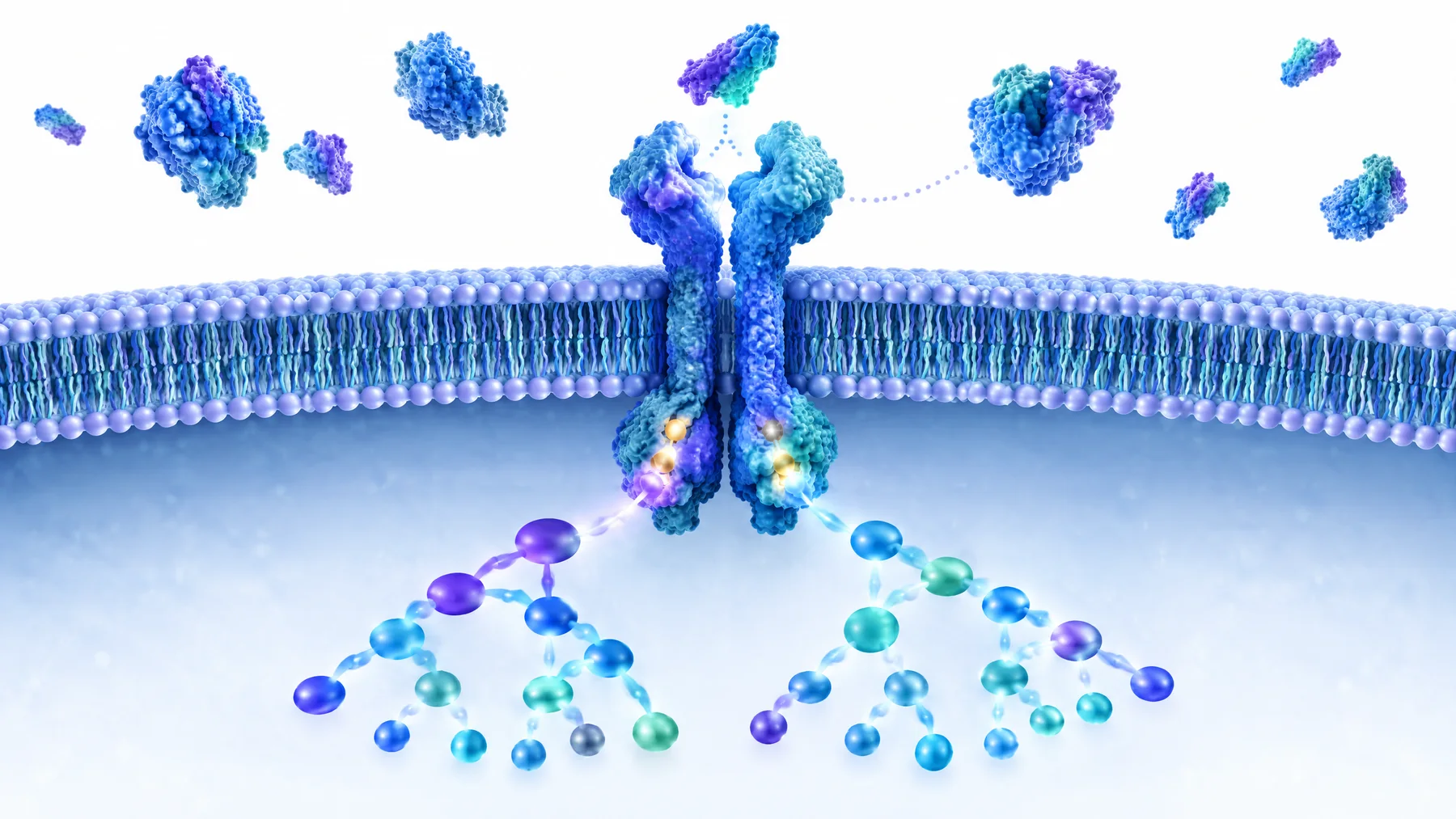
FOXO4-DRI is a synthetic peptide antagonist rather than the FOXO4 protein itself. “DRI” refers to a D-retro-inverso design: the peptide uses D-amino acids in reverse sequence orientation to mimic a FOXO4 interaction surface. The construct also includes a cationic HIV-TAT-derived cell-penetrating segment; this segment contributes to p53 contacts as well as cellular uptake in later biophysical work. [1] [2]
The appropriate category is **preclinical research peptide / investigational senolytic candidate**. It is not a naturally occurring hormone, and it is not an approved formulation simply because a supplier sells a vial marked “research use”. The foundational work used a defined research material, whereas a commercial research vial is not evidence of pharmaceutical quality, clinical safety or legal therapeutic supply. [1] [7]
The molecular pathway being tested
FOXO4 is a transcription factor. In the 2017 founding study, FOXO4 expression rose in ionising-radiation-induced senescent human IMR90 fibroblasts, and FOXO4 suppression reduced viability of the senescent cells while sparing the compared proliferating cells. The investigators therefore designed a peptide to interfere with the FOXO4–p53 interaction rather than attempting to administer FOXO4 itself. [1]
A 2025 NMR, calorimetry and cell-pull-down study directly mapped FOXO4-DRI binding principally to p53’s N-terminal transactivation-domain 2 (TAD2). It found that FOXO4-DRI competes with the FOXO4 forkhead domain for this interaction. This establishes a molecular binding mechanism, but it does not by itself establish selective benefit or safety in an organ or a person. [2]
In senescent-cell experiments, disrupting the interaction was associated with nuclear exclusion of active p53 and caspase-dependent apoptosis. That is a demonstrated observation in the studied senescent models, not proof that every p16- or β-galactosidase-positive cell in every disease will respond in the same way. p53 is a central regulator of cellular stress responses, growth arrest and apoptosis, which makes target selectivity a material translational question. [1] [2]
What the founding mouse and cell studies found
Baar and colleagues tested FOXO4-DRI in irradiated and doxorubicin-senescent cell systems, then in several mouse contexts. Their report described reduced senescence-related measures after doxorubicin exposure and improvements in selected fitness, fur-density and renal-function measures in DNA-repair-deficient XpdTTD/TTD mice and naturally aged mice. These are animal-model outcomes, not demonstrations that the peptide reverses human ageing or treats an age-related disease. [1]
The same paper described the peptide as well tolerated under its experimental conditions. That wording is necessarily narrow: the study did not supply a human pharmacokinetic programme, dose-ranging safety trial, long-term toxicology package or a clinically validated adverse-effect profile. Animal injection regimens reported in a paper are model methods, not human administration instructions. [1]
Findings depend on the model
In a study of naturally aged male mice (20–24 months), FOXO4-DRI was associated with higher serum testosterone and changes in testicular senescence and inflammatory-marker measures compared with vehicle controls. The authors explicitly noted that they lacked direct evidence that the peptide eliminated senescent Leydig cells in the aged mice, and they did not assess possible muscle or cardiac toxicity. The result is therefore a hypothesis-generating mouse finding, not evidence for treatment of late-onset hypogonadism in men. [3]
A separate bleomycin-induced pulmonary-fibrosis experiment used young male C57BL/6J mice. FOXO4-DRI-treated animals had lower collagen-related and senescence-associated readouts than bleomycin controls, while TGF-β-stimulated fibroblast experiments suggested greater sensitivity of myofibroblast-like cells than comparison fibroblasts. Bleomycin lung injury is a model rather than idiopathic pulmonary fibrosis in people, and the article has a published correction notice; neither the model result nor comparison with pirfenidone is a clinical head-to-head trial. [5]
Human cells are not human clinical evidence
The closest human-tissue evidence located was an ex vivo study of articular chondrocytes from non-osteoarthritic donors. Cells expanded to population-doubling level 9, a culture model with more senescence markers than early-passage cells, were treated in the laboratory. FOXO4-DRI removed more than half of those late-passage cells and reduced senescence measures, without a significant loss of the early-passage comparison cells. [4]
Importantly, removing those cells did **not** improve chondrogenic potential in the study’s pellet-culture assay. The authors also identified limited senolytics and unoptimised test conditions as limitations. This illustrates why an apparent selective cell-killing result cannot be assumed to restore tissue function, and why donor-cell experiments are not evidence of efficacy, dosing or safety in patients. [4]
A ClinicalTrials.gov API query for “FOXO4-DRI” returned no studies when checked for this record. That does not prove that no study could ever exist in another registry or under a different development code, but it means this review found no registered human trial there and no human efficacy or safety dataset to support clinical use. [6]
Risks and major unknowns
“Senolytic” does not mean harmless. FOXO4-DRI is intended to alter a p53 interaction and induce apoptosis in selected experimental settings. p53 has broad roles in stress responses, DNA-damage handling, growth arrest and cell death, so the boundary between desired target-cell elimination and unwanted tissue effects must be demonstrated rather than presumed. [1] [2]
Human bioavailability, tissue distribution, metabolism, persistence, immunogenicity, interactions, dose-limiting toxicities and long-term effects are not established by the available mouse and cell studies. The aged-mouse Leydig-cell authors specifically raised tissue-sensitivity and possible muscle/cardiac-safety concerns that their work could not address. There is no validated self-administration, dilution, storage or combination protocol. [1] [3] [4] [5]
Australian regulatory context
The Therapeutic Goods Administration (TGA) describes the Australian Register of Therapeutic Goods (ARTG) as the public reference database for therapeutic goods that can be supplied in Australia; unless an exemption applies, goods not in the ARTG cannot be supplied. No FOXO4-DRI ARTG medicine entry or TGA product information/consumer medicine information was identified in the public-register check for this review. It should therefore not be described as a TGA-approved medicine. [7]
TGA information also notes that special circumstances can exist for access to unapproved therapeutic goods. Such a pathway is not the same as ARTG registration, a product indication, a quality-assured retail formulation or evidence that a research peptide is appropriate for self-use. Regulatory status and clinical evidence must be assessed separately. [7]
How it compares with related research
FOXO4-DRI is distinct from a conventional replacement hormone or a simple antioxidant: it is a protein–protein-interaction peptide intended to interfere with a FOXO4–p53 survival mechanism in certain stressed or senescent cell models. It is also distinct from pirfenidone, which served only as a comparator in one mouse fibrosis experiment. A comparator arm in a non-human model does not make the two agents interchangeable or show that FOXO4-DRI works for pulmonary fibrosis in people. [1] [2] [5]
The published record supports a narrower conclusion than many “anti-ageing” claims: there is a biologically characterised research candidate with model-specific preclinical signals. It does not support a general rejuvenation claim, an approved indication, a universal route or schedule, or combining it with other experimental substances. [1] [3] [4] [6] [7]
A practical way to read FOXO4-DRI studies
First identify the model: irradiated fibroblasts, serially expanded chondrocytes, an aged mouse testis and bleomycin-injured lung are not interchangeable. Then separate direct measurements—such as peptide–p53 binding, cell viability, caspase activation or serum testosterone—from authors’ proposed downstream explanations. The Leydig-cell paper, for example, reported hormone and tissue-marker changes but acknowledged that direct clearance of senescent Leydig cells in aged mice was not shown. [2] [3]
Finally, give functional outcomes more weight than a single senescence marker. In the human chondrocyte experiment, fewer late-passage senescence-associated cells did not translate into better cartilage formation. Replication across relevant models, formal toxicology, pharmacology, manufacturing controls and controlled human trials would all be needed before any therapeutic conclusion. [4] [6]
Questions readers ask
Is FOXO4-DRI an approved medicine in Australia?
No FOXO4-DRI medicine entry or TGA product information was identified in the public ARTG check for this review. The TGA says the ARTG is the reference database for therapeutic goods that can be supplied in Australia, subject to limited exemptions and unapproved-access arrangements. FOXO4-DRI should not be represented as TGA approved. [7]
Has FOXO4-DRI been tested in people?
This review found no registered FOXO4-DRI study in the ClinicalTrials.gov API query and found no human clinical efficacy or safety study among the primary literature reviewed. The human chondrocyte paper used donor cells in the laboratory, not participants receiving the peptide. [4] [6]
Does the chondrocyte study prove it can regenerate cartilage?
No. FOXO4-DRI reduced senescence-associated cells in extensively expanded human chondrocyte cultures, but pretreatment did not improve the cells’ cartilage-forming potential in the pellet-culture experiment. That is a useful negative functional result, not evidence of cartilage repair in patients. [4]
Can animal-study injection details be used as a human protocol?
No. Animal study methods are used to test a hypothesis in a particular model. FOXO4-DRI lacks the human pharmacokinetic, dose-finding, safety and efficacy evidence needed to derive a human administration schedule, and no validated self-use or combination protocol exists. [1] [3] [5] [6]
What remains uncertain
The evidence base is preclinical and heterogeneous. The strongest studies establish molecular interaction and effects in selected cell and mouse models, but they do not establish human pharmacokinetics, manufacturing quality, dosing, safety, long-term outcomes or efficacy for any disease. A ClinicalTrials.gov query is not a complete global trial search, and an ARTG public-register check should not be read as legal advice or as a substitute for a formal TGA status determination. The pulmonary-fibrosis paper carries a correction notice.
References and further reading
- [1] Targeted Apoptosis of Senescent Cells Restores Tissue Homeostasis in Response to Chemotoxicity and Aging. Mechanistic cell-culture experiments, including senescent human IMR90 fibroblasts, plus doxorubicin-exposed, DNA-repair-deficient XpdTTD/TTD and naturally aged mouse experiments.
- [2] The disordered p53 transactivation domain is the target of FOXO4 and the senolytic compound FOXO4-DRI. Solution NMR, isothermal titration calorimetry, pull-down and modelling experiments using FOXO4, p53 fragments and FOXO4-DRI.
- [3] FOXO4-DRI alleviates age-related testosterone secretion insufficiency by targeting senescent Leydig cells in aged mice. Hydrogen-peroxide-induced senescent TM3 Leydig-cell experiments and naturally aged male mouse study with testicular and serum outcomes.
- [4] Senolytic Peptide FOXO4-DRI Selectively Removes Senescent Cells From in vitro Expanded Human Chondrocytes. Human articular chondrocytes from non-osteoarthritic donors expanded in vitro, treated in culture and assessed in pellet culture.
- [5] FOXO4 peptide targets myofibroblast ameliorates bleomycin-induced pulmonary fibrosis in mice through ECM-receptor interaction pathway. Bleomycin-induced lung injury/fibrosis in young male C57BL/6J mice, with fibroblast and myofibroblast cell-culture experiments.
- [6] ClinicalTrials.gov API search: FOXO4-DRI. Registry search query; the returned studies array was empty when checked for this review.
- [7] Searching the Australian Register of Therapeutic Goods (ARTG). TGA explanation of the ARTG, exemptions and unapproved-therapeutic-goods access context.