
What is Cagrilintide?
A synthetic, lipidated, long-acting peptide analogue of amylin (islet amyloid polypeptide). It is an investigational human medicine candidate, not an approved Australian medicine, not a topical ingredient, and not a native hormone. Cagrilintide itself is a single active substance; CagriSema is the distinct investigational fixed combination of cagrilintide with semaglutide.
Cagrilintide is a long-acting amylin analogue being studied for obesity and type 2 diabetes, alone and in the fixed combination CagriSema with semaglutide. It has credible randomised human trial evidence, but it remains investigational in Australia. Trial results, particularly for CagriSema, must not be treated as directions for a supplier vial or as proof that an unregistered product has the trial medicine’s identity, quality or safety profile.
What cagrilintide is — and is not
Cagrilintide is a synthetic peptide medicine candidate modelled on amylin, a peptide hormone released from pancreatic beta cells with insulin after meals. It was engineered to be stable and lipidated for prolonged action; it is therefore genuinely a peptide analogue, rather than a small molecule or a dietary supplement. The development paper describes it as a long-acting amylin analogue selected for clinical development in obesity. [1]
The name has been used for the development compound NNC0174-0833 in trials. It should not be confused with semaglutide, which is a GLP-1 receptor agonist, or with CagriSema, the investigational fixed combination of cagrilintide and semaglutide. A commercial-looking ‘cagrilintide’ vial sold online is not thereby the trial product, an approved formulation, or evidence that its contents, concentration, sterility and stability were assessed in the published studies. [1] [8] [10] [11]
Molecular pathway: an amylin-receptor approach
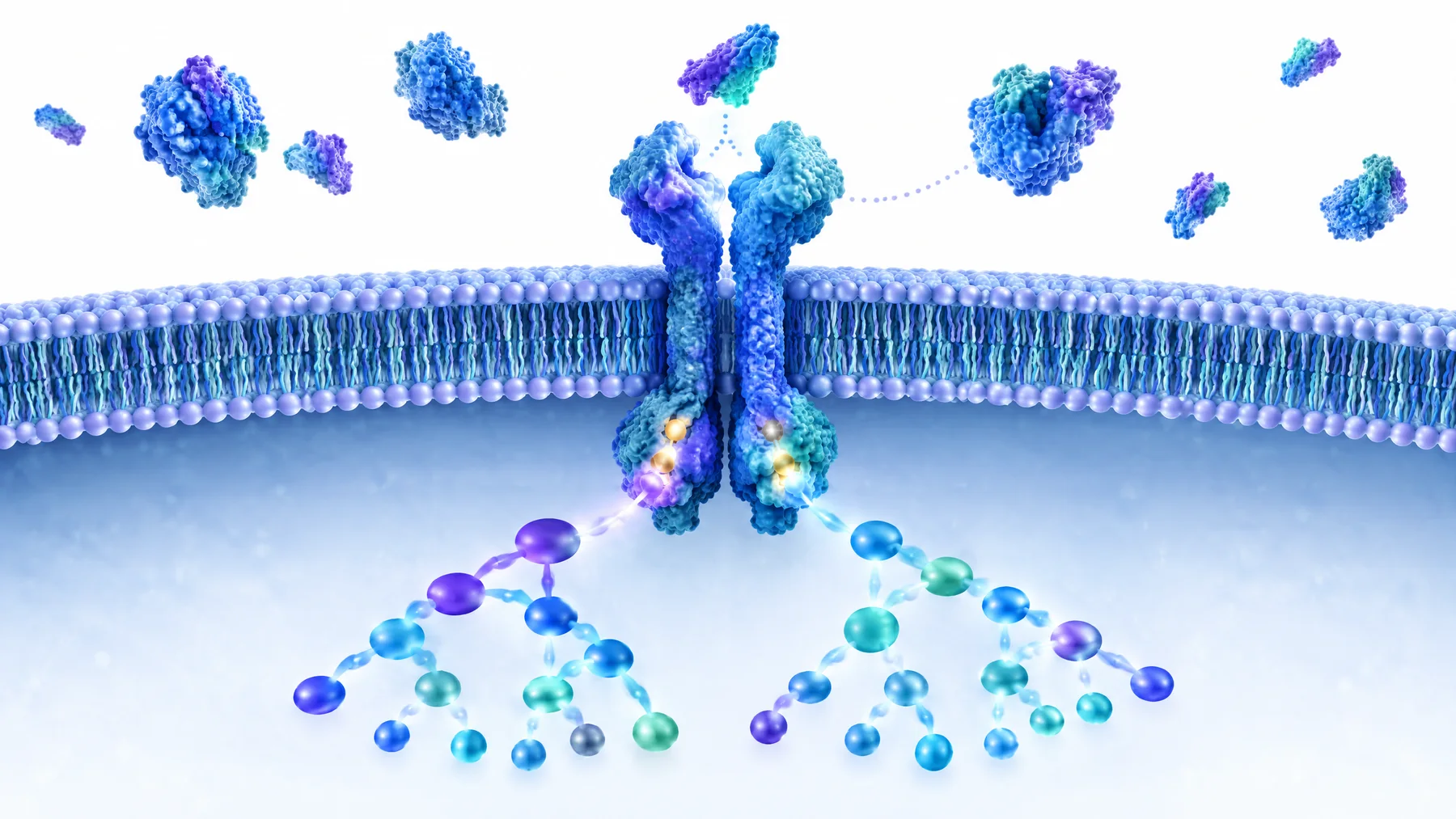
Amylin receptors are complexes involving a calcitonin receptor and receptor activity-modifying proteins (RAMPs). In cellular and animal work, cagrilintide shows activity at amylin and calcitonin-family receptors. This pharmacology is consistent with an amylin-analogue strategy, but receptor signalling observed in cells or mice does not by itself establish the precise pathway responsible for weight change in people. [1] [3]
The biological rationale is appetite and energy-balance signalling rather than a direct ‘fat-burning’ action. Endogenous amylin acts in brain regions involved in satiety; human trials show changes in body weight, but they did not directly prove that one specific brain receptor subtype caused those outcomes in participants. That distinction matters when reading mechanistic claims online. [2] [3]
What the receptor mouse model found
A 2025 preclinical study tested cagrilintide in male wild-type and RAMP1/3-knockout mice fed a high-fat diet. During three weeks of daily treatment, wild-type mice given cagrilintide lost 3.4 ± 0.51 g (n=8 per group), and the knockout reduced cagrilintide’s weight-loss potency. Food intake fell early in treatment in wild-type mice, and neuronal activation was seen in hindbrain regions. This is useful receptor-dependency evidence in a defined mouse model. [3]
It is not a human dosing study. The experiment used male mice, genetic receptor deletion, a high-fat-diet model and daily subcutaneous experimental treatment. The authors also note that brain gene-expression samples were taken after active weight loss had subsided and that there were no weight-matched groups, limiting separation of drug effects from effects of weight loss itself. These results should not be converted into claims about a proven human brain pathway. [3]
Human evidence for cagrilintide alone
The key monotherapy study was a multicentre, randomised, double-blind phase 2 dose-finding trial in 706 adults without diabetes who had overweight or obesity. Participants received study cagrilintide, placebo or liraglutide alongside trial lifestyle support for 26 weeks. This is meaningful human evidence, but it is a medium-term phase 2 trial rather than an Australian product label. [2] [8]
Under the trial-product estimand, mean weight change at week 26 ranged from −6.0% to −10.8% across cagrilintide dose groups, compared with −3.0% for placebo. The 4.5-mg cagrilintide group had a mean reduction of 10.8% versus 9.0% with liraglutide 3.0 mg. Those are group averages under protocol-defined trial conditions, not a prediction for an individual and not a validated self-administration schedule. [2]
Combination evidence is not monotherapy evidence
CagriSema combines cagrilintide with semaglutide, so its results answer a different question. In a 2021 phase 1b study of 95 exposed adults, adding cagrilintide to semaglutide 2.4 mg was assessed mainly for safety, pharmacokinetics and pharmacodynamics. The small, single-centre study reported greater mean weight reduction in several cagrilintide-plus-semaglutide groups than in the matched semaglutide-plus-placebo groups, while calling for larger and longer trials. [4]
In a 32-week phase 2 trial of 92 adults with type 2 diabetes, CagriSema produced greater mean weight change than either cagrilintide or semaglutide alone (−15.6%, −8.1% and −5.1%, respectively). In the much larger 68-week REDEFINE 1 obesity trial, cagrilintide–semaglutide produced a mean −20.4% body-weight change versus −3.0% with placebo. These findings support investigation of the fixed combination; they do not establish that cagrilintide alone produces the combination’s results. [5] [6]
A separate 68-week phase 3 diabetes trial, REIMAGINE 2, compared fixed cagrilintide–semaglutide with each component and placebo. Its primary outcome was HbA1c: the 2.4-mg/2.4-mg combination reduced HbA1c more than semaglutide 2.4 mg, by an estimated additional 0.16 percentage points. It reinforces that combination evidence belongs to the combination, not to improvised mixtures of separately sourced substances. [7]
Adverse effects and unanswered safety questions
Gastrointestinal adverse events were the most frequent issue in the phase 2 monotherapy study. Across cagrilintide groups, 41–63% reported gastrointestinal events versus 32% with placebo; nausea occurred in 20–47% versus 18%, and constipation, diarrhoea and injection-site reactions were also reported. About 10% of all randomised participants permanently stopped treatment, most often because of adverse events. [2]
Gastrointestinal events were also common in CagriSema research. In REDEFINE 1, they affected 79.6% in the combination group and 39.9% with placebo, were mostly transient and mild-to-moderate, and included nausea, vomiting, diarrhoea, constipation and abdominal pain. ‘Mostly mild-to-moderate’ does not mean risk-free, and trial adverse-event rates cannot verify the safety of an unregulated vial. [6] [10] [11]
Important gaps remain: the 26-week monotherapy study excluded diabetes, while later, larger studies concentrate substantially on the cagrilintide–semaglutide combination. Long-term outcomes, uncommon harms, outcomes after stopping treatment and applicability to people with different medical histories require the completed evidence base and regulator assessment. Sponsor involvement was substantial across the development studies, which is relevant context rather than a reason to discard the randomised data. [2] [4] [5] [6] [7]
Australian regulatory context and online supply
Cagrilintide should be treated as an investigational candidate in Australia, not as an approved medicine with an Australian dosing or storage label. At the time of this review, no cagrilintide entry, Product Information or Consumer Medicine Information was identified in the publicly accessible ARTG resources. The ARTG is the TGA reference database for therapeutic goods that can be supplied in Australia; unless an exemption applies, therapeutic goods not in it cannot be supplied. [9]
The TGA warns that imported, unregistered products promoted online with GLP-1 claims may be fake, may contain undisclosed ingredients and may not meet Australian standards for quality, safety or efficacy. In 2026, TGA testing found no GLP-1 or GLP-1 analogue in several products that claimed to contain them. Those alerts concern GLP-1-labelled products rather than cagrilintide specifically, but they are a directly relevant warning against assuming that online weight-loss vials match a medicine tested in clinical trials. [10] [11]
How to read cagrilintide claims responsibly
First ask whether a claim is about cagrilintide alone, CagriSema, or an unrelated seller-made blend. Only the first has monotherapy data; the second has a specific trialled combination and formulation; the third has no validated combined protocol simply because it shares ingredients or a marketing term. A phase, population, comparator, duration and estimand can materially change what a result means. [2] [4] [5] [6] [7]
Pramlintide is a useful scientific comparator because it is another amylin analogue and is commercially available as an adjunct to insulin therapy for diabetes. It is nevertheless a different molecule with a different approved use and injection frequency; its availability does not confer approval on cagrilintide. Semaglutide has its own regulated products, but that does not make a cagrilintide–semaglutide combination approved or make separate vials equivalent to a trial formulation. [1] [9]
Questions readers ask
Is cagrilintide an approved medicine in Australia?
No approved cagrilintide ARTG product or Australian product information was identified in this review. Cagrilintide has human trial evidence but should be described as investigational in Australia. The ARTG is the TGA’s public reference database for therapeutic goods that can be supplied in Australia, subject to limited exemptions and access pathways. [9]
Is cagrilintide a peptide or a hormone?
It is a synthetic peptide analogue of amylin. Amylin is a pancreatic peptide hormone; cagrilintide is not the native hormone but an engineered, lipidated, long-acting analogue. [1] [3]
What did the cagrilintide-alone trial show?
In a 26-week phase 2 trial of adults without diabetes and with overweight or obesity, mean weight change with cagrilintide ranged from −6.0% to −10.8%, versus −3.0% with placebo under the trial-product estimand. It was not a product label, did not establish long-term outcomes, and cannot tell an individual what outcome to expect. [2]
Does CagriSema evidence prove a result for cagrilintide alone?
No. CagriSema is cagrilintide plus semaglutide. The combination outperformed its components on some trial outcomes, but that is evidence for the tested combination and its trial conditions, not for cagrilintide alone or for a self-created blend. [5] [6] [7]
Can an online vial be assumed to be equivalent to the medicine used in research?
No. Published trials evaluate controlled study products, not any product sold under a similar name. The TGA warns that imported unregistered online weight-loss products may be fake, contain undisclosed ingredients or fail to meet Australian quality, safety and efficacy standards. [10] [11]
What remains uncertain
The pivotal cagrilintide-alone obesity study was phase 2, lasted 26 weeks and excluded diabetes; it does not establish lifelong effectiveness, rare harms or outcomes after stopping treatment. [2]
The largest published outcomes are for CagriSema, a fixed cagrilintide–semaglutide combination. Their efficacy and safety results cannot be assigned to cagrilintide alone or to an untested blend of separate products. [4] [5] [6] [7] [8]
The receptor-pathway work is principally cellular and mouse evidence; knockout mice and hindbrain activation cannot prove a fully specified causal pathway in humans. [3]
Several development studies were funded by or included employees of Novo Nordisk. This should be considered alongside the randomised designs, transparent methods and need for independent and post-marketing evidence if a product is approved. [1] [2] [4] [5] [6] [7]
No universal administration, dilution or storage instructions are provided because cagrilintide is not an approved Australian formulation and research protocols are not consumer directions. [2] [8] [9]
References and further reading
- [1] Development of Cagrilintide, a Long-Acting Amylin Analogue. Structure–activity and preclinical development report; Journal of Medicinal Chemistry, 2021.
- [2] Once-weekly cagrilintide for weight management in people with overweight and obesity: a multicentre, randomised, double-blind, placebo-controlled and active-controlled, dose-finding phase 2 trial. Multicentre randomised, double-blind phase 2 dose-finding trial; 706 adults without diabetes; 26-week treatment plus follow-up.
- [3] Cagrilintide lowers bodyweight through brain amylin receptors 1 and 3. High-fat-diet male wild-type and RAMP1/3-knockout mouse experiments, receptor assays and brain analyses; eBioMedicine, 2025.
- [4] Safety, tolerability, pharmacokinetics, and pharmacodynamics of concomitant administration of multiple doses of cagrilintide with semaglutide 2.4 mg for weight management: a randomised, controlled, phase 1b trial. Single-centre randomised, placebo-controlled multiple-ascending-dose phase 1b trial; 95 exposed adults; cagrilintide plus semaglutide.
- [5] Efficacy and safety of co-administered once-weekly cagrilintide 2.4 mg with once-weekly semaglutide 2.4 mg in type 2 diabetes: a multicentre, randomised, double-blind, active-controlled, phase 2 trial. Multicentre double-blind phase 2 trial in 92 adults with type 2 diabetes; 32 weeks; CagriSema versus components.
- [6] Coadministered Cagrilintide and Semaglutide in Adults with Overweight or Obesity. Phase 3a multicentre double-blind, placebo- and active-controlled trial; 3,417 adults without diabetes; 68 weeks.
- [7] Cagrilintide-semaglutide (CagriSema) versus semaglutide or cagrilintide in people with type 2 diabetes (REIMAGINE 2): a double-blind, randomised, controlled, phase 3 study. Multinational double-blind phase 3 trial; 2,713 adults with type 2 diabetes; 68 weeks; fixed combination, components and placebo.
- [8] A Research Study to See How Well CagriSema Helps People With Excess Body Weight Lose Weight (REDEFINE 1). Sponsor-provided phase 3 study record with cagrilintide, semaglutide, placebo and fixed-combination arms.
- [9] Searching the Australian Register of Therapeutic Goods (ARTG). TGA explanation of the ARTG and supply status of therapeutic goods.
- [10] Imported unregistered GLP-1 weight-loss products. TGA consumer and health-professional safety advisory, 2025.
- [11] Counterfeit weight loss products claiming to contain GLP-1. TGA laboratory-testing alert on counterfeit imported products, 2026.