
What is ARA-290 (cibinetide)?
Synthetic 11-amino-acid peptide derived from the helix-B surface of erythropoietin (EPO); aliases include cibinetide and pHBSP. It is an investigational human drug candidate, not a hormone preparation, supplement, or established medicine.
ARA-290 is a short EPO-derived peptide developed to engage a tissue-protection signalling concept without EPO’s red-blood-cell-stimulating activity. Rodent nerve-injury findings and several small, short human studies of small-fibre neuropathy are signals for further research, not confirmation of clinical benefit, long-term safety, or a consumer treatment protocol. In Australia it should be read as an unapproved, investigational substance rather than an approved medicine.
Identity: an EPO-derived peptide, not erythropoietin
ARA-290, also called cibinetide or pHBSP, is a linear synthetic peptide of 11 amino acids. It was designed from a surface region of the three-dimensional EPO structure. That origin can be misleading: ARA-290 is not recombinant erythropoietin, does not replace prescribed EPO products, and is not itself a glycoprotein hormone. The original peptide work separated tissue-protective activity from the blood-forming action associated with conventional EPO signalling. [1] [2] [6]
The appropriate category is therefore an investigational peptide drug candidate. A vial marketed online as “ARA-290” is not, merely by its label, an approved medicine or evidence that its contents, sterility, concentration and clinical instructions have been evaluated by a regulator. The clinical materials used in published trials were protocol-controlled investigational products, which is a fundamentally different setting from research-only supply. [4] [5] [7] [8]
The proposed molecular pathway
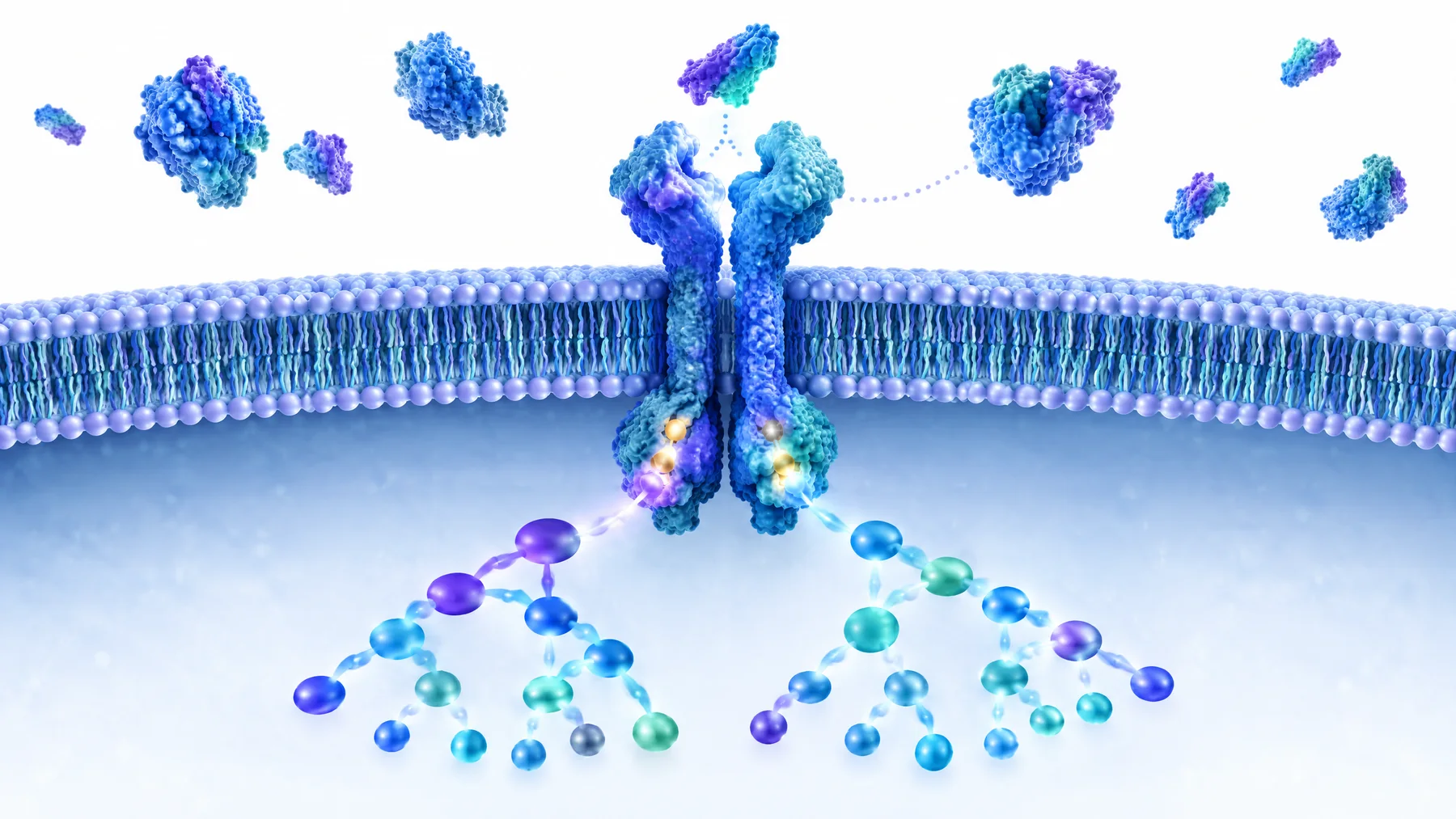
The working model is that tissue protection is mediated by a receptor complex involving the EPO receptor and the common beta receptor, CD131, often called the innate repair receptor in this research field. In primary preclinical experiments, EPO receptor and beta-common-receptor proteins were found in a complex in several tissues, and EPO or carbamylated EPO lost protection in beta-common-receptor knockout injury models. Those experiments support the receptor concept in model systems; they do not establish a therapeutic effect in people with neuropathy. [2]
ARA-290 was designed to reproduce part of EPO’s proposed tissue-protective surface rather than the EPO receptor-homodimer pathway responsible for erythropoiesis. Clinical papers describe downstream anti-inflammatory and repair signalling as a hypothesis consistent with the platform. In humans, however, direct target engagement in the affected nerve and a complete causal pathway from receptor activation to symptom improvement remain unresolved. [1] [5] [6]
What the animal models actually found
In a spared-nerve-injury model, ARA-290 given after peripheral nerve injury reduced tactile and cold allodynia in rats for as long as 15 weeks in that experiment. It also reduced allodynia in wild-type mice but not in beta-common-receptor knockout mice. This is useful mechanistic evidence that the effect in that model depended on CD131, not proof that the same result will occur in a person with diabetic or sarcoidosis-associated neuropathy. [3]
Animal evidence spans injury, inflammation and metabolic models, but model outcomes such as evoked pain behaviour, tissue markers or histology are not interchangeable with clinical outcomes. The spared-nerve-injury study was a controlled model of surgically induced neuropathic pain; it did not test the diverse causes, co-medicines, duration or functional consequences of human small-fibre neuropathy. [3] [6]
Human evidence: encouraging signals, small studies
A double-blind pilot in sarcoidosis-associated neuropathic symptoms had 12 ARA-290 and 10 placebo completers. At four weeks, the Small Fibre Neuropathy Screening List favoured ARA-290, especially symptom severity and autonomic-symptom components. Yet the Brief Pain Inventory improved to a similar extent in both groups. The authors explicitly noted the small sample, variable neuropathy and absence of definitive small-fibre testing in all participants as key limitations. [4]
A later phase 2b sarcoidosis trial randomised 64 people across placebo and three dose groups for 28 days. Its primary endpoint was corneal nerve-fibre area, a surrogate measure. The 4 mg group had a placebo-corrected mean increase of 697 square micrometres at day 28 (95% CI 159 to 1,236; P=0.012), while the 1 mg and 8 mg comparisons were not statistically significant. Pain improved across groups; the reported placebo-corrected pain result in participants with moderate-to-severe pain did not reach statistical significance. This pattern warrants replication and does not establish a clinically validated dose or regimen. [6] [7]
In a 48-person double-blind type 2 diabetes study, the active group showed better PainDetect change than placebo and modest between-group differences in HbA1c over the study and follow-up. Several results were less consistent: both groups improved on the Neuropathic Pain Symptom Inventory, neither group changed significantly on the Small Fibre Neuropathy Screening List, and the full cohort did not show a significant corneal nerve-density change. A favourable corneal result appeared in a post-hoc subgroup with lower baseline density. These are study findings, not a treatment schedule. [5]
Safety signals and major unknowns
The small human trials did not show a clear signal of erythropoiesis or major routine laboratory change attributable to ARA-290 over their short observation periods. In the diabetes study, adverse-event frequencies were broadly similar across arms, but there were four serious adverse events in the active arm; the investigators considered two possibly related, including worsening renal insufficiency in a participant whose furosemide dose had also changed. A fatal myocardial infarction after cellulitis was judged unrelated by the study safety committee. [4] [5]
Short trials with tens of participants cannot rule out rare harms, delayed harms, drug interactions, risks in pregnancy, risks in significant kidney or cardiovascular disease, or effects of product-quality failures outside a trial. “Non-erythropoietic” describes a design intention and limited observed laboratory profile; it is not a guarantee of safety. There is no basis in these studies for universal reconstitution, storage, route, dose or cycling advice. [1] [4] [5] [6]
Australian regulatory context
No ARTG-listed ARA-290/cibinetide formulation or Australian Product Information was identified in the public register searches undertaken for this record. The TGA explains that therapeutic goods not included in the ARTG are unapproved and have not been assessed by it for safety, quality or effectiveness. That means ARA-290 should not be described as an approved Australian medicine for neuropathy, diabetes, sarcoidosis, pain or tissue repair. [8]
The TGA describes tightly defined pathways by which particular unapproved therapeutic goods may sometimes be accessed, including clinical trials, the Special Access Scheme and the Authorised Prescriber Scheme. Those pathways are not endorsements of ARA-290, do not turn a research vial into an approved product, and do not create a general self-treatment pathway. Individual legal and clinical questions require a qualified Australian health professional and the current TGA guidance. [8]
How it differs from related substances
The key comparison is with EPO. Conventional EPO biology includes signalling through an EPO-receptor homodimer to stimulate erythrocyte production. The ARA-290 research program instead used an 11-residue sequence intended to emulate a proposed tissue-protective EPO surface and to avoid that haematopoietic mechanism. Similar ancestry does not make the two products clinically interchangeable. [1] [2]
ARA-290 is also not a general category label for “nerve repair peptides”. The clinical work has focused mainly on small-fibre loss and neuropathic symptoms in selected sarcoidosis and diabetes populations, using specific investigational material and outcome measures. It has not validated use for athletic recovery, cosmetic repair, general inflammation, neurodegeneration or healthy people. [4] [5] [6] [7]
A practical way to read the claims
Separate a symptom questionnaire from a structural surrogate and from a clinical outcome that matters to patients. Corneal confocal microscopy and GAP-43-positive fibre measures are useful research tools, but a rise in one of these markers does not by itself prove durable peripheral-nerve restoration, less disability or a favourable benefit–risk balance. In the phase 2b study, corneal nerve-fibre area trended back toward baseline after drug discontinuation. [6]
Also check the comparator, sample size and conflicts. The early sarcoidosis pilot was very small, and the diabetes paper disclosed that several authors were officers of, and held equity in, the developer. The phase 2b study was sponsored by Araim Pharmaceuticals and its public registry record reports 64 participants. These facts do not invalidate the results; they reinforce why independently replicated, adequately powered and longer studies are needed before clinical claims become routine-care claims. [4] [5] [7]
Questions readers ask
Is ARA-290 actually a peptide?
Yes. ARA-290/cibinetide is an 11-amino-acid synthetic peptide engineered from a surface region of erythropoietin. It is EPO-derived but it is not erythropoietin itself and not a glycoprotein hormone product. [1] [6]
Is cibinetide an approved medicine in Australia?
No ARTG-listed ARA-290/cibinetide formulation or Australian Product Information was identified for this record. Treat it as investigational and unapproved in Australia unless a regulator or clinician can identify a specific lawful pathway and product; unapproved goods have not been assessed by the TGA for safety, quality or effectiveness. [8]
Does the research prove that it regenerates nerves?
No. A phase 2b sarcoidosis study found an increase in a corneal nerve-fibre-area surrogate in one dose group and increased GAP-43-positive epidermal fibre length, while other measures and pain results were mixed. These findings are promising signals, not proof of durable nerve regeneration or a proven patient benefit. [6] [7]
Can published trial methods be used as a personal dosing guide?
No. The published methods describe supervised investigational protocols in defined patient groups, not validated directions for self-administration. The available studies do not support a universal route, dose, dilution, storage method, treatment duration or combination protocol. [4] [5] [6] [7] [8]
What remains uncertain
The evidence base is small, short-term and concentrated in selected sarcoidosis and type 2 diabetes populations; it does not establish long-term benefit, uncommon harms, optimal treatment duration or generalisability to other neuropathies. [4] [5] [6] [7]
Several outcomes were patient-reported or surrogate measures. The later sarcoidosis trial's positive primary biomarker result was confined to one dose group, while pain and other outcomes were mixed; correlations do not demonstrate causation. [5] [6] [7]
Some key publications disclose developer affiliations or equity, and the phase 2b registry identifies the developer as sponsor. Independent, adequately powered replication is especially important. [4] [5] [7]
Australian status is based on public ARTG and TGA material reviewed for this record. ARTG inclusion and unapproved-access arrangements can change, so product-specific status should be confirmed directly with the TGA or a pharmacist rather than inferred from a vendor listing. [8]
References and further reading
- [1] Nonerythropoietic, tissue-protective peptides derived from the tertiary structure of erythropoietin. Peptide mapping and experimental in vitro/in vivo tissue-protection studies of EPO-derived peptides.
- [2] Erythropoietin mediates tissue protection through an erythropoietin and common beta-subunit heteroreceptor. Biochemical receptor-complex experiments plus cardiomyocyte and spinal-cord injury models in wild-type and beta-common-receptor knockout mice.
- [3] ARA290, a Peptide Derived from the Tertiary Structure of Erythropoietin, Produces Long-term Relief of Neuropathic Pain: An Experimental Study in Rats and beta-Common Receptor Knockout Mice. Spared-nerve-injury allodynia experiment in rats, wild-type mice and beta-common-receptor knockout mice.
- [4] Safety and efficacy of ARA 290 in sarcoidosis patients with symptoms of small fiber neuropathy: a randomized, double-blind pilot study. Single-site double-blind placebo-controlled pilot; 12 ARA-290 and 10 placebo participants completed four weeks.
- [5] ARA 290, a Nonerythropoietic Peptide Engineered from Erythropoietin, Improves Metabolic Control and Neuropathic Symptoms in Patients with Type 2 Diabetes. Double-blind placebo-controlled investigator-initiated trial; 48 analysed participants with type 2 diabetes and painful neuropathic symptoms, with 28 days of dosing and follow-up.
- [6] Cibinetide Improves Corneal Nerve Fiber Abundance in Patients with Sarcoidosis-Associated Small Nerve Fiber Loss and Neuropathic Pain. Two-centre, double-blind, randomised placebo-controlled phase 2b dose-ranging study; 64 randomised participants, 28-day treatment period.
- [7] NCT02039687: Study of Efficacy of ARA 290 on Corneal Nerve Fiber Density and Neuropathic Symptoms of Subjects With Sarcoidosis. Completed sponsor-led, quadruple-masked, parallel, randomised phase 2 study with placebo and 1 mg, 4 mg and 8 mg ARA-290 arms.
- [8] Therapeutic Goods Administration: Unapproved therapeutic goods. Regulatory guidance and ARTG-access information; not a clinical study.