What is 5-Amino-1MQ?
5-amino-1-methylquinolinium (also written 5A-M1Q): a synthetic quinolinium small molecule investigated as an inhibitor of nicotinamide N-methyltransferase (NNMT), not a peptide.
5-Amino-1MQ is often grouped with “peptides” online, but its chemistry and evidence say otherwise: it is a small-molecule NNMT inhibitor. Its most direct evidence is biochemical and cellular. Short and medium-length studies in diet-induced obese male mice reported lower body weight or fat mass, including a study paired with a low-calorie diet. Those observations do not establish a human treatment, a safe dose, a route, a compounded preparation or a weight-loss benefit in people. For Australian readers, a research vial or online listing is not evidence that an approved medicine exists; ARTG status and a product’s AUST number matter for lawful supply.
Identity: a small molecule, not a peptide
The name 5-amino-1MQ refers to 5-amino-1-methylquinolinium, whose IUPAC name is 1-methylquinolin-1-ium-5-amine. PubChem lists the molecular formula as C10H11N2+ and molecular weight as 159.21 g/mol. It is a compact synthetic organic molecule with a quinolinium core, not a chain of amino acids. Calling it a peptide therefore misidentifies the substance and can blur the distinction between a research chemical, a peptide medicine and a hormone. [4] [1]
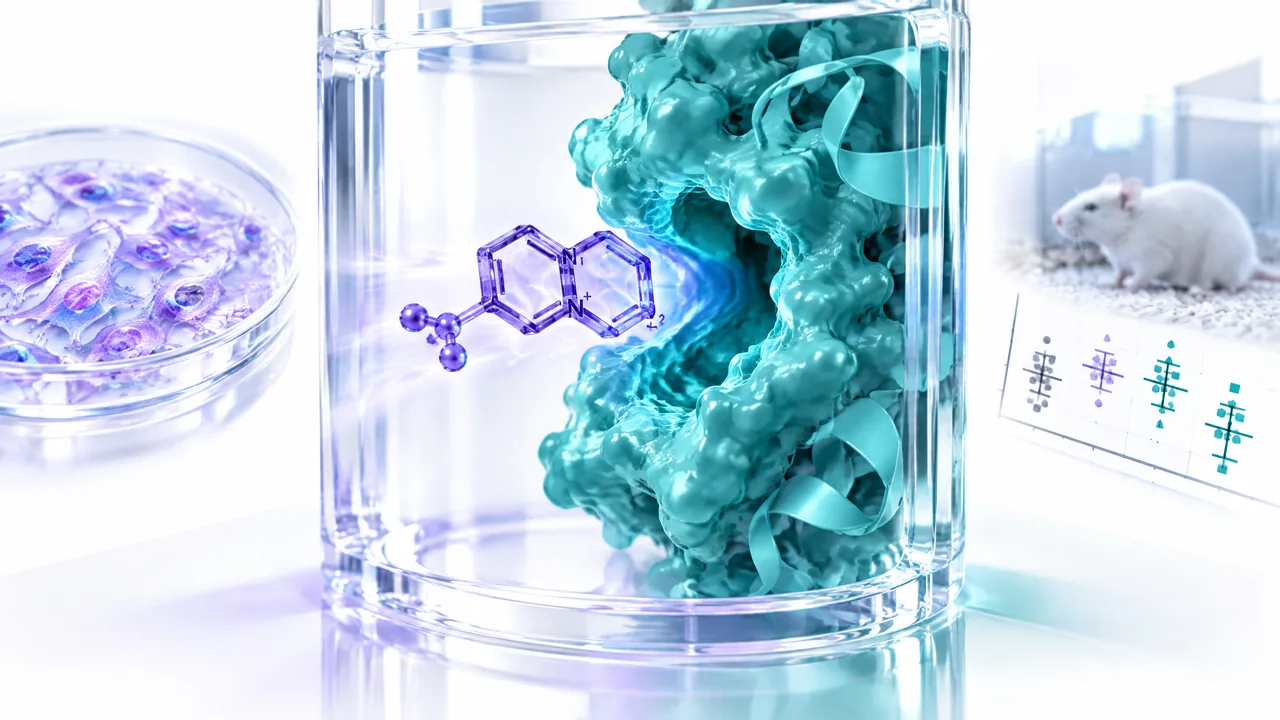
The published research positions 5-amino-1MQ as a nicotinamide N-methyltransferase (NNMT) inhibitor. In the 2018 lead-characterisation paper, it inhibited recombinant NNMT with a reported IC50 of 1.2 micromolar and showed high permeability in the authors’ PAMPA and Caco-2 assays. These are useful early drug-discovery findings; they do not demonstrate an orally effective or clinically developed medicine. [1]
What NNMT inhibition means—and what remains a hypothesis
NNMT is an enzyme involved in handling nicotinamide and methyl-donor metabolism. The 2018 investigators reported that NNMT-inhibitor exposure in adipocyte experiments was accompanied by higher intracellular NAD+ and S-adenosylmethionine (SAM), two metabolites with broad roles in cellular metabolism. This supports target engagement in that experimental setting, not a demonstrated human metabolic pathway. [1]
The same paper discusses possible downstream links involving NAD+-dependent sirtuins, SAM-dependent methylation and genes relevant to adipocyte biology. The authors explicitly framed several of these downstream steps as likely or speculative and called for in-vivo validation of white-adipose NAD+/SAM changes and mechanisms. It is more accurate to treat “boosted metabolism”, thermogenesis and epigenetic reprogramming as research hypotheses than settled effects of 5-amino-1MQ in people. [1]
What the named compound did in cells and mice
In differentiating 3T3-L1 mouse pre-adipocyte cultures, 30 and 60 micromolar 5-amino-1MQ reduced Oil Red O-measured lipid accumulation by about 50% and 70%, respectively. This is a controlled cell-culture result about lipid accumulation during differentiation. It cannot show that the same concentrations are attainable, safe or effective in human fat tissue. [1]
The 2018 in-vivo experiment was an 11-day proof-of-concept study in 17-week-old male C57BL/6 diet-induced-obese mice kept on a high-fat diet, with nine mice per group. The treatment group received repeated subcutaneous 5-amino-1MQ injections and the control group saline. At the endpoint, treated mice had a mean 5.1% loss from baseline body weight while controls gained about 1.4%; epididymal white-fat-pad mass was about 35% lower and total cholesterol about 30% lower in treated mice. Food intake did not significantly differ between groups. [1]
A separate Scientific Reports study used obese male C57BL/6J mice previously maintained on a Western-style diet. It compared a switch to a lean, lower-calorie diet plus daily 5-amino-1-methylquinolinium with the same diet switch plus vehicle. By study end, the treatment-plus-diet group had lost 6.3 g versus 2.9 g in the diet-switch vehicle group, and the reported percentage fat-mass loss was about 29.3% versus 2.9%. Because the intervention combined a diet change with the compound and did not include a Western-diet-plus-compound arm, it does not establish the compound’s independent effect under that diet. [2]
A related 2022 study analysed cecal microbiomes from the same general diet-induced-obesity context. Mice switched to the lean diet and given NNMT inhibitor showed a distinct bacterial pattern, including lower relative Erysipelatoclostridium and higher Lactobacillus than diet-switched vehicle animals; alpha-diversity measures did not significantly differ. This is an association in a proof-of-concept mouse study. It does not show that microbiome changes caused the body-composition findings or that a microbiome effect occurs in humans. [3]
Human evidence: no basis for a dosing or efficacy claim
An exact-term ClinicalTrials.gov API search for “5-amino-1MQ” returned zero studies. Combined with the studies located for this article, the evidence record is preclinical rather than a published human clinical-development program. A zero result for one registry query cannot rule out every conceivable unregistered or differently named activity, but it means there is no registered human protocol under that exact name in the queried database. [5] [1] [2] [3]
There is therefore no evidence-grounded human administration schedule, injection route, dilution method, storage instruction, expected weight-loss result or safety profile for 5-amino-1MQ. Mouse injection schedules and research formulations are experimental methods, not instructions for people and cannot be converted into a human regimen. [1] [2] [5]
Risks and major unknowns
The 2018 mouse paper described no observable adverse effects at the selected dose in its short study, but its own authors identified the need for more comprehensive dose-ranging and improved ADME work. That is not a human safety assessment. The available named-compound studies do not define human adverse effects, interactions with medicines, effects in pregnancy, effects on fertility, long-term cardiovascular or psychiatric risks, or risks in people with liver, kidney or metabolic disease. [1] [2] [5]
Product uncertainty is a separate concern from pharmacology. The TGA warns that unapproved weight-loss medicines may not meet Australian manufacturing standards, may contain a different amount of active ingredient than the label states, and can contain undeclared or harmful ingredients. A supplier’s “research use” wording or a vial label is not independent confirmation of identity, purity, sterility, stability or clinical suitability. [7]
Australian regulatory context
In Australia, the Australian Register of Therapeutic Goods (ARTG) is the public database for therapeutic goods that can legally be supplied, subject to limited exemptions and access pathways. The TGA says that the register can be searched by active ingredient, product name, sponsor or ARTG number; ARTG records may include product and formulation details and, where available, medicine information. [6]
No ARTG product entry, Product Information or Consumer Medicine Information for 5-amino-1MQ was verified in the public-register research for this article. Accordingly, it should be described as a preclinical research substance, not as a TGA-approved medicine or an approved weight-loss formulation. This does not decide whether a particular person may be considered under an applicable unapproved-goods pathway; the TGA notes that such pathways do not facilitate commercial supply. [6]
For a product promoted for weight loss, the TGA advises checking the label for an AUST L or AUST R number and searching the ARTG. Registered medicines carrying AUST R have been assessed for safety, quality and effectiveness for their intended purpose before supply; an online seller’s marketing claim is not an equivalent assessment. [7]
Do not conflate it with NAD+ or peptide medicines
5-Amino-1MQ is neither NAD+ nor a source of NAD+. It is an NNMT inhibitor studied partly because NNMT inhibition altered NAD+ and SAM measurements in adipocyte experiments. That distinction matters: an enzyme inhibitor, a coenzyme and a peptide receptor agonist are different classes of substance with different evidence, formulation requirements and potential risks. [1] [4]
Likewise, a research supplier’s vial is not an “approved formulation”. Published mouse experiments used a laboratory-synthesised compound under defined animal-study conditions, while the TGA’s consumer guidance emphasises that unapproved online weight-loss products may have uncertain quality, contents and safety. Neither the animal paper nor a supplier listing validates a consumer product. [1] [2] [7]
How to read the promising-looking mouse results
The outcomes are worth reporting precisely: they are signals in male diet-induced-obesity mouse models, not clinical outcomes. The 2018 study was short (11 days) and had nine mice per arm. The later diet-switch study had small treatment groups and evaluated a combined dietary and pharmacological intervention. Neither design answers whether people lose weight, retain lean mass, avoid regain, tolerate treatment or have improved long-term health outcomes. [1] [2]
A careful conclusion is narrower than common marketing language: 5-amino-1MQ has a plausible, experimentally measured NNMT target and preclinical signals in cells and obese mice. It has not crossed the evidentiary threshold for a human weight-loss treatment, and its correct category for an educational website is a research-only small molecule with substantial unanswered questions. [1] [2] [3] [5] [6]
Questions readers ask
Is 5-amino-1MQ a peptide?
No. It is 5-amino-1-methylquinolinium, a synthetic quinolinium small molecule (C10H11N2+), studied as an NNMT inhibitor. It is not an amino-acid-chain peptide and not a glycoprotein hormone. [4] [1]
Is 5-amino-1MQ an approved medicine in Australia?
This research did not verify an ARTG entry or TGA medicine information for 5-amino-1MQ. It should not be presented as a TGA-approved weight-loss medicine. The ARTG is the TGA’s public database for therapeutic goods that can legally be supplied, with limited exceptions and access pathways governed separately. [6] [7]
Are there human trials or a known human dose?
No registered study was returned by the exact-term ClinicalTrials.gov search, and the located evidence is biochemical, cell-based and mouse research. There is no validated human dose, route, dilution, storage method, efficacy estimate or safety profile to provide. [5] [1] [2] [3]
Did the mouse studies show fat loss?
Yes, in specific models. An 11-day high-fat-diet mouse study reported lower body weight and epididymal white-fat mass versus saline, and a later study reported greater weight and fat-mass loss when the compound was paired with a lean-diet switch. These are preclinical results and do not predict a human outcome. [1] [2]
Does a vial sold online prove that the compound is safe or genuine?
No. A vial is not proof of regulatory approval, identity, purity, sterility, stated concentration or suitability for human use. The TGA warns that unapproved weight-loss products may have uncertain ingredient amounts, contaminants or hidden substances. [7]
What remains uncertain
The evidence specific to 5-amino-1MQ is narrow: it consists of enzyme/cell work and a small number of mouse studies, not human pharmacokinetic, safety or efficacy trials. [1] [2] [3] [5]
The most prominent mouse studies used male diet-induced-obesity models, one was only 11 days, and the later body-composition study paired treatment with a diet switch. These design features limit translation and attribution of effect to the compound alone. [1] [2]
A ClinicalTrials.gov exact-name result of zero is informative but is not a universal proof of absence across all registries, unpublished work or alternate chemical naming. It does, however, provide no human protocol from which to infer administration or safety. [5]
This record found no verified ARTG formulation for the named compound. Regulatory availability can be fact-specific, so readers should use the live ARTG and a product’s AUST number rather than treat this article as legal or medical advice. [6] [7]
References and further reading
- [1] Selective and membrane-permeable small molecule inhibitors of nicotinamide N-methyltransferase reverse high fat diet-induced obesity in mice. Recombinant-enzyme and permeability assays; 3T3-L1 adipocyte experiments; and an 11-day controlled study in male C57BL/6 diet-induced-obese mice (n=9 per group).
- [2] Combined nicotinamide N-methyltransferase inhibition and reduced-calorie diet normalizes body composition and enhances metabolic benefits in obese mice. Controlled diet-induced-obesity experiment in male C57BL/6J mice comparing a lean-diet switch plus 5-amino-1-methylquinolinium with diet-switch vehicle and control-diet groups.
- [3] Reduced calorie diet combined with NNMT inhibition establishes a distinct microbiome in DIO mice. Cecal 16S microbiome analysis in diet-induced-obese mouse groups exposed to Western diet, lean-diet switch with vehicle, lean-diet switch with 5-amino-1-methylquinolinium, and lean controls.
- [4] PubChem: 5-Amino-1-methylquinolinium (CID 950107). Curated chemical identity and computed-property record.
- [5] ClinicalTrials.gov API v2 exact-term search for 5-amino-1MQ. Exact-term registry query; returned totalCount 0 at the time of research.
- [6] Therapeutic Goods Administration: About the Australian Register of Therapeutic Goods (ARTG). TGA regulatory register and access-pathway guidance.
- [7] Therapeutic Goods Administration: Weight loss products. TGA explanation of ARTG/AUST status and risks associated with unapproved weight-loss medicines.