What is PE-22-28 (mini-spadin research analogue)?
PE-22-28 is a synthetic seven-amino-acid peptide (GVSWGLR) designed from residues 22–28 of the sortilin-derived propeptide/spadin research series. It is a TREK-1 potassium-channel research analogue: not a hormone, mixture, coenzyme, small molecule, topical cosmetic ingredient, or scalp injection. The evidence located is cellular and mouse research, not an approved medicine formulation or an established human therapeutic candidate.
PE-22-28 is best understood as a short synthetic spadin analogue used to investigate blockade of the two-pore potassium channel TREK-1. A 2017 study found potent inhibition of human TREK-1 expressed in HEK cells and changes in several mouse screening and biomarker endpoints. Those results are scientifically interesting but do not establish that PE-22-28 treats depression, improves cognition or is safe in people. It is not an Australian-approved medicine, and research-supplier vials must not be represented as approved pharmaceutical products.
Identity: a seven-residue research peptide, not a clinical product
PE-22-28 is the short sequence GVSWGLR, corresponding to positions 22–28 in the sortilin-derived propeptide series. The direct PE-22-28 paper describes it as a deliberately designed seven-amino-acid shortened spadin analogue, selected after screening related sequences for TREK-1 blockade. That makes it a synthetic research peptide rather than an intact endogenous hormone or a standardised therapeutic formulation. [1]
Its parent comparator, spadin (PE 12–28), is a longer 17-residue peptide. PE-22-28, G/A-PE-22-28 and biotinylated G/A-PE-22-28 are distinct chemical entities, even though they are often discussed together as “spadin analogues”. Findings for one should not automatically be assigned to another. [1] [2]
The published PE-22-28 work used human-channel-expressing cells, cultured mouse neurons and male mice; it did not study topical use, hair or scalp outcomes. Describing it as a scalp injection or a hair-treatment peptide would therefore misstate both its identity and its evidence base. [1]
Molecular pathway: what was directly tested
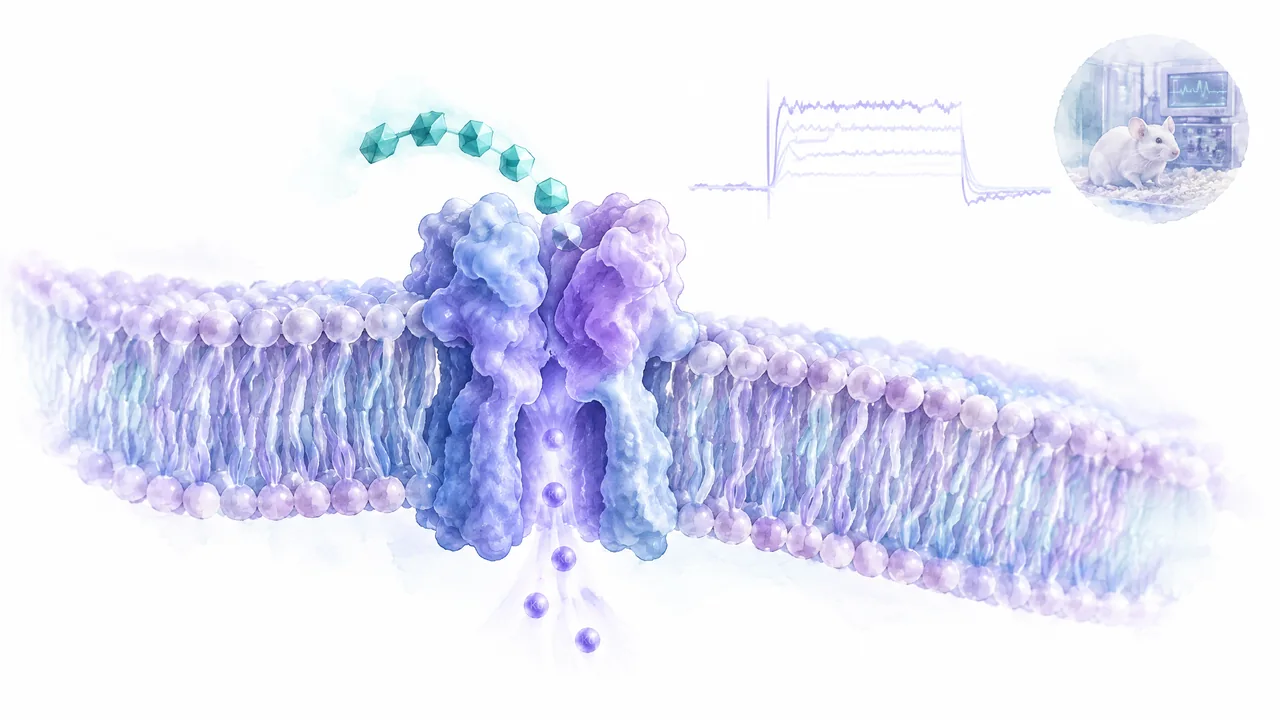
TREK-1 (encoded by KCNK2) is a two-pore-domain potassium channel that contributes to background potassium conductance and cellular excitability. In the direct study, whole-cell patch-clamp recordings in HEK cells expressing human TREK-1 showed PE-22-28 inhibited arachidonic-acid-activated TREK-1 current; the reported IC50 was 0.12 nM under that assay’s conditions, compared with about 40 nM for spadin. This is target-assay potency, not a human dose or proof of clinical potency. [1]
At the tested concentrations and in the particular recombinant-cell assays, PE-22-28 did not change currents from TREK-2, TRAAK, TRESK or TASK-1; the analogue series also did not alter hERG current in that experiment. These are useful early selectivity observations, but they are not a complete off-target, pharmacokinetic, toxicology, interaction or human-safety assessment. [1]
Model-specific findings: cells and mice only
The in-vivo experiments used naïve male C57BL/6J mice aged 7–9 weeks. In forced-swim testing, a single intraperitoneal research exposure to PE-22-28 was followed by lower immobility than saline; the paper also tested learned helplessness, novelty-suppressed feeding and a chronic corticosterone mouse model. These are controlled mouse endpoints used in antidepressant research screens, not diagnoses of human depression and not clinical efficacy outcomes. [1]
After four days of intraperitoneal treatment in mice, PE-22-28 was associated with more BrdU-positive cells in the hippocampus than saline in the reported experiment. In cultured mouse cortical neurons, exposure was associated with increased PSD-95 signal over time. BrdU labelling and PSD-95 are experimental markers interpreted in this study as neurogenesis- and synaptogenesis-related changes; they do not demonstrate durable functional recovery or brain effects in people. [1]
The study’s longer functional-effect measurements were for modified analogues, G/A-PE-22-28 and biotinylated G/A-PE-22-28, using forced-swim immobility at time points after injection. They are not human pharmacokinetic data, and they should not be transferred to unmodified PE-22-28 or converted into a human administration interval. [1]
How to read the ‘antidepressant-like’ language
In this literature, “antidepressant activity” refers to performance in preclinical assays such as forced swim, learned helplessness and novelty-suppressed feeding. It is appropriate to report the observed mouse results, but inappropriate to turn them into a claim that PE-22-28 treats major depressive disorder, prevents suicide or works rapidly in patients. The study itself did not enrol people or measure clinical symptoms. [1]
The biological rationale came from earlier spadin work: spadin bound and blocked TREK-1 in rodent and cell preparations, increased dorsal-raphe serotonin-neuron firing in mice, and altered several mouse behavioural tests. That is supportive target biology for the research programme, not a substitute for testing the shorter PE-22-28 sequence in human participants. [2]
Human evidence and safety: the central gaps
No human dosing, absorption, distribution, metabolism, excretion, interaction, pregnancy, immunogenicity or adverse-event dataset for PE-22-28 was identified in the sources reviewed. An exact-term ClinicalTrials.gov search returned no PE-22-28 study records. This supports a preclinical classification, while not proving that no study exists in every registry or publication worldwide. [4]
One human observational study measured serum concentrations of the broader sortilin-derived propeptide in people with major depressive disorder and controls. It reported lower levels in the patient cohort and explicitly noted small samples. It did not administer PE-22-28, test GVSWGLR as a treatment, or establish that changing this biomarker would improve depression. [3]
A rodent and cell study of the longer parent peptide spadin did not find certain TREK-1-related effects in the models it tested, including selected cardiac, pain, seizure and ischaemia endpoints. That limited reassurance applies to spadin under those experimental conditions; it cannot establish safety for PE-22-28 in people or for supplier products with different identity, purity or excipients. [7]
Comparison with related substances
Spadin (PE 12–28) is the longer research parent; PE-22-28 is its seven-residue shortened core; and G/A-PE-22-28 or biotinylated G/A-PE-22-28 are modified derivatives. In the 2017 screen, the short analogue showed stronger TREK-1 inhibition in the engineered-cell assay than spadin, but chemical modification affected activity and the longer-duration mouse observations were reported for the modified derivatives. “Spadin” and “PE-22-28” are therefore not interchangeable names for a medicine. [1] [2]
Australian regulatory context
The Australian Register of Therapeutic Goods (ARTG) is the TGA’s public database for therapeutic goods that can be supplied in Australia, and its public search covers product names and active ingredients. This review identified no PE-22-28 ARTG medicine entry, Product Information or Consumer Medicine Information. Accordingly, PE-22-28 should not be presented as a TGA-approved or ARTG-registered medicine; the ARTG remains the appropriate source to check a specific product claim. [5]
The TGA explains that therapeutic goods not included in the ARTG have not been assessed by it for safety, quality or effectiveness, although defined pathways can apply in particular circumstances. A vial sold by a research supplier is not, simply by being labelled “research use”, an approved formulation with a validated clinical protocol. [5] [6]
A practical way to interpret a PE-22-28 claim
First ask which exact molecule was tested. Native PE-22-28, G/A-PE-22-28 and biotinylated derivatives were all studied, but they are not the same substance. Next ask which system produced the result: recombinant human TREK-1 in HEK cells, cultured mouse neurons, naïve male mice or corticosterone-exposed mice. The answer determines what can reasonably be inferred. [1]
Mouse microgram-per-kilogram conditions and intraperitoneal or gavage routes in a paper are experimental methods, not instructions for people. With no human trial record, no approved formulation and no human safety or pharmacokinetic data identified, there is no evidence-based human dose, injection route, dilution, storage rule, schedule or combination protocol to provide. [1] [4] [5]
Questions readers ask
Is PE-22-28 an approved medicine in Australia?
No PE-22-28 ARTG medicine entry or TGA product information was identified in this review. The TGA states that the ARTG is the public database for therapeutic goods that can be supplied in Australia, so approval should be checked against a specific ARTG entry rather than inferred from a research-vial listing. [5]
Is PE-22-28 actually a peptide?
Yes. It is a synthetic seven-amino-acid peptide, GVSWGLR, developed as a shortened analogue within the spadin/sortilin-derived propeptide research series. It is not a small molecule, glycoprotein hormone or coenzyme. [1]
Has PE-22-28 been tested in people with depression?
No PE-22-28 human trial record was returned by the exact ClinicalTrials.gov search reviewed here. A separate human study measured a broader endogenous sortilin-derived propeptide as a serum biomarker; it was not a PE-22-28 treatment trial. [3] [4]
Do the mouse results prove a fast antidepressant effect in humans?
No. The direct data are target-cell experiments and behavioural/BrdU outcomes in mice. They motivate further research, but cannot establish human benefit, speed of benefit, safety or a clinical administration regimen. [1]
What remains uncertain
The direct PE-22-28 evidence is dominated by one 2017 preclinical research programme and uses recombinant cells, cultured mouse neurons and young male mice. Behavioural screening endpoints, BrdU labelling and PSD-95 changes are not clinical depression, functional recovery or human neurogenesis measures. The paper’s functional-duration data concern modified analogues rather than native PE-22-28 and do not provide pharmacokinetics. No PE-22-28 human dosing, safety, interaction, manufacturing-quality or clinical-outcome evidence was identified; the registry finding is limited to the exact ClinicalTrials.gov query. The Australian status is stated cautiously: no specific ARTG product record was identified in this review, while ARTG status should be verified against a current product search and exempt/unapproved pathways may have different rules.
References and further reading
- [1] Shortened Spadin Analogs Display Better TREK-1 Inhibition, In Vivo Stability and Antidepressant Activity. Whole-cell patch clamp in human TREK-1-expressing HEK cells and other recombinant K2P/hERG assays; cultured mouse cortical-neuron experiments; behavioural, BrdU and corticosterone-model experiments in naïve male C57BL/6J mice.
- [2] Spadin, a Sortilin-Derived Peptide, Targeting Rodent TREK-1 Channels: A New Concept in the Antidepressant Drug Design. Cell interaction/electrophysiology, mouse brain-slice and dorsal-raphe studies, and five mouse behavioural tests with longer spadin and TREK-1-deficient mice.
- [3] Serum sortilin-derived propeptides concentrations are decreased in major depressive disorder patients. Translational serum-propeptide measurement study comparing people with major depressive disorder and healthy non-psychiatric controls, with a small-sample limitation stated by the authors.
- [4] ClinicalTrials.gov search results for PE-22-28. Exact-term registry query reviewed for registered study records.
- [5] About the Australian Register of Therapeutic Goods (ARTG). TGA description of the public ARTG database, product information and lawful-supply context.
- [6] Unapproved therapeutic goods. TGA guidance describing goods not included in the ARTG and defined access pathways.
- [7] Spadin as a new antidepressant: absence of TREK-1-related side effects. Rodent physiological and disease-model tests plus cell electrophysiology using the longer spadin peptide.