What is Cerebrolysin?
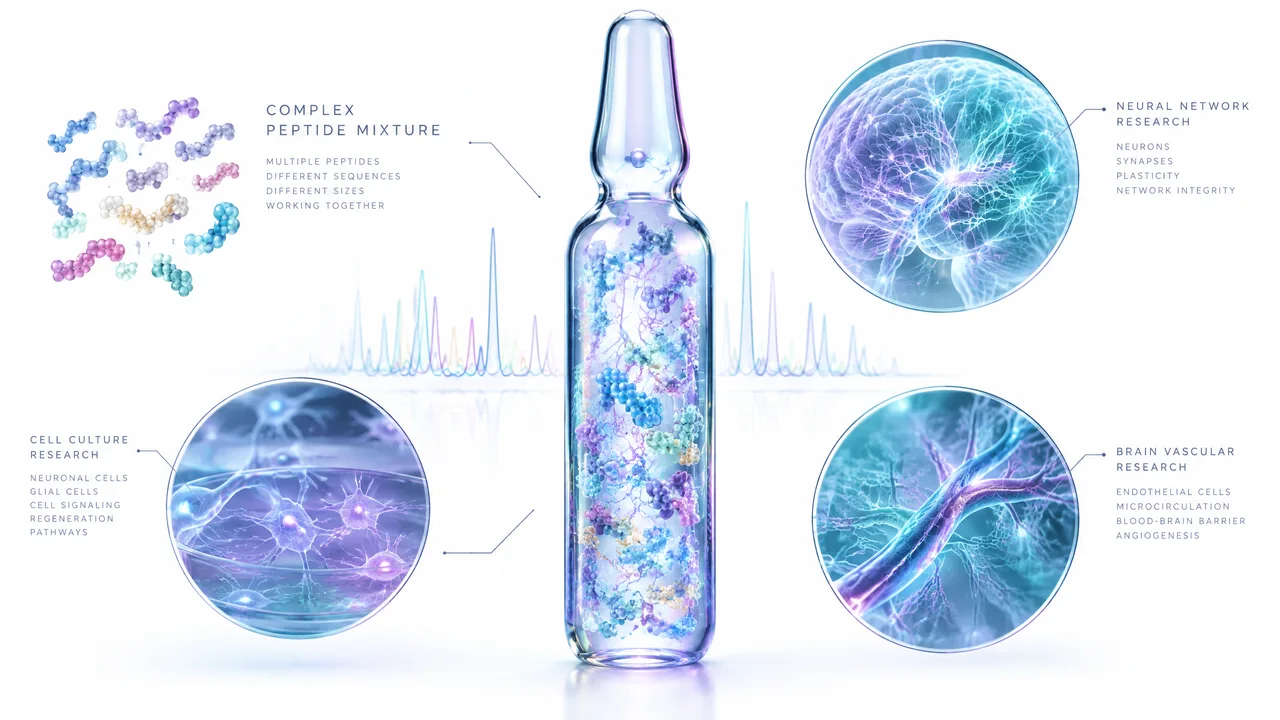
Cerebrolysin is not one defined peptide, hormone or small molecule. It is a standardised porcine-brain-protein hydrolysate: a heterogeneous mixture reported as approximately 75% free amino acids and 25% low-molecular-weight peptides (<10 kDa). The named, prescription formulation is a solution for injection in markets where it is licensed; an Austrian product monograph lists 215.2 mg/mL concentrate. That identity matters: evidence for the branded/defined medicine cannot be assumed to apply to loose, compounded, research-use-only or online-supplier vials.
Cerebrolysin is a porcine-brain-derived peptide-and-amino-acid mixture, not a single ‘brain peptide’. It has been studied in stroke, dementia and traumatic brain injury, but its strongest stroke evidence is conflicting: the large CASTA trial missed its confirmatory endpoint, while the smaller exploratory CARS rehabilitation trial reported better arm-function scores. Australian readers should not confuse overseas prescription formulations or study products with unregistered retail vials: the TGA ARTG returned no matching Cerebrolysin entry when checked. The clinical literature does not establish a self-directed administration protocol or a proven cognitive-enhancement use.
What Cerebrolysin is — and is not
Cerebrolysin is best described as a **biological peptide mixture**, not as a single peptide with one sequence or receptor. A primary cell-culture paper describes a standardised enzymatic breakdown of porcine brain proteins containing free amino acids and low-molecular-weight peptides. The Austrian monograph identifies the finished product as a prescription solution for injection. Therefore it is neither a topical cosmetic ingredient nor a typical ‘research peptide’ in the sense of one synthesised molecule. [1] [2]
A complex mixture also means that product identity is central to interpretation. In a 2024 laboratory comparison, preparations marketed as similar had different peptide fingerprints and did not show the same neurofilament-L bioassay activity as Cerebrolysin. This does not prove clinical superiority of any product, but it does show why a study of a defined medicine cannot validate an unspecified supplier vial or a blend. [11]
What molecular pathways are supported
The proposed biology is broad rather than receptor-specific. In primary rat neural progenitor cultures taken from ischaemic animals, Cerebrolysin increased proliferation and immature-neuron markers; inhibiting PI3K/Akt abolished the proliferation increase. That is useful causal evidence for a PI3K/Akt-dependent effect in that experimental system, not proof that it repairs human brain tissue through the same pathway. [3]
A human biomarker study in mild-to-moderate Alzheimer disease found higher **serum** BDNF after Cerebrolysin treatment, with greater changes in a combination-treatment group. Serum BDNF is not direct evidence of brain target engagement, and the association with cognitive change cannot establish that BDNF caused a clinical effect. Claims that Cerebrolysin is ‘BDNF’ or has a settled single molecular mechanism should therefore be treated as inaccurate. [9]
Model-specific experimental findings
In a rat embolic middle cerebral artery occlusion (MCAo) model, treatment begun after stroke increased BrdU-positive subventricular-zone progenitor cells and doublecortin immunoreactivity, reduced TUNEL-positive cells at the ischaemic boundary, and improved several behavioural measures at later assessment. In the same experiment, it did not significantly reduce infarct volume at one tested timing and dose. This is a model-specific finding in Wistar rats, not an outcome in people with stroke. [3]
The cultured-cell arm of that study provides a narrower mechanistic result: Cerebrolysin increased progenitor proliferation, differentiation-marker expression and migration, while PI3K/Akt blockade removed the proliferation effect. Animal stroke models have controlled lesions, homogeneous species and experimental conditions that are not equivalent to diverse human stroke causes, comorbidity, reperfusion care or rehabilitation. [3]
Human evidence in acute ischaemic stroke
The large CASTA trial randomised 1,070 people with acute hemispheric ischaemic stroke in Asia to Cerebrolysin or saline placebo, with follow-up to day 90. Its combined confirmatory endpoint based on modified Rankin Scale, Barthel Index and NIH Stroke Scale showed **no significant difference**. A severity-stratified finding favouring treatment was post hoc and described by the authors as requiring confirmation; it should not be read as a proven treatment effect. The trial was sponsored by Ever Neuro Pharma. [4] [13]
CARS was a different, smaller phase II rehabilitation study: 205 modified-intention-to-treat participants contributed to the day-90 analysis, all receiving a standardised rehabilitation program. It reported a higher Action Research Arm Test score and a favourable composite global outcome with Cerebrolysin versus placebo. Crucially, the paper calls the study exploratory and relatively small, and says that a large randomised trial is needed. These results cannot erase the neutral confirmatory result in CASTA. [5]
A Cochrane review of six acute-ischaemic-stroke RCTs (1,501 participants) found no demonstrated clinical benefit. It also found no mortality difference in pooled data and reported a possible increase in serious adverse events, while noting substantial risk-of-bias concerns and manufacturer involvement in several studies. This higher-level synthesis is an important counterweight to favourable individual surrogate or function-scale findings. [6]
Human evidence in Alzheimer disease
Older placebo-controlled studies in Alzheimer disease reported some positive signals, but they do not establish a contemporary, universally accepted dementia treatment. A 2002 multicentre trial of 192 participants found a statistically significant difference in the clinician-rated global CIBIC+ score at week 12, whereas the groups differed at baseline in age, age at dementia onset and hallucinations. Reported common adverse events included headache, dizziness, weight loss and anxiety. [7]
A 2006 279-participant, double-blind trial compared three treatment amounts and placebo over 24 weeks. Only the lowest tested amount achieved significant improvement on both the modified ADAS-cog and CIBIC+ at week 24; the higher amounts improved global outcome but not cognition. This non-linear result and the age of the studies make it inappropriate to infer a general cognitive-enhancement effect or a dose rule from the literature. [8]
Safety, uncertainty and why unsupervised use is a poor inference
Safety evidence is indication- and product-specific. The Austrian prescribing information lists hypersensitivity, epilepsy and severe renal impairment as contraindications for its medicine. In acute stroke trials, the Cochrane review found moderate-certainty evidence compatible with more serious adverse events, even though the total number of participants with any adverse event did not differ materially between groups. A statement that a product was ‘well tolerated’ in one study is not a guarantee of safety for an individual. [2] [6]
There is no validated universal dilution, storage, injection route, combination or self-administration schedule in this evidence record. Trial procedures and overseas labels are part of controlled clinical or jurisdiction-specific prescribing contexts, not instructions for readers. Combining Cerebrolysin with other unapproved substances introduces identity, interaction and attribution problems that have not been validated as a combined protocol. [2] [6] [11]
Australian regulatory context
On the TGA ARTG search for “Cerebrolysin”, there were **no matching results** when this record was prepared. The ARTG is the public database for therapeutic goods that can be legally supplied in Australia, so this supports describing Cerebrolysin as **not ARTG-approved/registered**, rather than calling it an approved Australian medicine. By contrast, the available official monograph is based on the Austrian Summary of Product Characteristics, and the manufacturer also says the product is not FDA-registered in the United States. [10] [12] [2]
Non-ARTG status does not mean a consumer should improvise an access route. The TGA states that unapproved goods have not been evaluated by it for quality, safety or efficacy; practitioner pathways require consideration of approved options, risk and informed consent. Personal importation has specific conditions and does not make a product clinically appropriate or assure product quality. Suspected medicine harms can be reported through the TGA’s consumer or health-professional adverse-event reporting channels. [12] [14] [15]
How to read claims and compare products
Do not compare Cerebrolysin as though it were interchangeable with a single defined peptide, a nootropic supplement, a neuronal growth factor or another porcine-brain hydrolysate. It is a mixture, and even ostensibly related preparations can have materially different peptide profiles and in-vitro activity. The fairest question is not ‘does this peptide work?’, but ‘which exact formulation, in which condition, against which control, on which pre-specified outcome?’ [1] [11]
For stroke claims, give greatest weight to prespecified, patient-relevant outcomes and adequately powered confirmatory trials. CASTA’s neutral combined endpoint, CARS’s exploratory arm-function result, and the Cochrane review’s risk-of-bias and serious-adverse-event findings together describe uncertainty—not a settled clinical recommendation. For dementia claims, older scale-based improvements and serum biomarkers are signals to investigate, not proof of disease modification or prevention. [4] [5] [6] [7] [8] [9]
Questions readers ask
Is Cerebrolysin actually a peptide?
It contains low-molecular-weight peptides, but it is **not a single peptide**. It is a standardised porcine-brain-protein hydrolysate containing a mixture of peptides and free amino acids. [1] [2]
Is Cerebrolysin approved in Australia?
The TGA ARTG search returned no matching Cerebrolysin entry when checked for this article. It should not be described as an ARTG-approved Australian medicine. [10] [12]
Does it improve stroke recovery?
The evidence is mixed. CASTA, a large trial, had a neutral confirmatory endpoint; CARS, a smaller exploratory rehabilitation study, reported improved arm-function scores. A Cochrane review concluded that clinical benefit in acute ischaemic stroke had not been demonstrated. [4] [5] [6]
Does it treat Alzheimer disease or prevent cognitive decline?
Older randomised trials reported selected cognitive or global-function improvements, but their findings are not proof of disease modification, prevention or a general cognitive-enhancement effect. Cerebrolysin is not ARTG-approved for Alzheimer disease in Australia. [7] [8] [10]
Can an online or research vial be treated as equivalent to the medicine studied?
No. The evidence refers to specified preparations, and laboratory comparison has found meaningful composition and biological-activity differences among products described as similar. Product identity and quality cannot be assumed from a name on a vial. [1] [11] [12]
What remains uncertain
This record deliberately separates animal, cell, biomarker and patient evidence. The principal stroke synthesis included trials through 2016 and found substantial risk-of-bias concerns; later individual studies would need separate critical appraisal rather than being assumed to overturn it. The Alzheimer trials cited are older and use scale-based outcomes; their study populations, formulations and healthcare settings may not generalise to Australia. The Austrian product monograph is a product-specific, manufacturer source and is not an Australian PI. The ARTG result is a live-search snapshot, not a guarantee about every possible future entry or an assessment of every imported product. No administration, dilution, storage, route or combined-substance protocol is provided because the evidence does not validate a universal self-use regimen.
References and further reading
- [1] Effects of Cerebrolysin on the outgrowth and protection of processes of cultured brain neurons. Embryonic chick neuronal culture experiments with an amino-acid comparator and time-lapse microscopy; includes a formulation description.
- [2] Cerebrolysin Product Monograph (Austrian Summary of Product Characteristics-based abbreviated prescribing information). Jurisdiction-specific prescribing-information document for the Austrian formulation; not an Australian label or an independent efficacy review.
- [3] Cerebrolysin enhances neurogenesis in the ischemic brain and improves functional outcome after stroke. Wistar-rat embolic MCAo experiment plus SVZ neural-progenitor culture assays and PI3K/Akt inhibition experiments.
- [4] Cerebrolysin in patients with acute ischemic stroke in Asia: results of a double-blind, placebo-controlled randomized trial. Multicentre, double-blind, placebo-controlled randomised trial (CASTA), 1,070 enrolled patients with acute hemispheric ischaemic stroke, followed to 90 days.
- [5] Cerebrolysin and Recovery After Stroke (CARS): A Randomized, Placebo-Controlled, Double-Blind, Multicenter Trial. Phase II, multicentre, randomised, double-blind, placebo-controlled rehabilitation trial; 205 participants in day-90 modified-intention-to-treat analysis.
- [6] Cerebrolysin for acute ischaemic stroke. Cochrane systematic review of six randomised controlled trials (1,501 participants) in acute ischaemic stroke.
- [7] Cerebrolysin in Alzheimer's disease: a randomized, double-blind, placebo-controlled trial with a neurotrophic agent. Multicentre, randomised, double-blind, placebo-controlled parallel-group trial; 192 participants with Alzheimer disease.
- [8] A 24-week, double-blind, placebo-controlled study of three dosages of Cerebrolysin in patients with mild to moderate Alzheimer's disease. Randomised, double-blind, placebo-controlled dose-comparison study; 279 mild-to-moderate Alzheimer disease participants.
- [9] Synergistic Increase of Serum BDNF in Alzheimer Patients Treated with Cerebrolysin and Donepezil: Association with Cognitive Improvement in ApoE4 Cases. Alzheimer disease treatment-group biomarker analysis measuring serum BDNF at weeks 16 and 28.
- [10] Australian Register of Therapeutic Goods (ARTG): Cerebrolysin search. Live public-database search, checked during preparation of this article.
- [11] Comparing the biological activity and composition of Cerebrolysin with other peptide preparations. Chromatographic peptide-fingerprint and cell-bioassay comparison of Cerebrolysin batches with other peptide preparations alleged to be similar.
- [12] Access an unapproved therapeutic good (health practitioners). TGA regulatory guidance for health practitioners, not a clinical study.
- [13] NCT00868283: The Safety and Efficacy of Cerebrolysin in Patients With Acute Ischemic Stroke (CASTA). Completed phase IV randomised, quadruple-masked, placebo-controlled parallel trial; actual enrolment 1,071; sponsor Ever Neuro Pharma GmbH.
- [14] Personal Importation Scheme. TGA consumer regulatory guidance, not a clinical study.
- [15] Report an adverse event or safety problem. TGA safety-reporting information for consumers and health professionals.