What Does Reconstitution Mean?
Reconstitution is the process of dissolving a lyophilized (freeze-dried) peptide powder in the product-specific diluent so it reaches a defined concentration and appearance. Research peptides are often shipped as a dry powder to improve stability during transit. The exact diluent, volume, mixing method, storage period and discard date must come from the supplied instructions or lot-specific certificate of analysis; bacteriostatic water is not universally appropriate.
What You Will Need
Before beginning, gather the labelled peptide vial, the exact sterile diluent specified by the product instructions, an appropriately sized sterile transfer device, alcohol swabs, a label, and an approved sharps container. Where a compatible protocol specifies approximately 3mL of bacteriostatic water per vial, a 10mL BAC-water vial may offer better value. This purchasing suggestion never overrides product-specific chemistry or supplied diluent instructions.
Choosing the Correct Product-Specific Diluent
Bacteriostatic water contains benzyl alcohol and is used for compatible multi-dose products. Sterile water has no preservative and is used where the labelled product specifies it. Some approved products include their own supplied diluent, while selected laboratory reagents may specify saline, buffer, or an acidic or basic solvent. Follow the exact product insert or lot-specific COA. Do not substitute bacteriostatic water merely because a vial will be punctured more than once, and do not assume a generic storage period applies to every formulation.
How much diluent does this formulation specify?
The correct liquid and final volume come from the exact product's validated directions, not just its nominal mg content. For arithmetic only, 10 mg divided by a verified final volume of 2 mL equals 5 mg/mL; this does not establish that 2 mL or bacteriostatic water is compatible with any particular peptide. Use the calculator only after confirming the formulation and final volume.
Step-by-Step Reconstitution Process
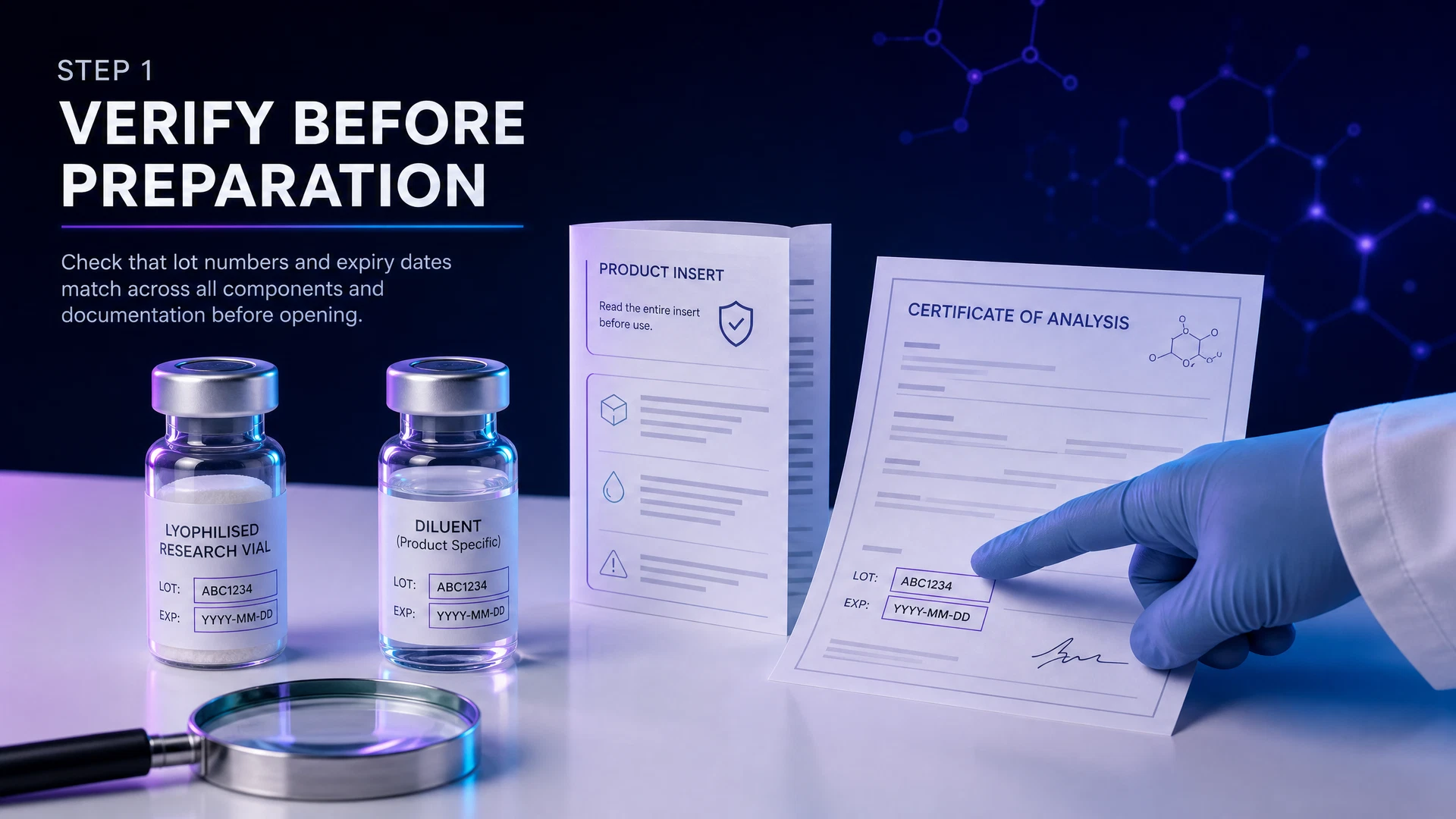
Step 1: Read the vial, product insert and lot-specific COA; confirm the exact diluent, volume, storage condition and expected appearance.
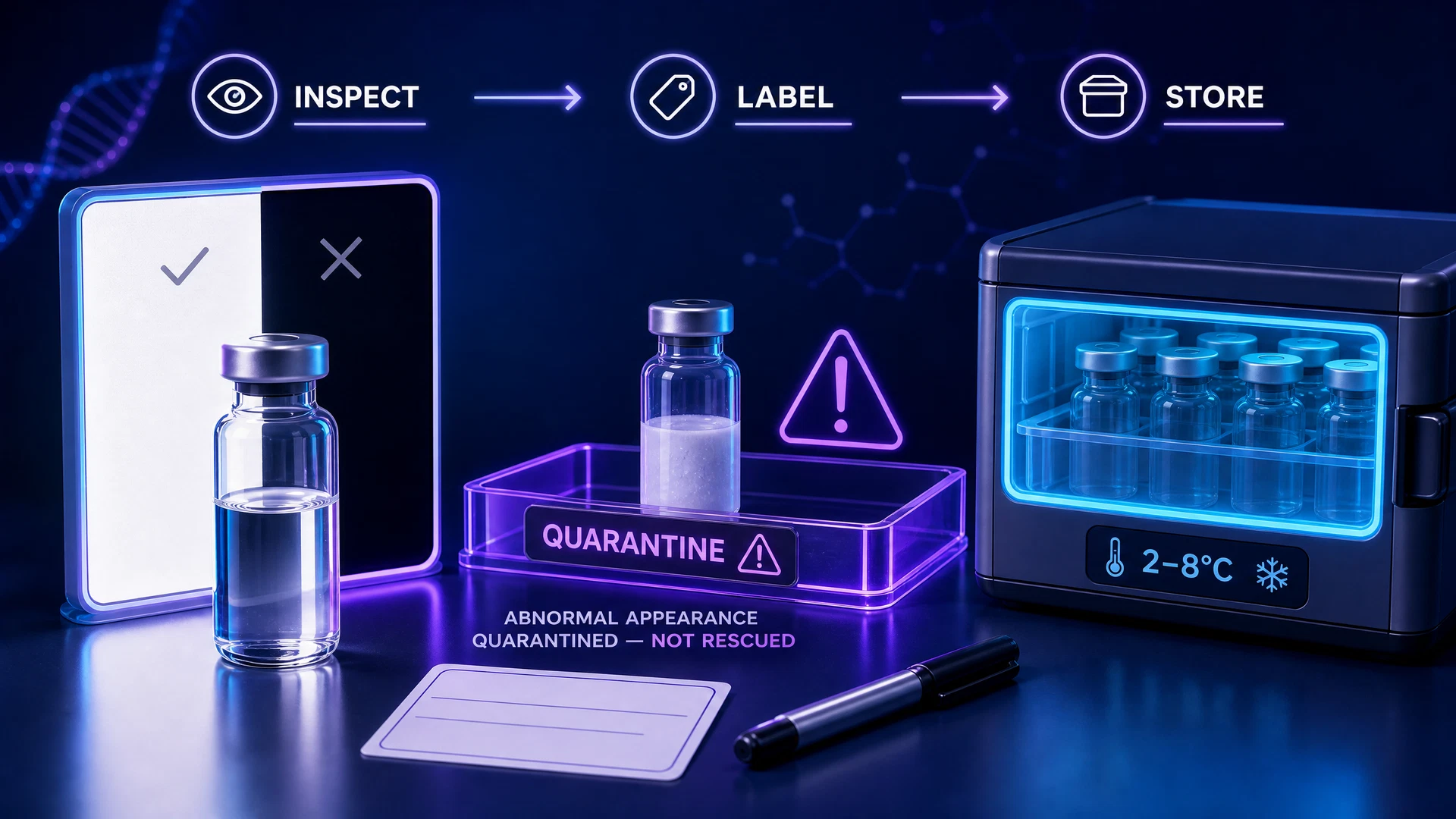
Step 2: Inspect the unopened vial and diluent for damage, expiry, moisture or a compromised seal.
Step 3: Prepare a clean workspace. Disinfect each stopper with a separate alcohol swab and allow it to air-dry.
Step 4: With an appropriately sized sterile transfer device, measure the specified diluent and transfer it slowly against the inside wall of the vial. Do not exceed the device capacity.
Step 5: Follow the product's mixing method and standing time. Many products use gentle rolling or swirling; do not shake, heat, sonicate or change pH unless the exact instructions require it.
Step 6: Inspect against light and dark backgrounds. If an intended clear solution remains cloudy, clumped, gelled, discoloured or visibly particulate, do not use it.
Step 7: Label with product, concentration, diluent, date and discard date, then store exactly as specified for that formulation.
Common Reconstitution Mistakes to Avoid
Common errors include using a non-validated diluent, treating a syringe marking as a mass, ignoring an abnormal cloudy or particulate solution, and assigning a generic storage or discard period. Confirm sterility and product-specific mixing instructions; do not rely on a universal 28-day or 48-hour rule.
Concentration Reference Table
These are mathematical examples, not instructions to choose a diluent or prepare a vial: 5 mg / 2 mL final volume = 2.5 mg/mL; 10 mg / 2 mL = 5 mg/mL; 10 mg / 3 mL = approximately 3.33 mg/mL. A U-100 marking corresponds to 0.01 mL of liquid volume; the amount of compound represented depends on the verified concentration.
How to Check a Concentration Calculation
Formula: labelled mass divided by verified final liquid volume gives concentration. A hypothetical 10 mg in 2 mL has a concentration of 5 mg/mL. On a U-100 scale, 0.01 mL is one marking; the concentration in that volume would be 50 mcg. This is arithmetic, not a dose recommendation or a substitute for product-specific directions.