The short answer
For most people, a dual-chamber pen is the best all-round way to buy a peptide in pen form. It keeps the peptide as a dry, freeze-dried (lyophilised) powder until you twist the pen, so it holds up better in the post than a premixed liquid pen when cold storage is not guaranteed from start to finish. It also skips the vials, syringes and needle transfers that a self-filled pen needs. Its main drawback is that it is harder to find.
The transit evidence comes from medicines that use the same molecule in both formats. Norditropin FlexPro, a premixed liquid somatropin pen, must be refrigerated until first use and should not be used if it has been warmer than 25 °C. Genotropin MiniQuick, a dual-chamber somatropin device, may be kept at or below 25 °C for a single period of up to six months before mixing, under its Australian Product Information.
A self-filled pen also starts as a dry vial, so it shares that advantage in transit. The difference comes after it arrives. You have to mix the powder with bacteriostatic water, then move the solution into a glass cartridge with a needle, and each of those steps is a chance to get the strength wrong or let contamination in. A dual-chamber pen replaces all of that with one twist inside a sealed cartridge.
No format is foolproof. Once mixed, any pen holds a liquid that needs refrigeration, and who made the product matters as much as the format. The rest of this guide explains each point and the evidence behind it.
The ways you can buy a peptide in pen form
"Peptide pen" covers three quite different products. They differ in what state the peptide is in during shipping, and in how much handling it takes to get from the box to a ready pen.
- Premixed (ready-to-use) liquid pen. The cartridge is filled with peptide already dissolved in a liquid. Approved medicines such as Ozempic, Mounjaro and Forteo use this format, with formulations and storage limits backed by regulated stability testing. Research and grey-market pens may look the same but have no published stability data for that exact product.
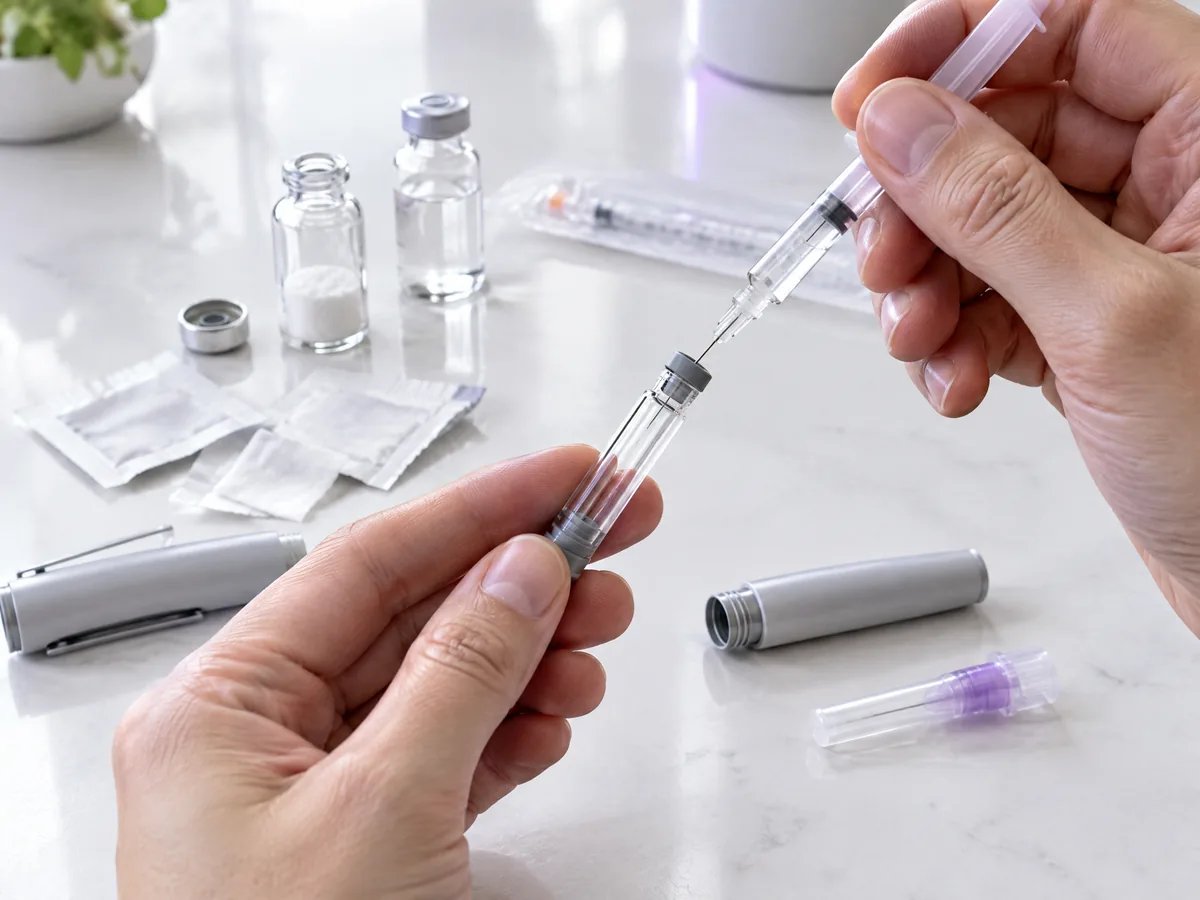
- Self-filled (reusable or refillable) pen. You buy a vial of freeze-dried peptide, a separate bottle of bacteriostatic water, syringes and an empty glass cartridge or reusable pen. You mix the vial yourself, then draw the solution up with a needle and inject it into the cartridge through its rubber seal. The peptide stays dry in transit, but the concentration, cleanliness and fill all depend on how carefully every step is done at home.
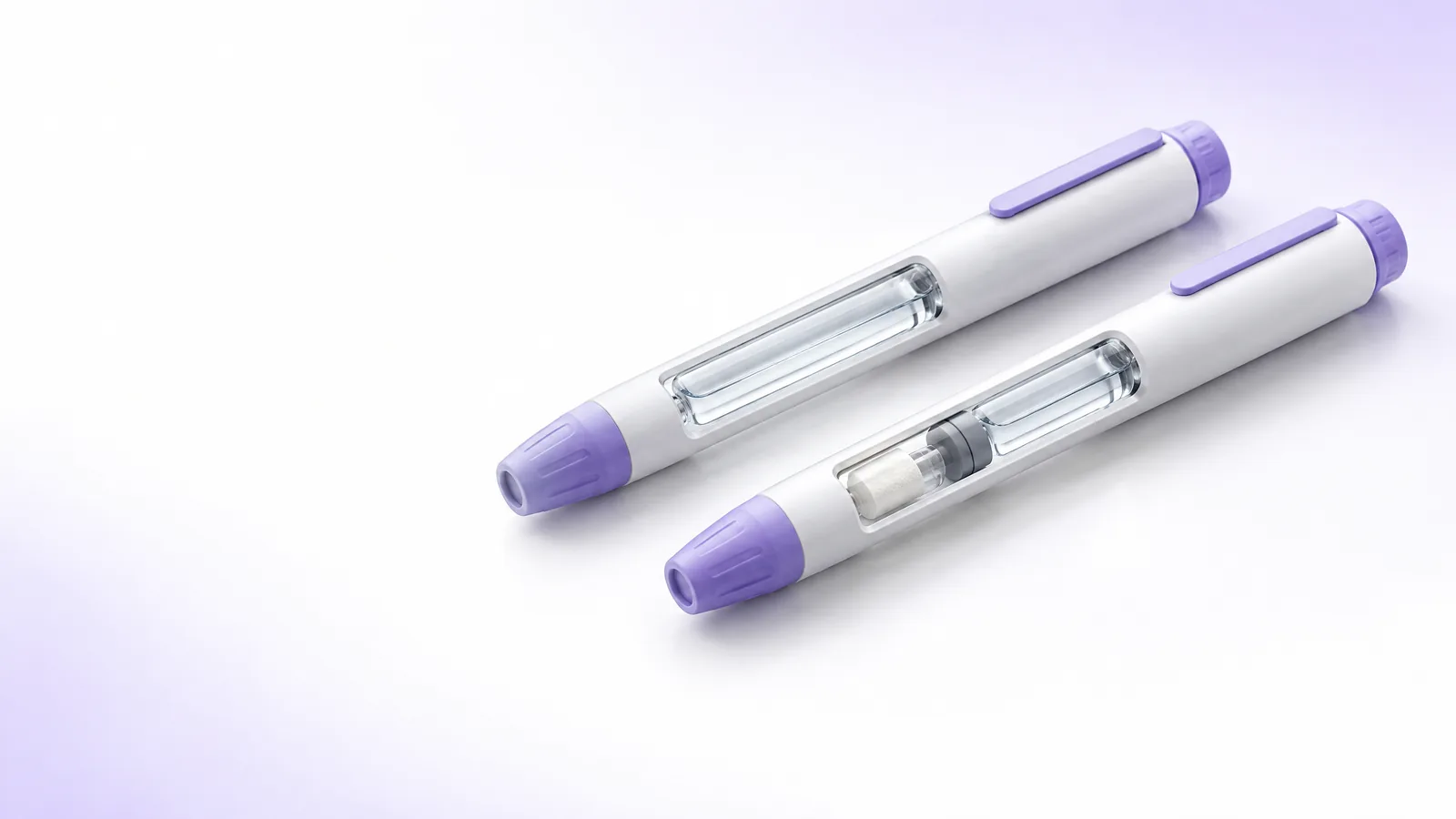
- Dual-chamber pen or cartridge. Dry powder in the front chamber, diluent in the rear chamber, separated by a rubber stopper. A twist or push sends the liquid through a bypass channel into the powder. A peer-reviewed review of dual-chamber devices describes them as products that keep the freeze-dried drug and the diluent in separate chambers to provide "high stability and convenience."
A self-filled pen and a dual-chamber pen both start dry, so both handle the trip better than a premixed liquid. Where they differ is everything that happens after the parcel is opened.
Why water is the problem: what happens to a peptide in solution
Once a peptide is dissolved, several kinds of damage can build up over time. A review of peptide formulation stability groups them into chemical and physical changes:
- Hydrolysis. Water breaks peptide bonds and cuts the chain into shorter fragments. It is described as one of the main degradation pathways for peptides.
- Deamidation and isomerisation. Asparagine and glutamine side chains convert to acids, and aspartate can rearrange. The peptide's charge and shape change, which can reduce its activity.
- Oxidation. Methionine, cysteine, tryptophan and other residues react with oxygen, light or trace metals.
- Aggregation. Molecules clump into soluble aggregates, visible particles or fibrils. A review of peptide aggregation notes that the chemical changes above can make clumping more likely.
- Adsorption. Peptide sticks to glass, rubber, silicone oil or the air–liquid surface, so less stays in solution.
Heat speeds most of these reactions up. Chemical reaction rates usually rise steeply with temperature, but aggregation does not always follow a predictable curve, so there is no reliable rule of thumb for how much potency a warm parcel costs. The only way to know is stability testing of that exact product, which is what regulators require. ICH Q5C specifically calls for stress testing to show whether accidental exposures, for example during transportation, are harmful.
Why freeze-dried powder holds up better
Freeze-drying removes most of the water. A review of pharmaceutical protein solids states that biomolecules are "generally less stable in the liquid state than in the solid", and that solid-state preservation has been effective in extending shelf life. Three mechanisms explain why:
- Less water to react with. Hydrolysis needs water. Taking most of it away removes the medium for many solution-phase reactions.
- A glassy, low-mobility solid. Stabilising sugars form an amorphous glass around the peptide. A lyophilised drug development review says this glass "greatly reduced the mobility of molecules and the rate of physical and chemical degradation."
- Low residual moisture. Well-made cakes are dried to low moisture levels. In one lyophilised antibody study, raising moisture from 1% to 8% dropped the cake's glass-transition temperature from 80 °C to 25 °C and made it degrade faster when warm. This is why the seal and the manufacturing quality of the dry chamber matter.
This is why manufacturers use dual-chamber systems for drugs that are hard to keep stable in solution. Vetter, a major dual-chamber manufacturer, notes that depending on the formulation, the dry product can remain stable for two to three years before it is mixed.
What the approved pen labels actually show
Approved pens are the best real-world evidence, because every storage rule on their labels comes from regulated stability testing. The pattern is consistent: almost every premixed liquid pen must be refrigerated before first use, and any time allowed out of the fridge is short and capped. The dual-chamber products (highlighted green) show the longest unrefrigerated windows before mixing.
| Product | Format | Before first use / mixing | After first use / mixing |
|---|---|---|---|
| Ozempic (semaglutide) | Premixed liquid, multi-dose | Refrigerate 2–8 °C until first use | 56 days at 15–30 °C or in the fridge |
| Wegovy (semaglutide), Australian PI | Premixed liquid, single-dose | Refrigerate; may be kept unrefrigerated up to 28 days, not above 30 °C | Discard after use |
| Mounjaro (tirzepatide) | Premixed liquid | Refrigerate; single-dose pen up to 21 days total at ≤30 °C | Single-dose: discard after use |
| Victoza (liraglutide) | Premixed liquid, multi-dose | Refrigerate 2–8 °C until first use | 30 days; throw away if exposed above 30 °C |
| Forteo (teriparatide) | Premixed liquid, multi-dose | Refrigerate at all times except when administering | Refrigerated; discard 28 days after first use |
| Norditropin FlexPro (somatropin) | Premixed liquid, multi-dose | Unused pens must be refrigerated; do not use if warmer than 25 °C | 4 weeks in the fridge or 3 weeks at ≤25 °C |
| Genotropin GoQuick (somatropin) | Dual-chamber cartridge pen | Refrigerate, or up to 1 month below 25 °C before mixing | Refrigerate 2–8 °C, up to 28 days |
| Genotropin MiniQuick (somatropin), Australian PI | Dual-chamber, single-dose | Refrigerate, or one period of up to 6 months at ≤25 °C before mixing (not back in the fridge) | Use straight away, or up to 24 h at 2–8 °C |
| Bydureon pen (exenatide ER) | Dual-chamber, single-dose | Refrigerate, or up to 4 weeks total below 30 °C | Inject immediately after mixing |
Two points are worth noting:
- Same molecule, two formats. Somatropin in a premixed pen (Norditropin FlexPro) has no unrefrigerated allowance before first use. Somatropin in a dual-chamber device (Genotropin MiniQuick) has up to six months at ≤25 °C. They are different manufacturers' formulations, so this is not a controlled trial, but it is the clearest like-for-like illustration available.
- Liquid pens can be stable when they are engineered and cold-chained. Ozempic, Mounjaro and Wegovy are genuine, stable products. Their limits only apply to that exact formulation in that exact device. They tell you nothing about a research pen filled by an unknown manufacturer.
What happens to a parcel in transit

Standard post does not control temperature. In a prospective study of 36 temperature-logged packages sent by three carriers, packages spent on average 68.3% of their transit time outside the 20–25 °C controlled room-temperature range. The hottest summer package reached 39.1 °C, and winter packages fell to −14.9 °C.
That study was American, and no equivalent logger study inside Australian parcels was found. Much of Australia regularly sees summer days well above the 25–30 °C ceilings on the labels above, and a parcel sitting in a letterbox, delivery van or parcel locker can get hotter than the outside air.
Regulators take this seriously. The US FDA says injectable GLP-1 medicines need refrigeration as stated on their package insert, and advises patients not to use an injectable GLP-1 that arrives warm or with inadequate ice packs, because it "can affect the drug's quality." WHO transport guidance requires qualified insulated packaging and temperature records for every shipment of temperature-sensitive products.
Freezing is a separate problem. Nearly every liquid pen label above says not just "do not freeze" but "do not use if it has been frozen." Ice packs placed directly against a liquid pen can do the same damage as heat.
Premixed research pens: the extra unknowns
An approved liquid pen comes with a formulation, a tested container and published storage limits. A premixed pen sold online for "research" usually comes with none of those. You cannot see what buffer, pH or preservative is in it, how long it was tested at what temperature, or how long it sat in liquid form before it reached you.
Australian regulators have documented what can go wrong with unregulated products. The TGA found counterfeit Ozempic-labelled pens containing insulin, and tested a "retatrutide" product that contained no retatrutide but about eight times the usual amount of semaglutide, after a serious adverse event. The TGA also warns that imported unregistered GLP-1 products may be fake or contain the wrong ingredients.
These problems come down to who made the product, not whether it is a pen or a vial. A dual-chamber pen from a poor manufacturer is still a poor product. But for a well-made product, the dual-chamber format removes the single biggest stability risk in transit: the peptide sitting in water while it travels.
Self-filled pens: what filling a cartridge yourself involves
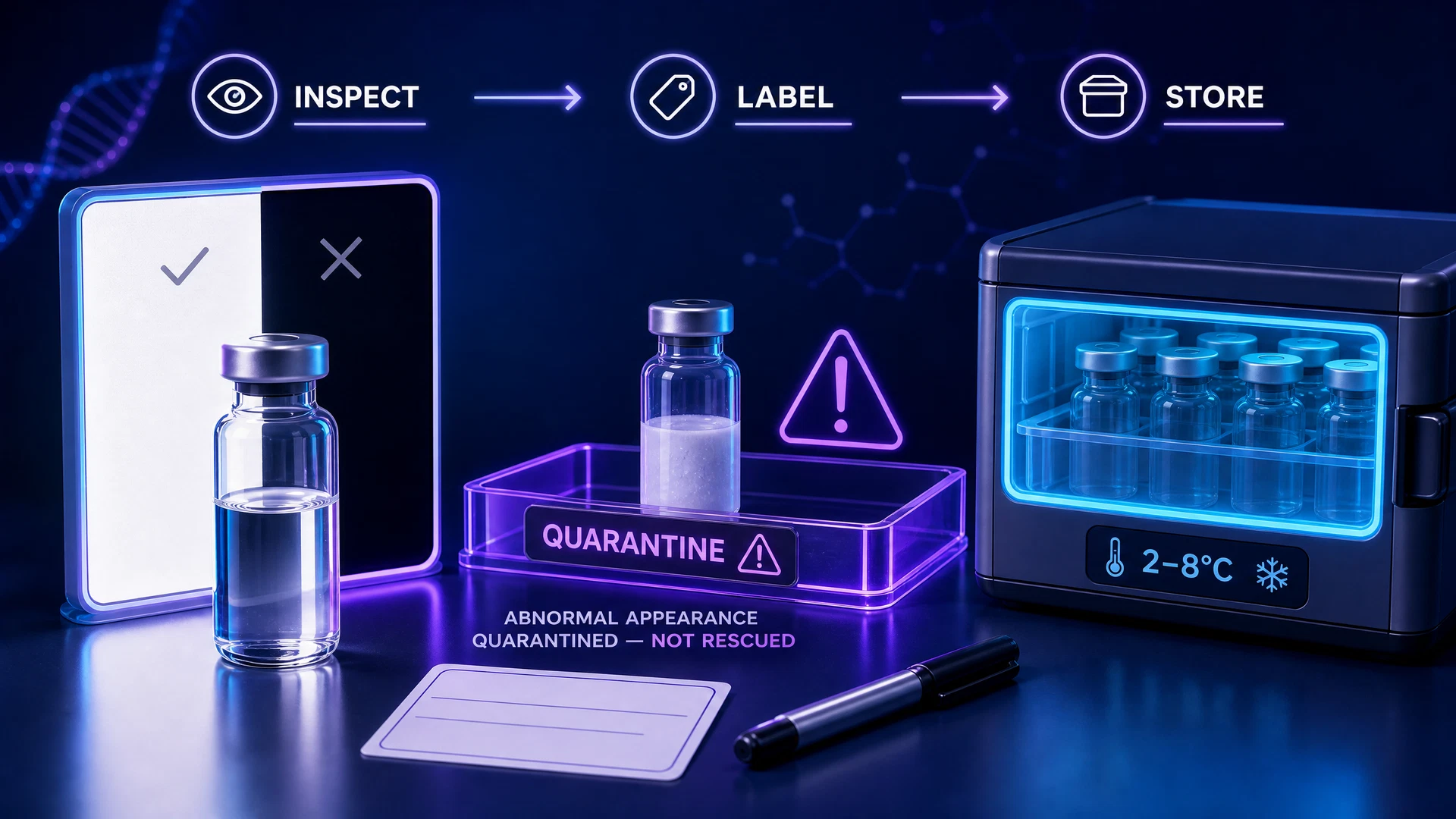
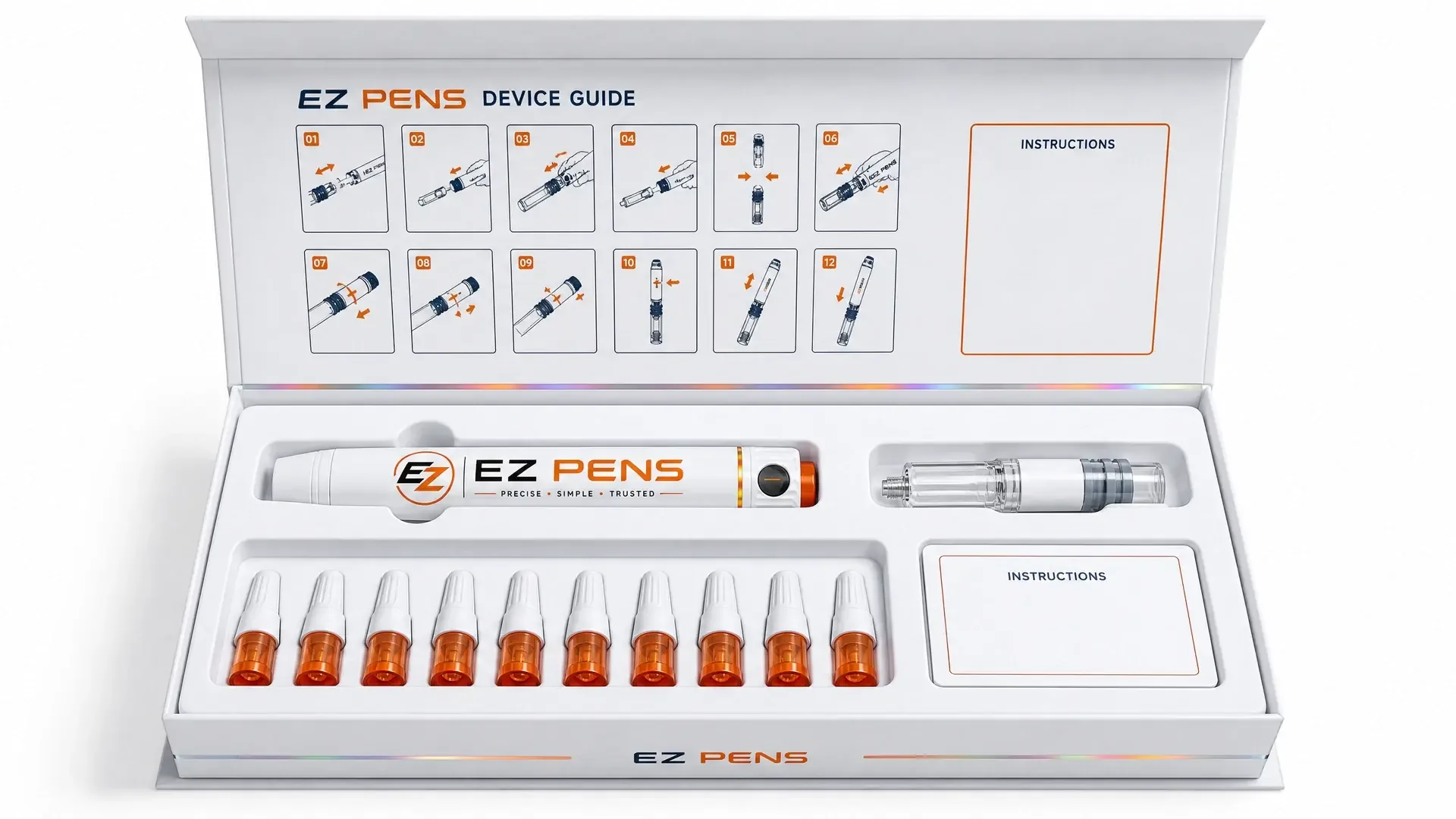
A self-filled pen is the do-it-yourself version of a pen. Instead of a sealed, factory-filled cartridge, you assemble one from separate parts. In broad terms, the powder vial is mixed with bacteriostatic water, the solution is drawn into a syringe, and it is then pushed through the rubber seal of an empty cartridge, which is loaded into a reusable pen body. The diagrams at the top of this guide show the difference at a glance. This guide does not give a step-by-step method; follow the instructions supplied with the specific product.
That process does work for many people, but it adds three kinds of risk that a dual-chamber pen is designed to remove:
- Getting the strength wrong. The final concentration depends on how much water goes into the vial and how much solution makes it into the cartridge. A misread syringe, a wrong calculation, leftover liquid in the vial or air in the cartridge can all change how much peptide each marking on the pen actually delivers.
- More openings for contamination. Every time a needle goes through a rubber stopper, it creates a path into the liquid. The CDC warns that leaving a needle in a vial septum gives microorganisms "a direct route" into the fluid, and that the preservative in multi-dose vials does not provide "complete protection against bacterial contamination." A self-filled pen needs several punctures across the water vial, the peptide vial and the cartridge before it is ready.
- Rubber fragments. A needle can cut a tiny piece out of a stopper as it passes through, known as coring. A 2023 review of vial coring reports rates that vary widely with the needle, angle and stopper, notes that repeated punctures increase the risk, and recommends closed or prefilled systems as one way to avoid it.
It is also more work. A self-filled pen means buying, storing and keeping track of a vial, a diluent, syringes, swabs, cartridges and a pen body, and getting each of them right every time.
How a dual-chamber pen works
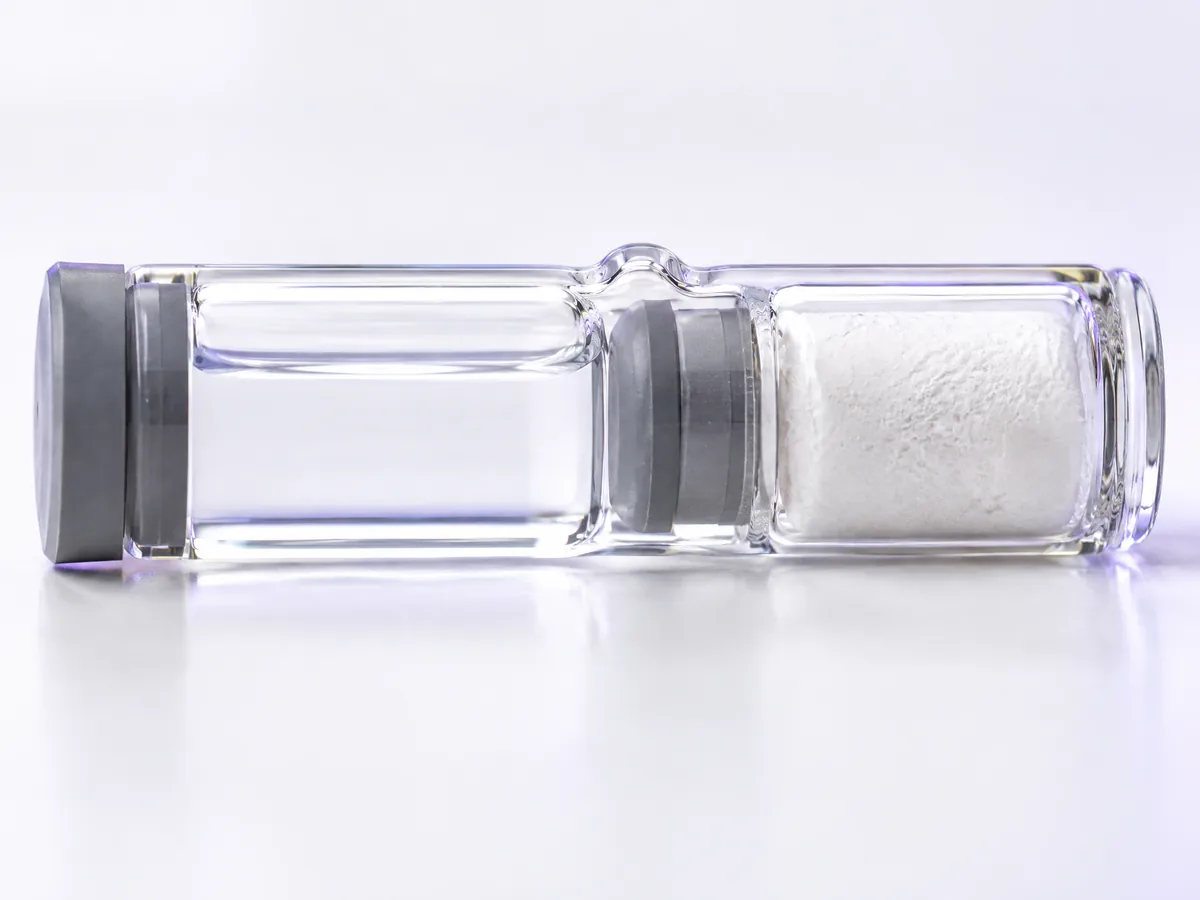
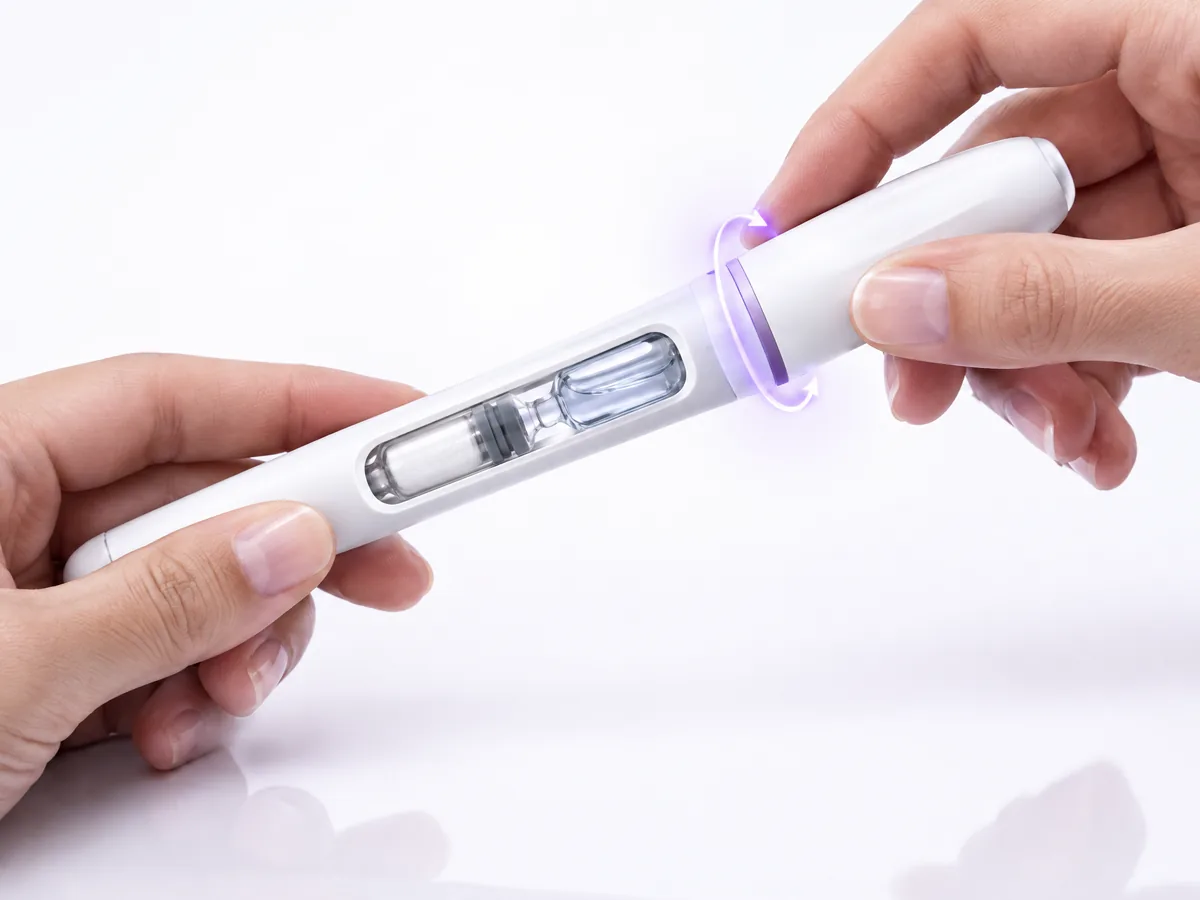
Inside the pen is a glass cartridge with two compartments. The powder is freeze-dried directly in the front chamber, and the diluent fills the rear chamber behind a rubber stopper. According to Vetter's technical description, a simple "twist and push" forces the diluent through a glass bypass into the front chamber, where it dissolves the powder.
- Stored apart. The peptide stays dry through manufacturing, shipping and storage.
- Activated once. Twisting the pen releases the diluent into the powder. Nothing is drawn up or transferred between containers.
- Dissolved gently. Approved dual-chamber labels such as Genotropin GoQuick direct a slow, swirling motion and warn against shaking vigorously.
Approved dual-chamber pens have been tested for usability. In human-factors testing of the exenatide dual-chamber pen, 97–100% of participants transferred the diluent successfully and 87–94% achieved complete mixing. Always follow the specific pen's instructions for activation, priming and inspection.
Self-filled vs dual-chamber: needle transfers vs one twist
Because both formats start as dry powder, the transit advantage is the same. The difference is what it takes to go from powder to a pen that is ready to use.
- Pre-measured diluent. In a dual-chamber pen the liquid volume is fixed at manufacture, so there is no measuring or calculating how much water to add. In a self-filled pen, the concentration is only as accurate as the person mixing it.
- A closed system. No needle goes through a stopper to draw liquid, and nothing is transferred between containers. With a self-filled pen, the solution passes from vial to syringe to cartridge.
- One twist instead of a kit of supplies. The diluent cannot be the wrong type or the wrong volume, and there are no separate syringes, swabs or empty cartridges to manage.
What does the evidence say? There are no head-to-head trials of self-filled versus dual-chamber peptide pens, so the best available evidence comes from closely related devices:
- A review of double-chamber syringe designs lists their main advantages as better dose accuracy, a lower risk of microbial contamination, and fewer handling steps and less preparation time.
- A systematic review of prefilled syringes in healthcare settings found they reduced medication errors by 10% to 73% compared with conventional preparation, depending on the drug and setting. It found limited data on contamination, and several authors work for a syringe manufacturer.
- In a randomised study of 63 pharmacists, nurses and pharmacy technicians, a prefilled syringe was prepared about two minutes (122.7 seconds) faster per dose than vaccines that needed reconstituting, and 81% of participants preferred it.
- A 2026 study of untrained adults preparing grey-market semaglutide from vials, using information found online, found participants completed on average only 15 of 34 required steps correctly. The authors noted errors that could lead to incorrect dosing, needlestick injuries or infection. The study was small, and covered vial preparation rather than cartridge filling, which adds another transfer.
Taken together, these studies support a simple conclusion: fewer preparation steps mean fewer chances for error and contamination. They do not prove that any particular pen is sterile or accurate. That still depends on how it was made.
It also helps to be clear about what bacteriostatic water does. Its 0.9% benzyl alcohol is an antimicrobial preservative for multi-dose use, not a peptide stabiliser. The familiar 28-day rule is the multi-dose vial sterility limit, not a guarantee that any peptide stays potent for 28 days. See bacteriostatic water vs sterile water for more.
Where a dual-chamber pen still needs care
Dual-chamber is the best all-round format, not an indestructible one. Its biggest practical downside is simply finding one. Keep these points in mind:
- They are harder to come by. Filling and freeze-drying inside a two-chamber cartridge is a complex and costly manufacturing process, and relatively few such devices have reached the market. Expect a smaller choice of peptides and strengths than with vials, and stock that can sell out.
- It is not heat-proof. Even the best label example, Genotropin MiniQuick, sets its limit at ≤25 °C. Heat above the cake's glass-transition range, moisture, oxygen and light can still damage a powder.
- Once mixed, it is a liquid. After activation, follow the product's refrigeration and use-by rules. Approved examples range from use immediately (Bydureon) to 24 hours (MiniQuick) to 28 days (GoQuick).
- Do not freeze it. Every dual-chamber label above says do not freeze.
- Keep it in the box. Several labels require storage in the original carton to protect from light.
- Inspect before use. A mixed solution that should be clear but is cloudy or has particles should not be used. See why peptides turn cloudy or clump.
If it is cold-chained door to door
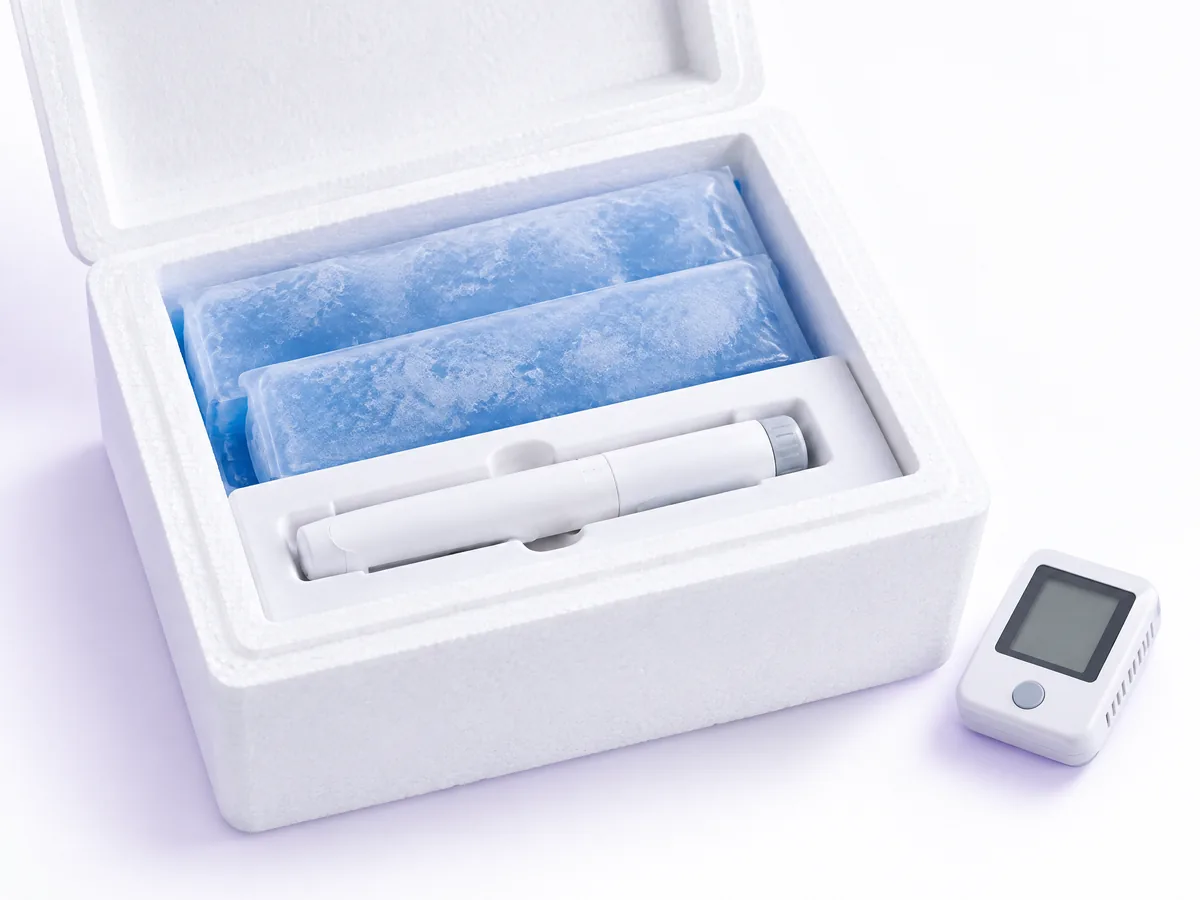
A premixed liquid pen that is kept at 2–8 °C from manufacture to your fridge, with a temperature record to prove it, can be a perfectly good product. That is how approved liquid pens reach pharmacies. In practice that means qualified insulated packaging, a barrier so the pen never touches ice packs directly, and a logger or indicator showing it stayed in range.
Without that evidence, you have no way to know what a liquid pen went through on the way to you. With a dual-chamber pen, the peptide stays dry for the whole trip.
Where to find dual-chamber pens
Because dual-chamber pens are hard to come by, here is one place to look. EZ PENS supplies single-use dual-chamber pen kits. Each kit pairs a pen with a sealed dual-chamber ampule that keeps the powder and liquid apart until the pen is prepared, so there is no separate vial, syringe or measuring step. See how EZ PENS kits work for the product's own instructions, and check the site for the current range and stock.
The same rules apply as for any dual-chamber pen: check the label, batch and expiry, follow the instructions supplied with that kit, and refrigerate it once mixed as directed. Disclosure: EZ PENS is a related supplier of Peptide Dosages Australia. This guide compares pen formats and is not dosing or medical advice.
Frequently asked questions
Is a premixed peptide pen ruined if it arrives warm?
Not necessarily, but you cannot tell by looking at it. Whether a given excursion is harmful depends on that product's own stability data. For approved injectable GLP-1 medicines, the FDA advises not using a pen that arrives warm or with inadequate ice packs.
Does a dual-chamber pen need to be refrigerated?
Follow the specific product's label. Approved examples are usually refrigerated, but allow a defined unrefrigerated period before mixing (up to six months at ≤25 °C for Genotropin MiniQuick in Australia). After mixing, refrigerate as directed.
Which type of peptide pen is best?
For most people, a dual-chamber pen. It keeps the peptide dry until you activate it, like a vial, but needs only a twist to mix, with no needle transfers or measuring. Its main downside is limited availability. A premixed liquid pen can be a good product if it has been kept cold the whole way and comes with proper stability data.
Is a self-filled pen as good as a dual-chamber pen?
In transit they are similar, because both keep the peptide dry until it is mixed. After that, a self-filled pen needs the powder mixed, the solution drawn up and injected into a cartridge, which adds chances to get the concentration wrong and more needle punctures through rubber seals. A dual-chamber pen does the mixing inside a sealed cartridge with one twist.
Is a dual-chamber pen better than a vial?
In transit they are similar, because both keep the peptide dry. The pen is simpler to prepare: the diluent is pre-measured and sealed inside, with no transfers.
Can I put a mixed pen back in the fridge if it got warm?
Only if its instructions allow it. Some labels, such as Genotropin MiniQuick's, say a pen kept out of the fridge must not be put back in.
Should I freeze a pen to make it last longer?
No. Pen labels consistently say do not freeze, and do not use a pen that has been frozen.
Sources
- Ingle & Fang, Prefilled dual-chamber devices, International Journal of Pharmaceutics (2021)
- Sousa et al., Brief report on double-chamber syringe patents, International Journal of Environmental Research and Public Health (2020)
- Benhamou et al., Prefilled syringes vs conventional preparation: systematic literature review, Annals of Pharmacotherapy (2024)
- Mehta et al., Prefilled syringes vs vaccines requiring reconstitution: randomised time and motion study, Journal of Medical Economics (2024)
- Ability of adults to correctly use grey market peptide semaglutide acquired without a prescription, Public Health Reports (2026)
- Mateen et al., Fragmentation and coring of a vial: an avoidable threat (2023)
- Genotropin Australian Product Information (GoQuick and MiniQuick storage)
- Genotropin MiniQuick Australian Consumer Medicine Information
- Genotropin GoQuick Pfizer labelling and instructions
- Bydureon Australian Consumer Medicine Information
- Bydureon dual-chamber pen, EMA product information
- Vetter, dual-chamber delivery systems (manufacturer technical description)
- LaRue et al., Evaluation of the dual-chamber pen design for exenatide (2015)
- Ozempic US Prescribing Information
- Wegovy Australian Product Information (TGA)
- Mounjaro US Prescribing Information
- Victoza US Prescribing Information
- Forteo US Prescribing Information
- Norditropin FlexPro FDA label (DailyMed)
- FDA, Concerns with unapproved GLP-1 drugs (shipping temperature advice)
- Temperature excursions during mail transit, J Am Pharm Assoc (2023)
- WHO model guidance for storage and transport of time- and temperature-sensitive products
- Designing formulation strategies for enhanced stability of therapeutic peptides
- Factors affecting the physical stability (aggregation) of peptide therapeutics
- Pharmaceutical protein solids: drying technology and stability
- Practical advice in the development of a lyophilised protein drug product
- Effect of moisture on the stability of a lyophilised antibody formulation
- Non-Arrhenius protein aggregation
- ICH Q5C, Stability testing of biotechnological/biological products
- Bacteriostatic Water for Injection USP label (DailyMed)
- CDC, Preventing unsafe injection practices (multi-dose vials)
- TGA, Counterfeit retatrutide product tested
- TGA, Counterfeit Ozempic pens detected
- TGA, Imported unregistered GLP-1 weight-loss products
Storage figures are quoted from each named product's label and apply only to that product. This guide compares formats; it is not dosing or medical advice.