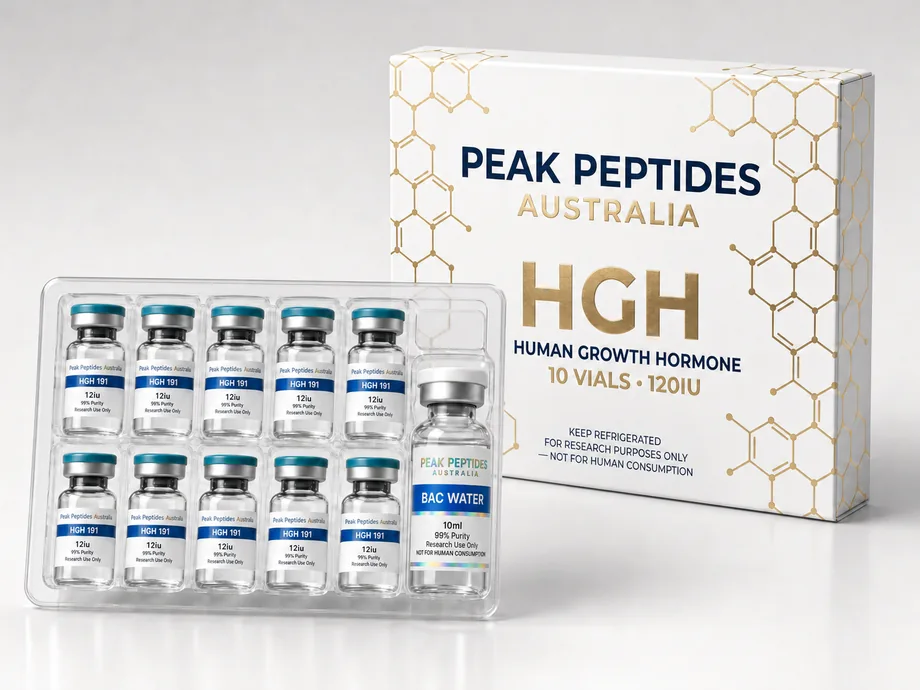
What is HGH 191AA (somatropin / full-length human growth hormone)?
‘HGH 191AA’ is an informal descriptor, not a distinct Australian approved product name. It generally refers to full-length recombinant human growth hormone (somatropin): a 191-amino-acid, approximately 22.1 kDa polypeptide hormone whose sequence is identical to pituitary-derived human growth hormone in an approved Australian somatropin product. In ordinary marketing language it may be called a peptide, but it is more accurately a full-length protein/polypeptide hormone, not a short research peptide or the hGH 176–191 fragment. (Sources 1, 5, 6, 9)
HGH 191AA usually means full-length somatropin, not a novel ‘research peptide’. Recombinant somatropin has substantial human evidence and Australian registered products for diagnosed growth hormone deficiency and other listed conditions, but that evidence belongs to assessed medicines and selected patient groups—not automatically to a supplier vial using the same sequence description. Primary structural work shows one growth-hormone molecule can bind two receptor extracellular domains, while controlled trials in adults with diagnosed deficiency found particular body-composition and metabolic effects alongside important limits. Australian product information documents clinically significant contraindications and monitoring needs. (Sources 1, 2, 3, 4, 5, 6)
Identity: a full-length hormone, not a new short peptide
The useful translation of ‘HGH 191AA’ is full-length human growth hormone. In the Australian Humatrope product information, recombinant somatropin is described as a 191-amino-acid polypeptide of about 22,125 daltons with the same amino-acid sequence as pituitary human growth hormone. That makes the number 191 a sequence-length description, rather than the name of a separate molecular invention. [1]
Identity still depends on the actual product. GENOTROPIN 5 mg GoQuick is an ARTG medicine containing somatropin, with an active Australian registration record. A vial advertised as ‘HGH 191AA’, however, is not thereby shown to have the registered product’s manufacturer, formulation, excipients, quality controls, approved indication or product information. The phrase should therefore not be treated as a prescription, brand name or guarantee of equivalence. [5] [6] [7] [8]
Molecular pathway: what has been directly demonstrated
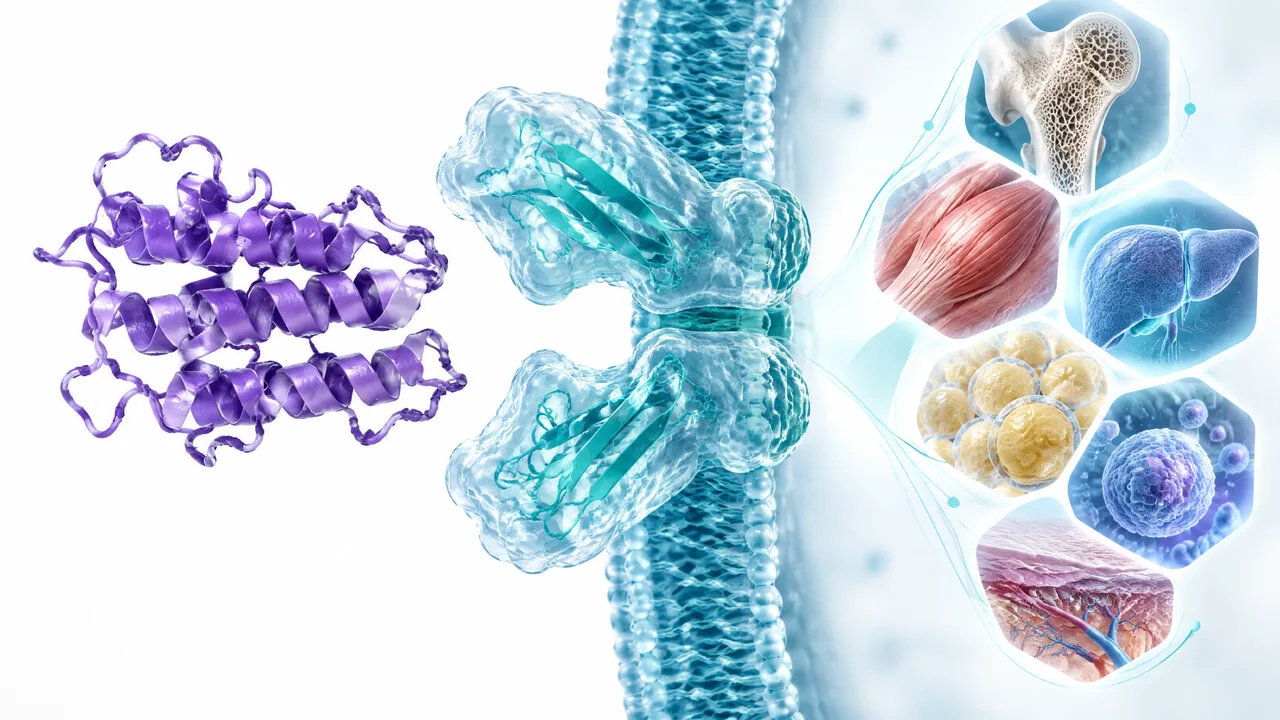
A landmark primary structural study used X-ray crystallography at 2.8 Å to examine human growth hormone bound to the extracellular domain of its receptor. In that experimental complex, one hormone molecule was associated with two receptor molecules. The authors found two hormone-binding sites and concluded that the contact areas supported a sequential receptor-dimerisation mechanism that may be important for signalling. [2]
This is strong evidence about receptor-binding architecture, but it is not a whole-body efficacy experiment. The crystal contains the extracellular receptor domain, not intact tissues or a patient. It supports a receptor-mediated mechanism for somatropin; it does not by itself establish a particular outcome such as muscle gain, fat loss, recovery or healthy ageing in people without growth hormone deficiency. [2]
Model-specific findings: structure is not a treatment trial
The receptor-complex model is valuable because it tests a precise question: how a human growth-hormone molecule and receptor extracellular domains fit together. The deposited structure is human in origin, used X-ray diffraction, and had no reported mutations in the structure entry. Its conclusion is therefore best read as molecular evidence for hormone–receptor assembly, not as proof of clinical benefit in any condition. [2]
The distinction matters when reading online claims. Biological plausibility can justify further clinical investigation, but it cannot replace trials in a defined population using a known, quality-assured formulation and outcomes that matter to patients. Claims that extend directly from receptor binding to cosmetic, athletic or injury outcomes overstate what the structural experiment measured. [2] [7]
Human evidence is for diagnosed growth hormone deficiency
In a multicentre, randomised, double-blind, placebo-controlled 12-month study of 166 adults with adult growth hormone deficiency, growth-hormone treatment decreased total and trunk fat and increased lean body mass relative to baseline. Total cholesterol and LDL cholesterol also improved. The same trial did not find significant treatment effects on strength, endurance, quality of life or bone mineral density. Those results are specific to adults with diagnosed deficiency; they do not establish the same balance of effects in healthy people. [3]
A smaller double-blind, crossover, placebo-controlled study used euglycaemic clamps in nine adults with adult-onset growth hormone deficiency. After six weeks of recombinant growth hormone, fasting glucose and insulin were higher and clamp glucose infusion rates were lower than with placebo; after 26 weeks, the study found no significant difference in glucose infusion rates. The investigators explicitly noted that, without a healthy control group, it was unclear whether the early change represented insulin resistance or restoration toward normal physiology. [4]
What these studies do not establish
The adult trial is informative but bounded: it enrolled people with adult growth hormone deficiency, followed them for one year, and assessed selected endpoints. Its negative strength, endurance, quality-of-life and bone-density findings are as important as its positive body-composition findings. Neither it nor the nine-person metabolic study validates non-medical use, an online-vial protocol, or a universal expected response. [3] [4]
Product indications likewise define particular diagnoses rather than a broad wellness category. Current Australian GENOTROPIN information lists indications including short stature due to deficient pituitary growth hormone and severe adult growth hormone deficiency, plus specified paediatric disorders. Diagnosis and individual management are integral to the evidence base, not optional details that can be inferred from a 191-amino-acid label. [6]
Risks and uncertainty are clinically material
Australian somatropin product information contraindicates use with active tumours or evidence of tumour growth, in children with closed epiphyses for growth promotion, and in acute critical illness after major surgery, trauma, burns or acute respiratory failure. The Humatrope information cites two placebo-controlled critical-illness trials involving 522 adults in which mortality was higher in the growth-hormone group (41.9%) than in placebo (19.3%). That finding is a warning about that high-risk setting, not a general mortality estimate for prescribed replacement therapy. [1] [6]
Other labelled concerns include fluid-retention symptoms such as peripheral or facial oedema, arthralgia, myalgia and paraesthesia; injection-site reactions and lipoatrophy are also reported. Somatropin can reduce insulin sensitivity, so the Australian information calls for observation for glucose intolerance. These risks and the individual variation in IGF-I response seen in the adult trial are reasons not to infer safety from sequence identity alone. [3] [6]
Australian regulatory context: formulation matters
Australian prescription medicines are entered on the ARTG with an AUST R number and assessed by the TGA for quality, safety and efficacy. The ARTG lists GENOTROPIN 5 mg GoQuick as a registered medicine, with somatropin as its ingredient, Pfizer Australia as sponsor and licence status A. This is the relevant meaning of an approved medicine: a specified product, not merely an ingredient name or a molecular-length claim. [5] [7]
The TGA states that therapeutic goods not included on the ARTG have not been assessed by it for safety, quality or effectiveness, although defined access pathways can apply in particular circumstances. Therefore, a purported research or supplier vial labelled ‘HGH 191AA’ must not be assumed to be an Australian-approved medicine. No dilution, storage or administration schedule can be responsibly transferred from an approved product information document to an unverified vial. [6] [8]
Avoid conflating HGH 191AA with related labels
Full-length somatropin is not the same thing as hGH 176–191, which is a C-terminal fragment. It is also not a growth-hormone secretagogue such as ibutamoren (MK-677), which acts through a different upstream category rather than supplying exogenous full-length growth hormone. Nor should it be treated as interchangeable with long-acting growth-hormone analogues such as lonapegsomatropin, somapacitan or somatrogon; these are distinct products with their own designs and regulatory records. [1] [9]
For competitive sport, WADA lists growth hormone, its analogues and fragments in the S2 prohibited class at all times. This anti-doping status is separate from a clinical indication and does not determine whether a product is medically appropriate. Athletes should use the current official list and their sport’s medical and anti-doping processes rather than relying on internet product descriptions. [9]
How to read an HGH 191AA claim
Start by asking whether the claim names an evaluated formulation and a studied population. ‘191 amino acids’ can describe an authentic somatropin sequence, but it does not identify the manufacturer, batch quality, potency, excipients or clinical evidence for the item in hand. An ARTG entry and its linked Australian product information are more useful evidence than a supplier’s sequence assertion. [5] [6] [7]
Then match the outcome to the model. A receptor crystal structure supports a structural interaction; a 166-person deficiency trial supports selected findings in diagnosed adult deficiency; a nine-person crossover clamp study supports a short-term metabolic observation with an acknowledged interpretive limitation. None is a validated combined protocol with other substances, and none supplies a general self-treatment schedule. [2] [3] [4]
Questions readers ask
Is HGH 191AA an approved medicine in Australia?
The phrase ‘HGH 191AA’ is not itself a demonstrated Australian product name. Somatropin is the active ingredient in ARTG-registered prescription products such as GENOTROPIN 5 mg GoQuick. Approval applies to that identified formulation and its listed uses, not automatically to any vial described as 191 amino acids. [5] [6] [7]
Is it a research peptide or a hormone?
It is best classified as a full-length recombinant protein/polypeptide hormone—somatropin—when the stated identity is accurate. It is not the short hGH 176–191 fragment and should not be casually grouped with short synthetic research peptides. [1] [9]
Do trials show better strength or exercise performance?
Not in the cited 12-month randomised trial in 166 adults with diagnosed adult growth hormone deficiency: body-composition measures and some lipid measures improved, but strength and endurance did not show significant treatment effects. This cannot be generalised to healthy people or sporting performance. [3]
What safety issues need clinical attention?
Australian product information includes contraindications involving active tumours and acute critical illness, and identifies fluid-retention symptoms and reduced insulin sensitivity among clinically relevant concerns. Medical assessment and monitoring are part of the approved-medicine context. [1] [6]
Can a supplier vial be handled like an approved pen or cartridge?
No conclusion follows from a shared sequence label. Approved product instructions apply to the named, assessed formulation; the TGA says goods outside the ARTG have not been assessed for safety, quality or effectiveness. This record deliberately provides no dilution, storage or administration instructions for supplier vials. [6] [8]
What remains uncertain
The 2.8 Å receptor study is an extracellular-domain crystal structure, so it does not directly measure whole-body effects, tissue-specific responses or clinical outcomes. [2]
The largest cited controlled clinical trial enrolled adults with diagnosed adult growth hormone deficiency and followed them for 12 months; its results should not be transferred to healthy people, sport, cosmetic use or other conditions. [3]
The metabolic crossover study had only nine participants and no healthy control group, a limitation identified by its investigators. [4]
No evidence reviewed here verifies the identity, sterility, potency, excipients, storage history or clinical equivalence of vials sold under the informal ‘HGH 191AA’ label. [5] [7] [8]
References and further reading
- [1] HUMATROPE: Somatropin (rbe) for Injection — Human Growth Hormone. Approved product-information document; includes formulation description, indications, contraindications, safety information and cited clinical evidence
- [2] Human growth hormone and extracellular domain of its receptor: crystal structure of the complex. X-ray crystallographic structural study of human growth hormone complexed with extracellular human growth hormone receptor domain at 2.8 Å
- [3] Growth hormone (GH) replacement therapy in adult-onset gh deficiency: effects on body composition in men and women in a double-blind, randomized, placebo-controlled trial. Multicentre, randomised, double-blind, placebo-controlled 12-month clinical trial in 166 adults with adult growth hormone deficiency
- [4] Effects of treatment with recombinant human growth hormone on insulin sensitivity and glucose metabolism in adults with growth hormone deficiency. Double-blind, crossover, placebo-controlled clinical trial using euglycaemic clamps in nine adults with adult-onset growth hormone deficiency
- [5] GENOTROPIN 5mg GOQUICK somatropin (rbe) powder for injection with preserved diluent pre-filled pen (ARTG ID 166829). ARTG registration record
- [6] Australian Product Information: GENOTROPIN and GENOTROPIN GoQuick; GENOTROPIN MiniQuick. Current manufacturer product-information document
- [7] Prescription medicines. TGA regulatory guidance page
- [8] Unapproved therapeutic goods. TGA regulatory guidance page
- [9] The Prohibited List. Current WADA Prohibited List and category guidance